Stiga Helix Hybrid XH and DNA Hybrid H Review: New Generation vs Old Generation Hybrids
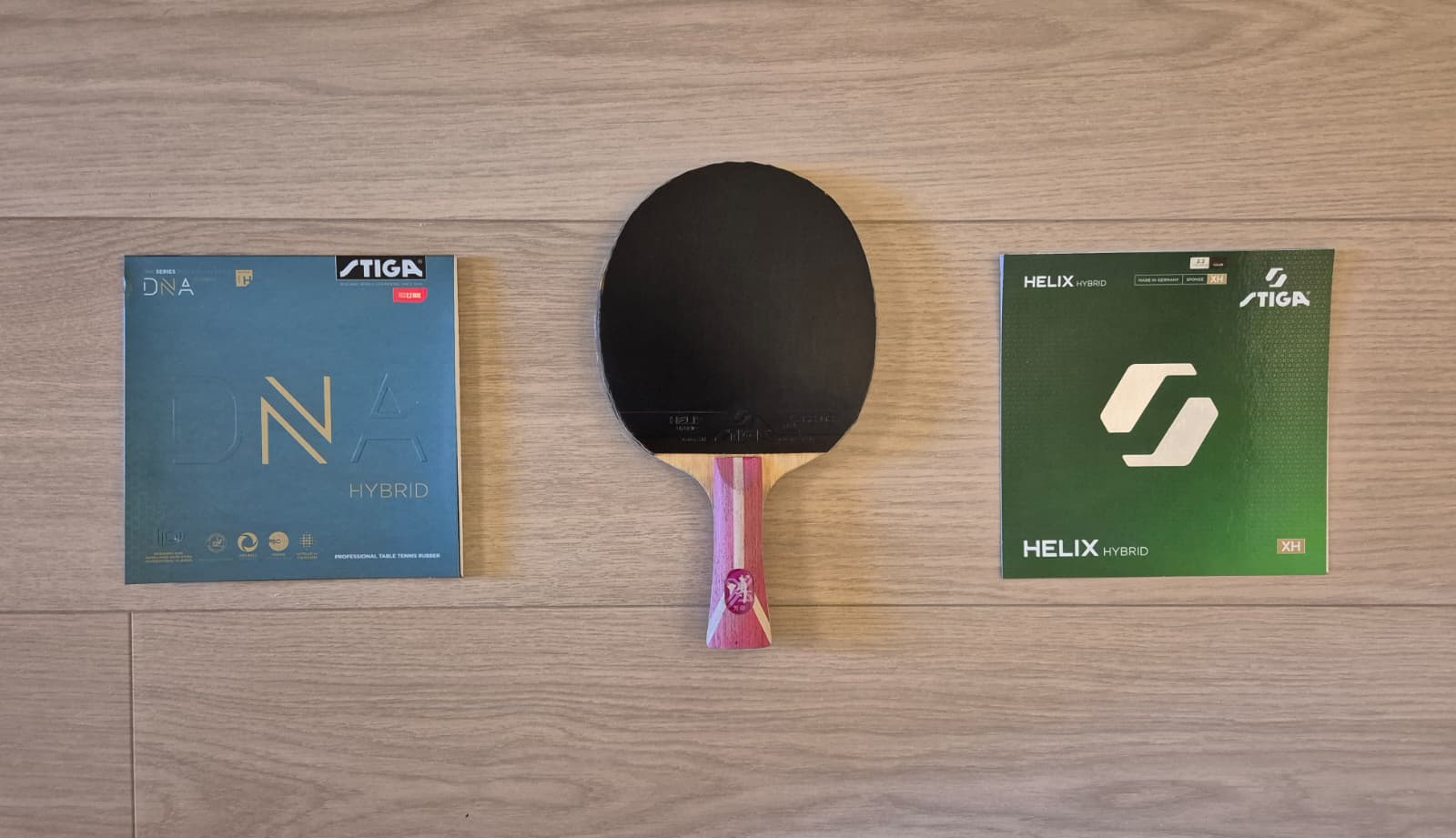
The Helix Hybrid is a flexible Dignics 09c alternative that comes in several hardnesses and is easier to activate for amateurs, while the DNA Hybrid H is showing its age and feels built for an older meta, especially on the backhand
A new blogpost and a new brand this time! Today I’m diving deep into Stiga’s new Helix Hybrid (XH) and their previous hybrid gen, the DNA Hybrid (H), so get ready for a long and fun review as there is a lot to say about both!
I’ll start this review by saying that I was happy to finally get to review some Stiga products as many of our club players play with their rubbers (i.e. DNA Platinum, DragonGrip) and my first true custom blade was the Stiga Allround Classic, a really amazing beginners blade that will always have a place in my heart, such a fine piece of equipment that is. So obviously I was excited to get to test Stiga gear again and keep on expanding the rubber database.
And since I recently visited my friends from Sport Europe - TableTennisStore.eu at their office in the south of the Netherlands, I got the Stiga rubbers (Helix XH 2.2mm and DNA H 2.2mm) and a couple others to test that I will review in the coming weeks. And as always, a big thanks to them for that, they are a great partner and you all still get the 25% off from them (in all blades and rubbers where this applies) by clicking on the button/banner below :)
To finish the intro, the sneak peek of this review is that the Helix Hybrid is a very clever alternative to the Butterfly Dignics 09c, it is easier to activate for amateurs, has a bit less high-end power, and it comes in different hardness degrees, something that I find super helpful and that differentiates it from the Dignics 09c, where if you want softer, you are stuck with the Glayzer 09c which is not really a Dignics 09c. So I found that move by Stiga very smart! And about the DNA Hybrid, I think it’s showing aging symptoms, it comes from an older generation of hybrids and it’s not a bad rubber as you will read below, but it has a fair amount of disadvantages when compared to the Helix so I enjoyed it less. It has a couple of good points nevertheless, it’s just a bit less balanced and more abrupt in its behaviour.
OK so that was the intro and now let’s get into the real deal! Grab a drink and a snack (a drink without a snack is like a garden without flowers, it works, but it’s less nice xD) and get ready for a wall of text as per usual, I’ll try to make it fun on the way ;)
Side note: There are also softer and harder versions of both rubbers, but I have not tested those. The softer versions are more controlled and focused on spin, while the harder versions aim at delivering more speed while retaining most of the spin. Stiga has their own really nice image/graph where you can compare speed and spin, so make sure to use it when choosing the rubbers!

Stiga
Helix Hybrid XH
Stiga
DNA Hybrid H
The TL;DR: Helix Hybrid XH 52.5 & DNA Hybrid H 50
| Category | Helix Hybrid XH 52.5 | DNA Hybrid H 50 |
|---|---|---|
| Weight | Heavy, 53g cut to the B2X, similar to other harder heavier hybrids | Lighter, 47g cut to the B2X, considerably less heavy |
| Sponge & Topsheet | Hard 52.5 sponge (but feels softer and livelier) with a slightly tacky topsheet | Medium-hard 50 sponge (feels harder and deader) with a slightly tacky topsheet |
| Spin potential | A lot of spin and great grip on all shots, surely more than enough for all amateurs | A lot of spin and grip when you brush it correctly and/or in the high gear, low gear chokes the ball |
| Speed & Gears | High gears, it starts lively already on a medium gear, no clear limit, very fast but relatively controlled | Low amount of gears, it’s very 2-gearish like the BlueGrip S2, low dead gear and an explosive high |
| Throw angle | Very high throw angle, reminds me of Dignics 09c, medium-long flight depending on the gear | Medium throw angle and lower than Helix Hybrid, something similar to the BlueGrip S1 or Nuzn 48 |
| Drives & Loops | A lot of power that is easy to control when you play forward, both close and far from table, easy openings and easy counterloops | Less power but also less control, worse openings and counterloops, a bit all-or-nothing shots, lacks power far from the table |
| Serves | Decent spin but less than the Dignics 09c likely due to lively sponge, hard to keep it short | Very good spin when you brush it thinly, more than Rakza Z, easier to keep it short and lower |
| Flicks | Very good flicks on both sides, easy due to high throw and lively sponge but controlled due to grip and dwell | Not as easy to do flicks on both sides due to low dwell, banana flicks with thin brushing are fine |
| Pushes | Fairly good control for a fast rubber like this one, watch out for spin sensitivity in heavy spin serves | Top-notch control on short pushes, long pushes need brushing, less sensitive to incoming spin |
| Blocks | Fairly good at blocking and easy-ish to control the catapult effect, better than a Dignics 09c | Great blocking but you need to adjust to the choking effect on passive blocks, active blocks OK |
| Flat hits | Not bad at all due to lively sponge, better than expected for a hybrid | Good direct counters for a hybrid but low safety margin, timing is key |
| Boosting | I would not boost it as it has different hardnesses, this is one of the unique selling points of the rubber | You can boost it to make it more alive but dwell time will suffer and it’s already low, go for Helix instead |
| Price & Durability | Premium rubber segment without discounts, if durability holds for 3-4 months it can for sure compete against the Dignics 09c | Middle towards expensive price, I think durability will be good but I’d rather buy the Helix Hybrid for its performance on the table |
The technicalities
I tested a black Helix Hybrid Extra Hard (XH) which comes in max thickness (2.2mm) and was 76.5g uncut and 53g cut to my B2X blade. It came with a thin translucent protector (like the Donic BlueGrips or Joola Trinities) that you can reuse as a protector. It had no inward/built-in tension that I could notice and it has a low stickiness when you get it from the nice green and silver package.
Regarding the other rubber, I got a red DNA Hybrid Hard (H) which I chose in max thickness (2.2mm) and weighed 71g uncut and 47g cut to my B2X blade, also not displaying any built-in tension and coming with a thin plastic protector. It had the same amount of tackiness from the package as the Helix Hybrid (low) and I was pleasantly surprised about the weight it had, not too heavy!
Lastly, Stiga has its own nice speed and spin quadrant which you can also translate to the different player levels. In this case, both rubbers are aimed at the high intermediate / advanced amateurs, but you can also buy the softer versions that can be perfectly used by normal intermediate players. I think the Helix Hybrid in 50 degrees can be all good for intermediates with good technique and the DNA Hybrid M is already popular in this segment as well, so you have plenty of choice with the different rubber hardnesses. It's really nice of Stiga to have so many options.
How I tested the Stiga Helix Hybrid XH and the Stiga DNA Hybrid H
Same blade as always for these two, the DHS Fang Bo B2X with a weight of 89g (got a new one, 3 blades were too few haha).
What is nice about this review is that this time I did not lock each rubber to one wing, I rotated both of them across forehand and backhand instead, it was about 1.5 weeks with the Helix Hybrid XH on the forehand, then swapped, and vice versa with the DNA Hybrid H.
In the beginning I thought that I’d like the Helix Hybrid more on the forehand, so I got the 52.5 degrees there and chose for the 50 degrees on the backhand with the DNA Hybrid H. However, after playing like that for a while, I realised that I preferred the opposite, and changed until the end of this review. Ideally I would have had an XH DNA Hybrid for the forehand but surprisingly the H version felt hard and dead enough, and the Helix Hybrid was just fine on the backhand (one degree less would have been a bit better though).
So yeah, in total the testing period was about 4 weeks, where I also combined 2 weeks with the Tibhar MK Hybrid and MK Pro as that review is coming soon as well (and got nice insights while doing so). The DNA Hybrid H needed a bit of a break-in period (1-2 sessions) before it played like it does now and the Helix Hybrid XH did not need that, it played the same from the get-go.
The Stiga Helix Hybrid XH and the Stiga DNA Hybrid H in depth
Sponge & Topsheet Feeling
The first thing I noticed from the very beginning is that these two rubbers are fairly different from each other, and they seem to follow different thinking philosophies, which is important to mention in the beginning so you understand the rest.
To explain this, I thought a little bit about the history of both hybrids, and I came to the conclusion that what happened was more or less something like this: A couple years ago, when Stiga started making hybrids, they wanted to make Chinese-like hybrids as they mostly had tensors, so then they took the normal DNA rubber and made it harder, less lively and more linear in the lower-medium gears, while still keeping the explosiveness of the higher gear. This was a very common trend back then, and I have talked extensively about it in my Donic BlueGrip S2 review which displays the same mentality.
But after a couple years, Stiga saw the success of the Dignics 09c and changed their approach, so they started thinking of pure hybrids to compete against Butterfly. They probably realised that this was where the market was heading, and they made the Helix Hybrid as a Dignics 09c alternative, adding the different hardness degrees to compensate for a clear gap that Butterfly had.
So this all means that the Stiga Helix Hybrid XH is pretty much a Dignics 09c in its construction, and it also plays very similar to that. And the DNA Hybrid H tries to get closer to a Chinese hybrid, and it misses the mark in my opinion as it has become a 2-geared hybrid that may or may not be of players preference. It is not mine, but that’s a personal taste.
OK, now that you know that, then it is easy to imagine what this does to the sponge and topsheet feeling of both rubbers.
The Helix Hybrid feels softer and more alive than a normal 52.5 hybrid would feel, and sometimes you may even doubt whether it is a pure hybrid or a tensor hybrid. When you test it, you will also notice that there is a sort of ‘click feeling’ when the ball leaves the sponge, (that kinda hollow pop you get from other bigger-pores, weaker-walls, less-densely arranged-pips tensors) and my first thought was the factory boosting felt clearer than with many other hybrids. I also found it nice to hold in the hands, you get a lot of feedback through the index finger on the backhand side, and it’s comfortable to handle because they added some extra finger grip support, like Joola did with their Trinity Charged and Dynamic. I like those little ergonomic hacks!
On the other side, the Stiga DNA Hybrid H is a completely different story in the hand as I mentioned above. It feels pretty dead and slow on its lowest gear and somewhat dead on medium contacts, having that choking behaviour I discussed before with older gen hybrids. Then at full gas, it wakes up and becomes explosive and with low dwell. If I had to place it, it reminds me of a normal Chinese hybrid on the lower and medium gears, and it behaves like a normal tensor in the higher gears (in a way, a bit like the Hurricane 8-80 power of Nittaku I reviewed before)
Finally, speaking of the topsheet tack, neither of these is a tacky rubber in the Chinese sense, but they are not equal either. The Stiga Helix Hybrid XH became a tad tackier (no hanging ball of course, almost no hybrids have that) than the Stiga DNA Hybrid H after using it (I always measure after cleaning them only), and the DNA Hybrid H sits at about the same low tack level as the Tibhar MK rubbers or the Andro NUZNs (i.e. grippy topsheet, very light stick, a ball will not hang on it). Sheet to sheet variation does happen with hybrids and depends a fair amount on weather conditions, but overall, these are not tacky hybrids like the Dignics 09c or the Rakza Z.
Speed & Control
When it comes to speed and control, we can also see significant differences between the two rubbers, which come from the two different philosophies I explained above.
Starting with the Helix Hybrid, it is a rubber with a high amount of gears, and I don’t say very high because the rubber is pretty lively and its catapult activates early, so there is no passive low gear like there is with the DNA Hybrid or other types of hybrids (i.e. Rakza Z or Glayzer 09c). This is something I enjoyed on my backhand, but a little bit less on my forehand.
Regardless of that, the rubber is pretty linear and the medium gear is nice and fast but with control, and the higher gears (I didn’t see an immediate speed cap on the rubber) are very explosive and powerful but still predictable. So the feeling is similar to a Dignics 09c but with a more controlled bounce, a slightly less amount of high end power, and a slightly safer flight distance that I will discuss later on. Overall, the Helix Hybrid XH is easier to engage than a Dignics 09c and feels a little bit softer, so that makes its high end power lower, but the road to the ceiling feels shorter too. And in my opinion, this is a good tradeoff for most of us amateurs, we don’t need what Fan Zhendong needs, so I support this design decision here from Stiga.
As you can see, you could pretty much summarise the Helix Hybrid’s speed and control as a safer and easier to engage version of the Dignics 09c, which is both a good and a bad thing depending on how you play. Because if you remember from that review, I mentioned that even though control was high, you have to play the ball toward the table (I know it’s obvious) because if you don’t play forward and go a bit upwards, there is a big chance that the ball goes long. So yes, there is a lot of control, but that is when you play the rubber like it’s supposed to be played, so there might be players that say that it has a low amount of control, it’s possible as well, it depends on the player. I’ll discuss this in depth when I get to the looping section.
Then getting to the Stiga DNA Hybrid H, which behaves pretty differently!
As mentioned before, the DNA Hybrid’s lowest gear reminded me a lot of the Donic BlueGrip S2, and on its higher gears, it was a bit like the Nittaku Hurricane 8-80 power. So I would say that this is a low-gears rubber, which fits in the picture of how some hybrids were done in the past.
In the very beginning, the rubber choked the ball, so it would almost feel as if the ball dropped dead in the net at those low contact speeds. I had to adjust quite a lot in the beginning, as I didn’t expect this, but once you know it, you can also use it to your advantage as I will describe in the pushing section.
Regardless of that, after you went for the shot, and started swinging harder, the rubber would show its other face (like a true Jekyll and Hyde, inside joke) where it would be very fast and with a low amount of dwell time. So yeah, the rubber has plenty of catapult but it is hard to activate and quite abrupt when it does. Now you understand what I meant with the 8-80 power resemblance, and why it also felt like the BlueGrip S2.
So the summary of the DNA Hybrid is that it is pretty non-linear, and whether that is a problem or a feature depends entirely on the player, so you decide, I personally didn’t like it, that’s my honest opinion.
Spin & Grip
Now getting to the next section, spin and grip, also some differences here but a bit less than before, as they are both very spinny rubbers, but often require different ways of activating that maximum grip and spin production.
With the Helix Hybrid, I felt like the grip was amazing, on par with the Dignics 09c or the Joola Trinity rubbers. It’s the kind of rubber where no matter whether you brush it thin or hit it thick, you know you are always going to get a lot of grip, so this is great for all kinds of shots. And this was also in humid conditions as I tested this rubber during pretty rainy days here in the Netherlands, where humidity was sometimes on the higher level (70%+).
I’m not sure if I would say that the spin of the Helix Hybrid is as high as the one of the Dignics 09c, but it comes pretty close to that, so in the rubber database I will categorise it as similar to the Joola Charged and Dynamic. The reason for this is probably twofold in my opinion: it has a significantly less tacky topsheet when compared to the Dignics 09c and it is a bit more focused on speed and power than on spin, which matches the current trend and meta of table tennis nowadays. This also makes it better for flat hits and quick counters than the Dignics 09c, so it’s a tradeoff I don’t mind to take. But in any case, there is plenty of spin for us amateurs, and very often the opponents would not be able to return your shots due to that.
On the other hand, the DNA Hybrid H has a good amount of grip and a lot of spin as well, but only when you brush it thinly or if you hit-brush it properly, everything else aside from those 2 happy cases is a bit meh. Yes it has good grip and very good spin in theory, but it can sometimes feel a bit hit-or-miss. I will explain the thin brushing in the serves and pushes sections and the hit-brushing on the loops section, but overall it has to be mentioned that what Stiga categorises as maximum spin in their speed/spin quadrant has some extra requirements which is not the case with the Helix Hybrid, where you can just hit the ball and forget about it.
Throw Angle
If you’ve played with a Dignics 09c and a NUZN 48 (or BlueGrip S1) before, you can pretty much fold this section into that, you already know how both the Helix Hybrid and the DNA Hybrid are when it comes to throw angles. But for those of you who haven’t played with the above before, both rubbers are different in their throws and flight distances, so let’s get into that.
The Stiga Helix Hybrid XH has a very high throw, and a long flight to go with it, which is an important characteristic of this rubber and one of the things you will notice in your first sessions with it. Balls leave high and travel long (high-ish and long-ish is probably the better way to put it, but you get the point), so you must play everything towards the table and go forward, otherwise it goes long. It is very much a Dignics 09c situation in that way, except with less built-in catapult with the high end gear so the adjustment is a little gentler. This is also one of the reasons why I loved it on the backhand, it reminded me so much of the Dignics 09c, but again, personal preference!
Please do remember though, the blade has a lot to do with it, because with my Fang Bo B2X (direct and low dwell, inner but often feels like outer) the throw won’t be as high as with other blades. This is the reason why whenever I do these reviews I know that if I’m getting a high throw with the B2X, it’s going to be very high throwing on something like a DHS Wang Chuqin or Long 5. So always remember to pair rubbers with the right blades, it’s the combination that makes the right setup for you ;)
In any case, moving to the Stiga DNA Hybrid H, it throws lower, I’d say something like other hybrids I have played with, medium-high or medium-low depending on the blade. The practical result of that is that you have to go a bit more up rather than more forward, and that is the reverse of what the Helix Hybrid XH wants of you. It is also the reason why it reminded me a bit of some Chinese rubbers of the past when it comes to technique, and it means that on a blade like the B2X, the margin of error is much smaller. Combined with the low dwell that the DNA Hybrid H has, it is the reason that it will not stay on my frame, on a B2X I want a rubber with a higher throw to compensate for the blade. So keep that in mind if your blade is a dwelly and/or flexy one, the DNA Hybrid H may well fit very differently there.
Drives & Loops
There is a lot to tell in this section, so let’s go step by step!
Starting with the Helix Hybrid XH, warm up drives are nice and easy, and the rubber gives you a very nice click feedback feeling. Nothing crazy here, but you can already feel that the catapult effect is there and that you are going to be able to play powerful shots with confidence.
Then you start looping topspin balls and the first thing that shows up is how much power it has, but there is a certain sense of safety in there, at least for me on the backhand. It is not like a fast and furious rubber, this one has a nice linear-ish feeling to it, probably a combination of how the gears, throw and flight distance all work together. I will mention though, that on the forehand I had more trouble controlling it at full speed, so do notice that it's still a very fast rubber.
Opening backspin on both sides was also super easy, to me it felt as brainless as with the Dignics 09c, which I again loved on the backhand. It’s one of those rubbers where you can just swing hard and forward, and the rubber does the work for you. My backhand is not as good as my forehand, and when I come across a rubber like this, where I don’t have to think, just go, it’s always such a nice feeling. It’s also my favourite thing of the Dignics 09c by the way. And yes, those loops have a lot of speed but also a ton of spin, so they are very tricky for the opponent. Oh and, the Helix Hybrid reminded me quite a lot of the Joola Trinity Dynamic in that respect, except that the Helix Hybrid XH feels significantly softer and livelier, where the Joola Trinity Dynamic feels more Chinese. So the Stiga goes more towards the tensor side of things, worth mentioning as well here.
Then counterlooping, which for me was one of the best things with this rubber. On the forehand, it was scary easy, and I mean that as a compliment, you just have to go forward with almost a normal loop motion, and it lands on the other side, with a lot of kick and danger for the opponent. On the backhand, I found it a bit more difficult due to the timing and the catapult, but that’s more my technique than anything else (I did have good semi-flat counters and counter hits, tell you later about that). So yeah, if it's that easy on the forehand, it should be just as easy on the backhand, I just have to do better ;)
The bad side of all of the above (yes friends, there is always a tradeoff, nothing is perfect in table tennis), is that the high gear catapult is less than with a Dignics 09c but it’s still quite present. This means shots going long on the forehand if the blade is fast (B2X is fast) unless technique is correct, and passive shots being a bit more difficult than with other rubbers. I will discuss this later on, but also the reason why I enjoyed it more on the backhand, there I like a bit more catapult to help with the shots.
By the way, as a quick anecdote, our top club player (who played at the highest level in the Netherlands before) used it on his backhand (his best side) and I did some blocking for him. I thought I would need a new frame after that, those shots were cratering my blade nicely haha so yes, it is a very powerful rubber when used correctly!
Then moving to the DNA Hybrid H, which was a very different story.
Since the rubber likes a different type of stroke (more brushy), and does not do as good with hit-brushing (I mean it does, but low dwell and a lot of catapult), I did not enjoy driving and looping as much.
Sure thing, normal warm up drives are just fine, nothing weird there, forehand felt a bit like a Chinese hybrid on low-medium shots, and backhand you felt like you had to do some extra work to get it going, just like a Chinese hybrid again.
Then you would start looping and the story would be different, especially on the B2X, which in my opinion, is not the right blade for this rubber, as the B2X accentuated the 2-gear behaviour and abrupt character of the rubber. I say abrupt but you could also say non-linear or explosive, some people may enjoy that, but I prefer smooth transitions between gears and a bit more linear behaviour so I always know what to expect.
Anyways, both forehand and backhand loops were a bit all or nothing, if I aimed forward and hit-brushed correctly (or brushed thinly for a safe shot), most balls were on the table, but the margin of error was very small, and this made me lose a couple easy points in matches. Certainly with heavy backspin pushes, it was more challenging than necessary to open those on both sides, but especially on the backhand where you often had to either brush thinly and do a slow loop, or take unnecessary risks to try to give a tricky shot to the opponent. This is also why you see others describing this sort of situation as ‘low dwell, explosive catapult’ which has the effects I described above.
So my summary of the situation with the DNA Hybrid H is that the rubber’s risk-reward ratio and its 2-gear behaviour, were not my preference when it came to looping, especially not on the B2X. I’m pretty sure that the DNA Hybrid M would have been a better fit for my backhand though, so I will try that in the future as well.
Last important thing to mention before I close this section: away from the table the Stiga DNA Hybrid H sort of runs out of power, and on my B2X it had a clear speed cap at the medium-long distance, so if you like to take a big step back and do rallies from there, this is not the rubber that is going to help you. The Stiga Helix Hybrid XH had no problem at all far from the table, so that is one more point for the Helix Hybrid.
Serves
Serving also had different characteristics with both rubbers, and since I tried them both on both sides, I got a good idea of how they work when serving.
Starting with the Helix Hybrid, I could get decent spin on the pendulum and normal backhand serves, but I often needed to watch out for the catapult effect to keep them short and low. This was significantly harder than with the DNA Hybrid, and especially on longer serves I overshot the table quite a lot of times.
Somehow it was more difficult to just brush thinly with the Helix Hybrid, and to me this fit quite well in the new trend of hybrid rubbers where spin is not the main focus, I also experienced the same with the Joola Trinity rubbers, particularly with the Charged. For such a spinny rubber overall, I got a bit of tensor bouncy vibes when serving, so that was a minus point for the rubber, no rubber can be good at all things!
With the DNA Hybrid H it was much easier to keep the ball short and low, and I could get more spin on fast light brushes than with the Helix Hybrid, that’s for sure. I remember how I was struggling a bit with direct points on normal long backspin/sidespin backhand serves with the Helix Hybrid, and then swapped to the DNA Hybrid and that became much more consistent and dangerous. I would even say, that on thin brushes, the DNA Hybrid is as good or better than my Rakza Z, but again the catch is to just purely brush, if you hit it too thick, the catapult will activate and your serves often go long or are pretty empty. Which is interesting because you also felt like you had a Chinese hybrid on light brushes and a normal tensor when you went for a fast harder serve, curious to see, and not something I had experienced too often, it’s usually a bit less extreme.
So yeah, I liked the DNA Hybrid H more for serves, and that was to be expected once you have read the above sections describing how rubbers work. Same as having a tacky Chinese rubber on forehand or a tensor hybrid, good and bad things for both.
Flicks
For the flicks, again quite the difference between the 2 rubbers.
With the Stiga Helix Hybrid XH, flicking was pretty easy, especially on the backhand, where I got the same power flick feeling as with the Dignics 09c. I guess it makes sense, the higher throwing nature of the rubber does the lifting for you, so a backhand flick over a low short ball clears the net with safety and still lands with power. That is the confidence-inducing feeling I talked about before, when after you have done a couple of those in a game, you feel like you can always do them, and it actually makes your technique and game better, as you now dare and are not overthinking it. So over the test period I definitely flicked more balls than I normally would, also on the forehand (and some of them even landed :P).
On the other hand, with the Stiga DNA Hybrid H you have to be a bit more careful (low throw, low dwell), and I felt like the intended use case was safe brushed flicks, which definitely had a good amount of spin and a short flight, but they weren’t a way to finish the point, it was just a way of opening up the rally. Nothing bad for us amateurs, but worth mentioning.
So yeah, I felt like you had to generate the arc yourself, and against a genuinely heavy short backspin ball that was not easy, so I defaulted to a dangerous push, which I actually loved with the DNA Hybrid H, and I started doing even more pushes later on, especially on the forehand.
I think that it is interesting how both rubbers sort of shaped my way of playing, and this is for those who think that equipment does not matter. Sure, you can play all shots with both rubbers, but in a tight rally, are you going to play the high percentage shot or the low percentage shot? It’s a matter of mathematics, and table tennis players are always good at math, so that’s why equipment is important (OK, mini-rant about equipment over hahaha)
Pushes
Ah pushes, one of the sections where people do not spend too much time at, but you may want to read this one properly, because the DNA Hybrid was a beast at pushing short.
But let’s start with the Helix Hybrid, as pushing with it was pretty much the same I got with the Dignics 09c but with a bit more catapult in the lower gears, so it was harder to drop the ball dead or short, and also a bit harder to do long pushes well.
But do not think that the Helix Hybrid does not push well, it definitely is fairly decent at pushing given how much built-in catapult it has and how sensitive it is to incoming spin, you just have to know how to use it and adjust to it, it takes a couple sessions. So yes, you still get pushes that come out spinny and relatively low, so it can also be a weapon and not just a way of keeping the rally going (with this much catapult in the sponge I really was not expecting that). But as said above, it is quite spin sensitive, so in the first week I put a decent number of pushes into the net or shot them long before my angle settled.
The Stiga DNA Hybrid H on the other hand, what a pushing rubber!!! I wanted to push short all day long with this, especially on the forehand. This was by far my favourite part of the rubber, and only for that, it deserves a place in my memory.
Basically, and because of that 2-gear choking behaviour, combined with a fair amount of spin insensitivity, I could drive my opponents mad with short dead wide forehand pushes, they were very deceptive and the amount of spin on the incoming ball was not so much, so I got a fair amount of direct points like that, also give sidespin pushes where with the Helix Hybrid I would have definitely stepped to the right and do a backhand flick. I don’t know, I just had so much fun pushing short with the forehand 70% of the table!
Long pushes with the DNA Hybrid were different, and I had to really make sure to just brush it or the ball would fly away (i.e. the catapult showed up on a stroke where you did not want it.) So the same rubber gives you one of the best short forehand pushes I’ve ever felt and also a tricky long push in the same rally, which is a strange combination to live with, but hey, it is what it is!
Blocks
Blocking is one of my least favourite parts of the Dignics 09c, and this is also a little bit the case with the Helix Hybrid. It is not easy to block on autopilot, you need to stay focused and block actively with the right blade angle. This is the tradeoff of having both a lot of high end power and easy catapult activation on the medium gear, normal loops are not that hard to block passively (better than with the Dignics 09c), but with power loops from high level players you have to watch out or the ball flies long. You really notice that the rubber is made for counterlooping, not so much for passive defense.
For me, the one rule to follow on the backhand was to again aim at the table and keep going forward, always forward and finishing the stroke, otherwise the built-in tension takes the ball long. This is by the way the exact same tip I would give players with a Dignics 09c.
The Stiga DNA Hybrid H on the other hand, is much better at blocking, and here its 2-geared personality works in its favour. Passive blocks with this rubber are dampened and fall much shorter than with the Helix Hybrid, and powerful incoming loops come back low and controlled rather than flying off. Control overall in the passive game is one of the best things about it, just like with the pushing game. The only thing to watch out for is the choking of the ball, so if you get a low speed low spin shot, like you would with anti and long pips for example, then you actively have to do something with your stroke or the ball would go straight into the net.
To summarise this section, if I was choosing rubbers purely on their blocking and defensive characteristics, the Stiga DNA Hybrid H would be the pick, and if I was choosing for attacks and counterloops, it would be the Helix Hybrid for sure.
Flat hits & counterhits
The Helix Hybrid XH is relatively safe on punches and semi flat hits, and that is a slightly odd thing to say about a hybrid rubber, but remember what I mentioned above, it’s a pure hybrid that comes closer to the tensor hybrids, so that explains that.
Punches benefit from the easy catapult activation and borrowed tempo, and backhand counters near the table were very nice as long as you remember the golden rule, aim at the table and go forward to make the high throw angle work for you and not against you. This was the same experience I had with quick forehand counters, even though I still preferred to add some spin and go more for a counterloop, the rubber is really made for that.
And then looking at the Stiga DNA Hybrid H, flat hits were very direct on the forehand, the ball went where you aimed at, with very little arc and like a rocket, which made it a bit hit or miss. When you are focused and choose the right shots, you will get a good amount of winners, but when your contact is too thick or thin or you mistime it, it is a clean error, it will not go on the other side of the table. This is in line with what I would expect from a rubber that I would classify as a pure hybrid but with a clear Chinese hybrid tendency.
So in one line, the Stiga Helix Hybrid XH counters and counterloops with a higher safety margin but you need to play it forward and to the table, and the Stiga DNA Hybrid H counters more directly but without that safety margin, so it really is a matter of preference, but I would personally always choose safety over directness for those tense match moments where raw power matters less than keeping the rally going.
Boosting
Short section here, and my answer is don't boost either of them, but for different reasons.
The Stiga Helix Hybrid XH already feels factory boosted, it has plenty of built-in tension, a high throw and an early catapult. Adding more oil to that machine is going to make a rubber that is already demanding even more demanding, probably just making it unstable for most of us amateurs (pros will boost it sure, that’s a different story). So if you find your current version too hard, maybe just downgrade to the softer versions :)
The Stiga DNA Hybrid H is more tempting, because the obvious idea is to boost it and fix the deadish feel and get a higher throw and earlier catapult. But in my opinion, even though you may fix the low and medium gears, you will also affect the high end gears, making it even less dwelly and more explosive, which will likely cost you points in the tense rallies. If you want that Chinese hybrid experience where the rubber is dead-ish but still has some catapult, there are plenty of alternatives out there that may fit this better.
Price & Durability
On price, both of these are in theory very expensive rubbers, with the Helix Hybrid being almost as expensive as a Dignics 09c, and the DNA Hybrid being just a little bit cheaper. In practice though, you can find both of them for a better price, even if I look today at the online prices in Europe without too many sales going on, I can find them both for less than 60 euros, making it much more attractive to buy them.
Personally, I would not get the DNA Hybrid H for more than 50 euros, I think that there are way better alternatives out there in that price category. And for the Helix, I’d say that if you can find it for 50-60€, that’s a very good deal, you get an easier to play Dignics 09c and for less money, so durability is really just the only question.
And speaking about durability, my test is always about a month, and sometimes I already see that the topsheet is giving up, like with the Gewo Iconixx reviews I recently published, but with both the Helix Hybrid and the DNA Hybrid I did not experience that, I think that they can comfortably go to 3-4 months like most of the other hybrids out there, and that is fine.
I have heard that the DNA Hybrid goes a bit longer without degrading and that the Helix Hybrid may start seeing some degradation at around 50-60h play, so watch out for that, it’s a very new rubber and we will need to see how it fares, but for now, I’m happy with what I’m seeing, just some marks on the topsheet but purely cosmetic, I have the same on the black Dignics 09c and the Rakza Z, and they do not affect their playing characteristics so far.
So yeah, if they hold for let’s say 4 months and you can get them for a good price, I’d definitely say that the Helix Hybrid is a good deal, and the DNA Hybrid will depend on the type of player, probably the DNA Hybrid M will be a better catch than the harder 50 version I tested.
So who are these rubbers for?
For the Helix Hybrid I have it more or less clear, it’s essentially an easier to play Dignics 09c that comes in different hardness degrees and has a lower price, so I’d say that the following kind of players will enjoy it:
With the DNA Hybrid H I struggle a bit more to see who would benefit from this rubber or who would usually go for it, but in any case, I’d say that you will like it if:
And then the needed disclaimers of who will either not benefit or not enjoy these two rubbers.
The Stiga Helix Hybrid XH is not for you if you are a beginner or a lower intermediate, please save yourself the money, a rubber that sends every imperfect ball long is not what you need while you are still developing your strokes. It is also not for you if you play a passive, blocking, waiting game, because you will spend your evening watching balls go long when you play against strong opponents. And if you already have a very fast outer carbon blade, this may not be the right rubber as it will only make the balls go even longer. Finally, if you like soft sponge tensors, this probably won’t be the right choice either.
The Stiga DNA Hybrid H is not for you if you need a rubber that is linear and very predictable, also not if you like high dwell and safe rubbers. It is also not the one if you play away from the table, because it runs out of power back there, and it is not the one if you want a rubber to compensate for a low dwell lower throwing blade, which is my own situation (at least for testing, it would fit better on the DHS Wang Chuqin) and the reason it is coming off my frame after the testing period
Final thoughts
It was really nice to come back to Stiga after a couple years, and I had a lot of fun testing the new Helix Hybrid and the former hybrid gen with the DNA Hybrid.
And that’s exactly the part I enjoyed the most of this review, testing 2 different generations of hybrids and seeing where the meta of table tennis is going. Whereas before Stiga and many other manufacturers (see Donic) were trying to get closer to the Chinese rubbers, nowadays the trend has changed and the new generation of hybrids are all between pure hybrids or tensor hybrids, with some of them going more towards the tensors (i.e. NUZN, MK Hybrid) and some others going more towards the pure hybrids (i.e. Joola Trinity Charged and Dynamic, Gewo Iconixx).
This all is probably happening because of the new ball and the recent developments in materials and game tactics, where it all comes together to benefit quick backhand exchanges that are more focused on speed than spin. It’s an interesting trend that in my opinion is here to stay, and I think we will see more and more of this ‘new hybrids’ that all share similar characteristics to help that new kind of meta: high throw, semi-linearity, minor tackiness and a lot of power based on legal factory tuning.
That was my review of the Stiga Helix Hybrid XH and the Stiga DNA Hybrid H, until my next review, and see you at the table!
Need personalized equipment advice?
I can help you find the perfect blade and rubber setup for your playing style.