Donic BlueGrip S1 Review: Better Speed-Control Balance Than BlueGrip S2
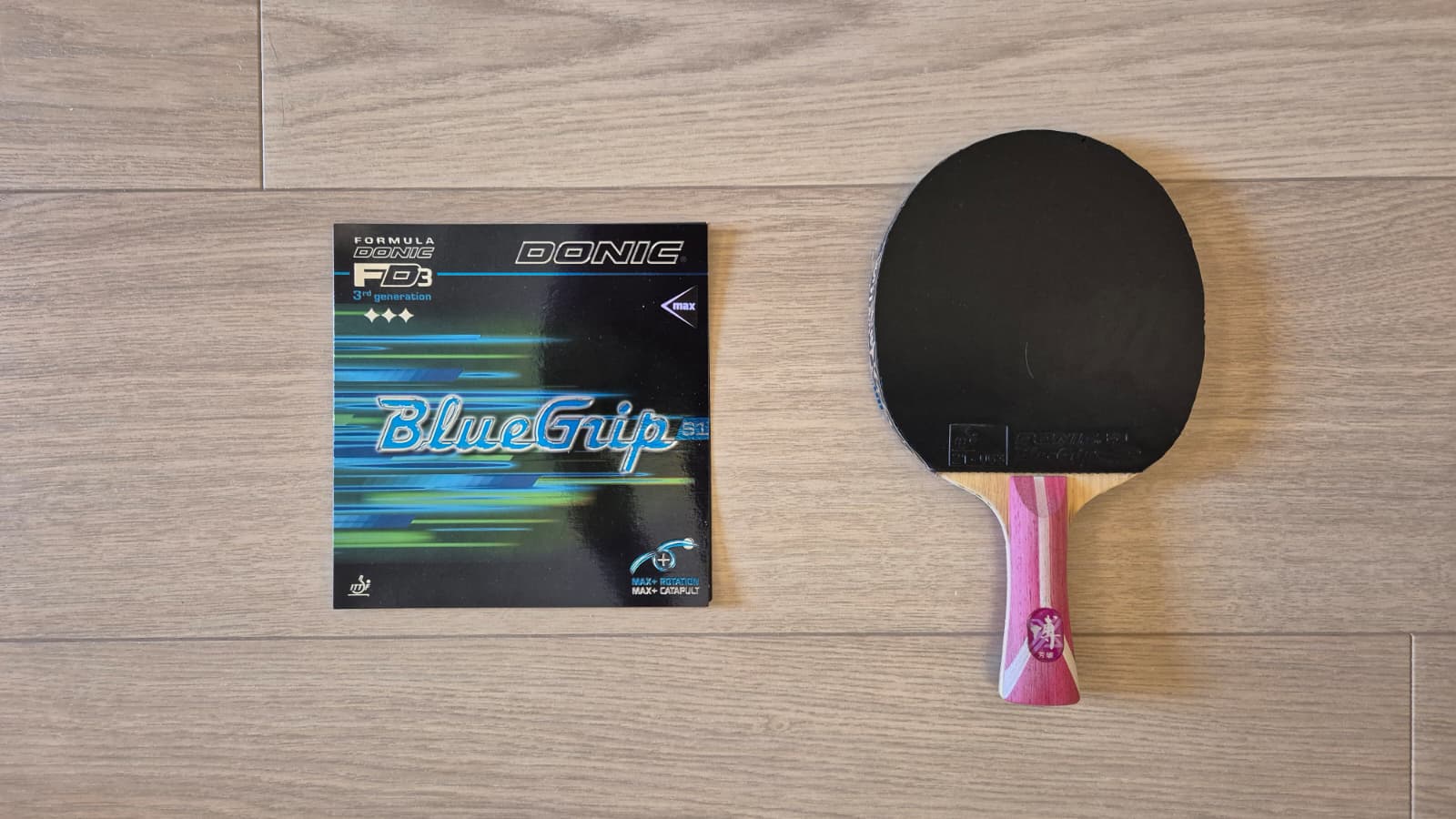
How does the Donic BlueGrip S1 actually play? Who should consider the upgrade from BlueGrip S2? And what are the tradeoffs when comparing S2 and S1?
Today I'm continuing with my Donic Bluegrip Series reviews and this week it's the turn of the Donic BlueGrip S1, a direct upgrade from the Donic BlueGrip S2 that sits below the Donic BlueGrip C2.
This is an exciting rubber that deserves a little more attention than it gets, and even though it may not be as durable as other direct competitors like the Andro NUZN 48, I still really enjoyed playing with the BlueGrip S1 on my backhand. I actually took it to my 4-day training camp at Borussia Dusseldorf (more on this soon) and played with it during the whole programme, tournament included. I enjoyed the results and the playtesting period, and will for sure recommend it to people who want a 48 degree rubber that combines three parts of a modern hybrid tensor with one part Chinese hybrid rubber. The result is better than I expected after testing the BlueGrip S2 (very 2-geared nature), so I'm looking forward to telling you all about it!
And before we get started, this time I got the Donic BlueGrip S1 from our club sponsor SE - TableTennisStore.eu so a big thanks and a shoutout to them for that. I love having a sponsor that is so involved with our club and always wants to help with my reviews <3
So let's get started with the BlueGrip S1 and talk about its characteristics in depth!

Donic
BlueGrip S1
The TL;DR: Donic BlueGrip S1
| Category | Donic BlueGrip S1 |
|---|---|
| Weight | Medium-ish, around 47g cut to my Fang Bo B2X blade |
| Sponge & Topsheet | Medium-hard sponge with a slightly tacky topsheet |
| Spin potential | High when engaged properly |
| Speed & Gears | Many gears, slow in the touch game, fast when engaged |
| Throw angle | Medium throw angle, lower and longer flight than BlueGrip S2 |
| Drives & Loops | Nice and easy, good control and enough power |
| Serves | Good spin, a bit less than with the Andro NUZN 48 |
| Flicks | Good backhand flicks but less safety than with the BlueGrip S2 |
| Pushes | Good control and spin, dangerous aggressive long pushes |
| Blocks | Good blocking, can work on both dead and active blocks |
| Flat hits | Pretty good with counters and flat hits |
| Boosting | No need to boost it |
| Price & Durability | Average for ESN rubbers, usually between 40-50€ |
The technicalities
The Donic BlueGrip S1 comes in a nice black and green package, weighs about 69-70 grams uncut and around 47g cut to my DHS Fang Bo B2X. The sponge is light blue and it likely is similar to the ACUDA S1 sponge (Donic does not specify this anywhere I could find though, but the S2 had the Acuda S2 sponge) while the topsheet is harder and slightly tacky. The initial tack will fade away after the first few play sessions but it will still keep some minimal tack after a month of playing with it if well protected (I always clean all my rubbers with a TT sponge and water, plus a rubber protector once dried). To give you an idea of its tackiness, think a tiny bit tackier than the Andro NUZN/Tibhar MK rubbers, but just by a little bit.
Donic positions this rubber as the next step from the BlueGrip S2, something from intermediate players onwards, a rubber for those players who understand the basic fundamentals of technique and want a more powerful and low throwing rubber but without going to the very powerful BlueGrip C-series. In my experience, this is exactly correct and I would definitely recommend this rubber to intermediate and high intermediate players, but it can also work for advanced players with relatively fast carbon blades, where BlueGrip C2 may be too much. So this is definitely not a rubber for beginners, please take that in mind.
How I tested the Donic BlueGrip S1
For the Donic BlueGrip S1 I went back to my normal testing blade, the DHS Fang Bo B2X, and I also tested it a little bit on the DHS Wang Chuqin.
I felt like the rubber would be powerful enough for my backhand and that it could be a good alternative to the Andro NUZN 48 that I recently tested, and also to the Glayzer 09c that I'm currently testing on my backhand as well. Even though I tested this primarily on my backhand, the BlueGrip S1 can perfectly fit on the forehand for those of you who prefer a softer hybrid forehand rubber with perhaps a softer tensor on the backhand. I recently recommend this setup to an intermediate player I helped and he was very satisfied, but I also recommended it to another player for his backhand as a hybrid alternative to Rakza 7 (he wanted a harder hybrid rubber that was close to the tensor world so it was one of the alternatives I gave him) so hey, it can work on both sides! You decide :)
Oh and, it's also good to mention here that this was definitely a more intensive test than other times, as I brought it along to my 4-day Borussia Dusseldorf / Andro Schule training camp and tested it for around 25 hours in less than a week, plus the normal weekly testing that lasted for about a month. This was definitely plenty of time to get a very good understanding of how the rubber plays and feels during training and competitive games.
The Donic BlueGrip S1 in depth
Sponge & Topsheet Feeling
The sponge is said to be around 47-48 on the ESN scale, so it feels medium-hard to the hand/finger when compressed, but once glued to the blade, it will play a bit softer than that, not much more though, this is not like the Butterfly Dignics 09c that feels way softer during play time than what it actually says on the package (to me it never felt like a 44 on the japanese scale).
The sponge has a good amount of catapult built in, but it will only activate once you apply a certain force to it, so it's like the carbon buried into an inner blade, it is there for the higher gears and it will behave comfortably good during the low gear touch rallies. So a classical tensor hybrid really.
And now talking about the topsheet, it is the BlueGrip topsheet, not too soft, not too hard (this is not a DHS Hurricane 3 Neo topsheet), and it gives a good feeling during the rallies. As I mentioned before, it is mildly tacky when you take it from the package and then it will only feel slightly tacky after a few play sessions. This is also one of the reasons why I mentioned that it feels closer to a tensor hybrid than to a true pure or Chinese hybrid (i.e. Glayzer 09c, Rakza Z, Hurricane 8-80, etc).
Speed & Control
Let's get started with the main difference between the Donic BlueGrip S2 and the BlueGrip S1: You can forget about the 2-geared learning behaviour of the BlueGrip S2. The BlueGrip S1 is a mature rubber that has many more gears than its little brother and you won't need to adjust much to it if you are coming from similar rubbers to it.
And yes, for those of you who are wondering about the dampening / choking effect of the rubber on the low gears, it is still there, but in my opinion it is much more balanced and better done. Whereas I sometimes struggled with the BlueGrip S2, I had zero slippage issues with the BlueGrip S1 and I actually quite enjoyed the balance that it has between speed and control. Passive blocking and the touch play were all nice and easy, and it has plenty of built-in catapult effect for most of us amateurs. It also does not have a very apparent speed cap like its little brother and you won't reach that speed limit easily.
However, like with the BlueGrip S2, this rubber also rewards a thicker contact and properly activating the sponge. If you do this, you will get a pretty satisfying shot and a relatively difficult ball to return for your opponent. You can especially notice this when you swing it nice and hard after a long serve or if they give you an easy dead ball. On those shots, and provided you hit-brush into the sponge, I'm pretty sure the opponent will not return the ball most of the time. It does not have the speed of a Dignics 09c / NUZN 48 but it still has a great amount of kick and power to it. Think Dignics 09c power but with a couple notches less in terms of speed and certainly spin (still plenty though), and maybe just one or two steps less than the NUZN 48.
And finally, speaking about the passive play and the touch short game, it is quite reliable and you can drop the ball nice and dead behind the net if you add a little bit of your own spin. It is also pretty good on backhand flicks, and it works nicely for aggressive pushes. I will talk about this in the next section.
Spin & Grip
You know I like spin over speed and that I always value a rubber with a strong grip for when the situation gets a bit dire ;)
Since the Donic BlueGrip S1 is a spin-first rubber (as opposed to the other Donic Blue-series which are more about power and speed), I had high expectations on what the rubber would be able to achieve. I was a bit disappointed with the spin of the BlueGrip S2 for my level of play (for beginners and low intermediates it's plenty though), so I wanted to see how it would compare to the Andro NUZN 48 on this section.
The result of the analysis was quite satisfying and I found myself having a lot of spin in most of my shots. It's not as much as the NUZN 48 but there is not a world of difference between the two rubbers. I actually enjoyed the more tamed nature of the BlueGrip S1 in moments where I had to play a safer and more controlled shot.
As with the BlueGrip S2, you do need to work a bit harder for your spin than with the NZUNs. I think that those have even better grips and they bite the ball really well on passive shots, producing more spin than the BlueGrip S1. But when you do things right, the BlueGrip S1 has a lot of spin and kick, enough to at least match (or surpass) the Glayzer 09c. I think for those of you who like the Donic feeling (which is just different than other rubbers, I don't know how to feel about that, but there is just this thing to Donic rubbers), you may very much enjoy the BlueGrip S1.
So yeah, spin and grip is very good on the BlueGrip S1 and I will also talk more about this in the upcoming sections.
Throw Angle
The throw angle of the BlueGrip S1 is lower and longer compared to the BlueGrip S2. This is probably one of the main things you will notice when you start playing with it if you come from its little brother, and I think it is a good thing because it makes your shots more dangerous for the opponent.
So whereas the BlueGrip S2 has a very noticeable short and high flight, the BlueGrip S1 feels more like a NUZN 48 in its throw angle behaviour. It is a more direct rubber, and in combination with my Fang Bo B2X, I had to adjust my racket angle a tiny bit on heavy backspin shots, but on normal topspin rallies, it has a very comfortable medium-long throw that lands the ball safely on the table but does not give an easy counter to the opponent. So I'd say all good for the backhand if you have a decent technique, and a good throw angle for the forehand as well if you are looking for safety and control there (in between low throwing Chinese forehand rubbers and medium-high throwing rubbers like Rakza Z).
Since the throw angle felt so similar to the NUZN 48 to me, you can easily read the Andro NUZN 48 review and check what I wrote there, it will pretty much apply to the Donic BlueGrip s1 as well.
Drives & Loops
I really enjoyed normal backhand drives with the BlueGrip S1, and I could get very long backhand rallies during warm-ups. At some point my training partner commented on how we looked like those pro players warming up their backhands before an important competition game, almost robotic, short wrist/forearm movement and all balls on the table. This definitely did not happen as easily or effortlessly with the BlueGrip S2.
So one of the main differences with the BlueGrip S2 is that the built-in catapult of the BlueGrip S1 is much more evident on lower speed shots (hence, a more advanced and powerful rubber) so you will have less trouble with activating the sponge. You can keep your drives more compact and they will have more power and a longer flight than with the BlueGrip S2. This is by the way similar to the NUZN 48 but there is less power in those shots, so a bit more control and safety there, which may be good or bad for you, you decide.
Opening backspin loops is also pretty easy and safe, but a little bit less than with the BlueGrip S2. This is mostly due to the extra rebound speed, longer flight, and diminished throw / dwell time, so you have to be a bit more precise on those shots but they will be more dangerous. I also noticed that with the BlueGrip S2 you could (and it was rewarded in a way) have a tighter grip on the handle and hit more through the ball, but with the BlueGrip S1, a looser grip and more wrist momentum is rewarded. You can still hit through the ball a bit, no problem, the rubber still likes that, but your technique just needs to be better than with the BlueGrip S2 to land the shot. Further from the table it will be easier to land the shots with the BlueGrip S1, which makes all the sense as well.
Counterloops were also very easy, much easier than with the BlueGrip S2. This also makes sense, the S2 is built for control and not really for counterloops as this is an advanced shot that most developing players don't have to bother with. But with the BlueGrip S1, a rubber more made for high intermediate players, the shot is very nice and easy, and you can also just hit through the ball and many times the ball will be on the table. That was quite satisfying and left the opponent wondering what happened with their opening loop a couple times!
Serves
Serves were spinny but a little bit less spinny than I would expect from a spin-first rubber. It is true that the spin was good and that I could send some heavy spin serves that some opponents did manage to put back on the table (top-side spin especially) but it is also true that I could generate a bit more spin with the NUZN 48 on the backhand, especially when it comes to backspin serves. As said, it was a small difference but big enough to mention.
As opposed to the BlueGrip S2, I did not experience any issues with short serves and my adjustment period to the rubber was immediate. Short serves did not pop much due to the rubber dampening effect and all of my long serves were pretty dangerous. I did have to be a bit careful with overshooting the table when I hit the ball a bit thicker, but I'd say this was the exact same thing as with the BlueGrip S2 and the NUZNs, so nothing new, brushing is better for serves anyways, so no issues there.
Flicks
Backhand flicks were easier than with the BlueGrip S2, as I felt like the grip was better and the ball would have a bit more momentum after contacting the rubber. Those flicks were also more dangerous than with the BlueGrip S2 but a bit riskier due to the diminished dwell time and throw angle. The rubber is quite direct on backhand flicks (especially combined with my B2X blade), definitely more direct than something like Rakza Z or Glayzer 09c, and this effect was noticeable. But when you landed the shot, they had more power and were more dangerous, so it is a matter of tradeoffs as always!
I also had less trouble with having to contact the ball thicker in order to get it over the net, and I enjoyed that coming from the BlueGrip S2. Overall I think that the BlueGrip S1 is a much better balance between speed and control for me than the BlueGrip S2.
Pushes
Short pushes were very nice, and just like with the BlueGrip S2, I could drop those quite short on the other side of the net without too much effort thanks to the dampening on the ball. I again really enjoyed those drop shots, as it's one of my main shots when the occasion arises (against a lob or a semi-dead short ball), so that was a plus point!
Long pushes were also nice and low, and I did not have to adjust the blade angle as I had to do with the BlueGrip S2. I remember one of the training days at the Borussia Dusseldorf / Andro Schule camp where I was practicing with one of the best guys there (our good friend SJ) and he had a lot of trouble with my long backhand pushes. He could often just attack every ball after a long push but he commented how he was having a lot of trouble on those. I did not test any NUZNs with him, but I felt like in this department, the BlueGrip was as good as the NUZNs. It can also be my imagination of course, but hey, let's just say there was enough spin to make the big guy sweat a bit.
Blocks
Blocks were definitely easier with the BlueGrip S1 compared to the BlueGrip S2. I could just do my lazy dead blocks and most of those would go on the table. The rubber felt pretty similar to the NUZN 48 in this regard (a bit safer perhaps), especially when the opponent was giving me some strong loops. This also worked just fine on normal drives, but I had to put a bit more effort on those.
One thing to mention here is how easily I could do 'windshield' blocks to the forehand with the BlueGrip S1. On another of those training camp days, another of the great guys (P.) had a lot of trouble with getting most shots blocked to his backhand and then randomly to his forehand. The BlueGrip S1 made it very easy to do this kind of deceptive shot with a small twist of the wrist, and I struggled to make those as smoothly as with the BlueGrip S2.
Overall, I enjoyed the ease of blocking of the BlueGrip S1 more than I enjoyed the super controlled and slow blocking of the BlueGrip S2.
Flat hits and counterhits
I think that one of the nice details of the BlueGrip series so far, is that you can do really nice counter-hitting when the incoming ball has a decent amount of spin. Some other rubbers are worse at doing this (more sensitive to the hit-brush ratio), but with the BlueGrip S1 it felt really comfortable to do this shot. So this is definitely one thing to be aware of, depending on your playstyle!
And even though my flat and counter hits were already pretty good with the BlueGrip S2, they definitely got easier and more dangerous with the BlueGrip S1. The rubber is doing most of the work for you and keeps the ball pretty low and loaded, so those shots were almost always a direct point. Do notice that those shots were not as easy to do as I'm explaining here, but definitely easier than what I'm used to with tackier rubbers. I don't think I will change my backhand style to become a hitter-blocker but if I wanted to, I'd definitely consider the BlueGrip S1 for this, as I enjoyed increased easiness and comfort on both of those shots.
Boosting
This is the same as with the BlueGrip S2 and I see no need for boosting of the rubber. It has enough catapult on its own, and the sponge is not that hard that I would consider boosting it, so just don't do it. It's ready to be played out of the box.
Price & Durability
Without any discounts, the price of the BlueGrip S1 is pretty much the same as the BlueGrip S2 (around 40€ to 50€) but yet again, I have seen some offers in different shops (including our club sponsor TableTennisStore.eu) so you may be able to get it for less. This means it is not an expensive rubber and it falls into the normal ESN category.
And when it comes to the matter of durability, which is a common issue for many ESN hybrid tensors, I do think that the BlueGrip S1 is holding up better than its little brother, the BlueGrip S2. I've given it a harder time than I did with the BlueGrip S2 and it's holding up pretty well after a rough month. It could be that the durability is slightly worse than the NUZNs, but only by a small amount, and I have not experienced any white spots on the topsheet as some others have mentioned (I did see this a tiny bit on my C2 already, very minor though and it does not affect performance at all).
So overall, I think that the QA/QC of the BlueGrip S2/S1/C2 is not bad and that the durability isn't that bad either when properly taken care of, but perhaps there is a bit more inconsistencies between sheets than I have seen with the NUZNs. But in any case, I'm used to wild variabilities within my normal DHS rubbers so I'm not too sensitive to this topic anymore!
Lastly, there are some players I have helped who are now playing with the BlueGrip S1, so I will update this post with more info as I hear from them and with my own experience as well.
So who is this rubber for?
I'd say that the Donic BlueGrip S1 is an intermediate+ hybrid rubber for those who already have a good technical foundation but want to take it to the next level, so I'd say that you will like it if:
1. You were a developing player before and now want to step up your game from your initial BlueGrip S2 (or similar) to something that has a bit more bite and danger while keeping the focus on spin and precision first.
2. You are a high-intermediate player but still want a relatively controlled hybrid tensor rubber to keep on developing your technique.
3. You are a high intermediate player with the wrong backhand habits and want to rework your technique but without the speed shock of the BlueGrip S2 (or similar). Be mindful of your blade of choice here, as a very fast blade will still be tough to develop the correct technique with the BlueGrip S1 on it.
And who may not enjoy the rubber?
This category is bit more difficult than with the BlueGrip S2 as the BlueGrip S1 fits a bigger range of players, but I'd say that you may not like it if:
1. You want hybrid rubbers with a certain amount of rebound speed (think NUZN or similar) or a maximum level of spin (think Dignics 09c).
2. You'd like to use this rubber on your forehand but want a bit more speed and spin (or hardness) on it. You may then choose the BlueGrip C2, which I will review next.
3. You are looking for a very long lasting rubber, something that lasts 6 months at least at peak performance (think Hurricane 3 Neo or similar).
4. And of course, any of the players who may prefer the BlueGrip S2.
Overall, I think that if you love the (Donic) BlueGrip vibes but you need more speed and spin than the S2 can give you (but without going for the full catapult experience), you will feel at home with the BlueGrip S1. And if this is not you, no worries, you still have plenty of alternatives out there!
Final thoughts
I really enjoyed testing the BlueGrip S1 on my backhand, and I will definitely keep it as one of the rubbers I consider when helping players with their equipment choices. I think it's a rubber that can work for many different types of players, and that sits in a nice space between true hybrid tensors like NUZN (or similar) and the pure hybrids like Rakza Z (or similar).
I also think that the balance between speed and control is much better on the BlueGrip S1 than on the BlueGrip S2 for players who are a bit more advanced, and it's possibly a good rubber choice for those of you who enjoy the BlueGrip C2 on your forehand but want a softer backhand experience. If that is your case, definitely consider the BlueGrip S1.
Overall, I'd say that for me, the upgrade from the Donic BlueGrip S2 to the BlueGrip S1 is well worth it, especially considering that the price difference isn't really an issue.
That was my review of the Donic BlueGrip S1, until my next review, and see you at the table!
Need personalized equipment advice?
I can help you find the perfect blade and rubber setup for your playing style.