Donic BlueGrip C2 Review: An Unexpected Budget Alternative to Butterfly Dignics 09c
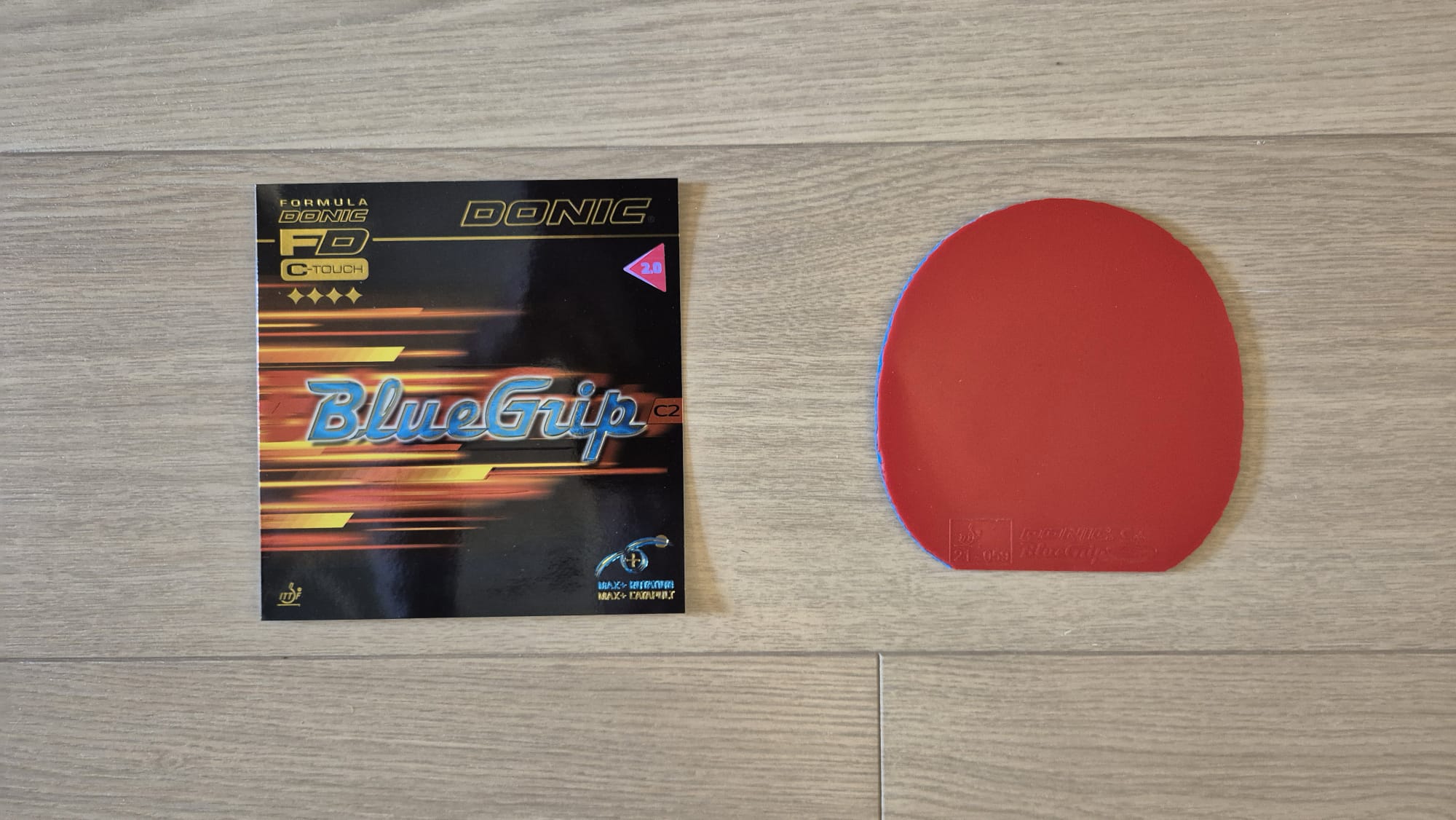
How does the Donic BlueGrip C2 actually play? Is it an upgrade from the Donic BlueGrip S1 or something different? And can it really be a cheaper alternative to the Butterfly Dignics 09c?
This is my last week before the summer holidays so I wanted to leave you all with a review of a great rubber that gets quite a lot of attention in the community: The Donic BlueGrip C2.
I'm excited to tell you more about the BlueGrip C2 as I believe that it has quite a lot of similarities with the Dignics 09c, perhaps not something you would expect immediately (I didn't as well) as both rubbers are in a different category (Dignics 09c more of a pure hybrid, BlueGrip C2 more of a hybrid tensor) but in reality, you get kind of similar results on the table when paired with a carbon blade.
And before we get started, even though I bought this rubber myself, our club sponsor SE - TableTennisStore.eu will still give you a 25% off when you click on the link below, so a big thanks and a shoutout to them for that!
So let's get started with the BlueGrip C2 and talk about its characteristics in depth!

Donic
BlueGrip C2
The TL;DR: Donic BlueGrip C2
| Category | Donic BlueGrip C2 |
|---|---|
| Weight | Heavy-ish, around 50g cut to my Fang Bo B2X blade |
| Sponge & Topsheet | Hard 55 sponge (feels softer) with a slightly tacky topsheet |
| Spin potential | Lots of spin on most shots, very high spin potential |
| Speed & Gears | Many gears but faster than S1 in all of them |
| Throw angle | High throw angle, higher than S1 and Rakza Z |
| Drives & Loops | A lot of power that activates pretty easily |
| Serves | Very good spin, similar or a bit more than NUZN 48 |
| Flicks | Easy due to the high throw and catapult, less safety than S1 |
| Pushes | Decent control and high spin, good for long pushes |
| Blocks | Good blocking but more difficult than with S1 |
| Flat hits | Not very good, it is safer in combination with brushing |
| Boosting | I would not boost it, there is no need for it |
| Price & Durability | Average for ESN rubbers, usually between 45-55€ |
The technicalities
The Donic BlueGrip C2 comes in a nice black, yellow and red package, weighs about 72-ish grams uncut and around 50g cut to my DHS Fang Bo B2X. The sponge is light blue and it feels pretty hard initially while the topsheet is just slightly tacky. The initial tack will fade away after the first few play sessions but it will still keep some minimal tack after a month of playing with it if well protected (I always clean all my rubbers with a TT sponge and water, plus a rubber protector once dried). To give you an idea of its tackiness, think a tiny bit tackier than the Andro NUZN/Tibhar MK rubbers, but just by a little bit. So in this area, pretty much the same as the BlueGrip S1.
Donic seems to position this rubber as an upgrade from the BlueGrip S1, trying to cater to advanced players, but in my opinion, and even though I agree that this is an advanced rubber for advanced players, it is quite a far step from the BlueGrip S1, as it behaves differently. This is also why I mentioned that I didn't expect the rubber to be a budget alternative to the Dignics 09c.
So yeah, this is definitely not a rubber for beginners or even low intermediates like the S1 could be (bit of a stretch though but still), please do take that in mind before wasting some money on it.
How I tested the Donic BlueGrip C2
For the Donic BlueGrip C2 I went back to my normal testing blade, the DHS Fang Bo B2X, and I also tested it quite a lot on a much slower blade, the Donic Appelgren ALL+ World Champion 89.
I did this because I wanted to test it on both extremes of the blade spectrum. When I initially tested it on the Fang Bo B2X, paired with the BlueGrip S1 on the other side, it was quite the contrast. The differences were noticeable, and while I had a lot of control with the BlueGrip S1, the BlueGrip C2 gave me a much harder time to keep the ball on the table. It certainly had a lot of power to it, but it became very clear from the get-go that this was not a rubber for safety and control.
So after this initial test, I changed it to the Donic Appelgren and actually got to see a different nature of the rubber. The calm and quiet nature of the soft Appelgren made it much more controllable and it became a sort of higher throwing boosted Hurricane 3 Neo, which is pretty much the feeling I've always had with the Dignics 09c while I still played it. Surely this was in the beginning of my BlueGrip C2 journey, and things would change a bit after a couple weeks, but I still enjoyed it more on the Donic Appelgren than on the Fang Bo B2X, even though it nicely compensated for the low throw of the DHS blade.
It is also good to mention that I mostly tested it on my forehand, as I found it a bit too heavy and difficult to control on my backhand (same to what I nowadays experience with the Dignics 09c). Initially I bought it in red so I could primarily try it out on my backhand, but I've since then changed my mind and felt like it would fit better on the forehand, even though I've mentioned before that I don't enjoy very high throwing rubber on the forehand (I still don't, but on the Appelgren blade it was all right).
The Donic BlueGrip C2 in depth
Sponge & Topsheet Feeling
The sponge is supposed to be very hard, sitting at an intense 55 ESN degree, but in reality, I think you get a pretty similar experience to the Dignics 09c, where the hardness on paper doesn't really match the feeling that you get when playing it. It is easier to activate the sponge than you would think, specially on carbon blades, and the feeling that you get in your hand is more of a 52 ESN degree rubber. I'm testing the Joola Trinity Dynamic soon (which is supposed to sit at 52.5 degrees) so I can compare when I get to that.
The sponge has a lot of catapult built in, and as I said before, it is much easier to activate than the one of the BlueGrip S1. Even in the lower gears, there is always a bit of catapult added to the shot, so that's why I'd place the BlueGrip C2 more in the hybrid tensor category a bit more than I would say about the BlueGrip S1.
And now talking about the topsheet, it is the BlueGrip topsheet, not too soft, not too hard (this is not a DHS Hurricane 3 Neo topsheet), and it gives a good feeling during the rallies. As I mentioned before in the other reviews, it is mildly tacky when you take it from the package and then it will only feel slightly tacky after a few play sessions. This is also one of the reasons why I mentioned that it feels closer to a tensor hybrid than to a true pure or Chinese hybrid (i.e. Glayzer 09c, Rakza Z, Hurricane 8-80, etc).
Speed & Control
If the speed difference between the BlueGrip S1 and S2 was already noticeable, the difference between the S1 and C2 is as noticeable. The BlueGrip C2 is significantly faster than its little S1 brother, and this is one of the main things to take into account when changing from one to another.
This is especially important when you are using the BlueGrip C2 with a fast composite blade like the Fang Bo B2X, where I had to take some time to adjust to the rubber's speed and catapult so as not to overshoot the table too much. However, if you play the BlueGrip C2 on a slower composite (or all wood) blade, then it will be just fine, and it actually feels quite nice on some of those. For example, I remember that the feeling on the Donic Appelgren was very pleasant and controlled, and it turned a pretty slow 5+2 blade into a serious weapon with a lot of power and safety. In a way, very similar to how a boosted orange Hurricane 3 Neo or a Dignics 09c would behave, the main difference being the throw angle.
It is also worth noting here that the 'choking / dampening' effect that was present on the BlueGrip S2 (and to a certain extent on the BlueGrip S1) is inexistant on the BlueGrip C2. The rubber has a lot of initial grip and releases the ball quite rapidly in a bouncy way, so that's also why I mentioned above, that this is not so much a pure hybrid, but a powerful hybrid tensor like the NUZN line, with a bit more tackiness and dampening than those.
Another factor is whether the rubber prefers a thicker contact like the BlueGrip S2 and S1 preferred, and I'll also mention here that this is not so much the case for the BlueGrip C2. It is a rubber where thicker contacts will get you a lot of catapult and spin, but thinner contacts are also perfectly fine and you will get safer shots in that way. That also reminded me of the Dignics 09c in a way, where for lower topspin balls, you have to brush the top of the ball more than hit-brush it like you would do with a Hurricane rubber.
And finally, when it comes to the passive play and the touch short game, it is also quite a reliable rubber like the BlueGrip S1 was, and you can drop the ball short if you add a bit of your own spin. It is a tad trickier to do than with the BlueGrip S1 but it's not that bad at all.
Overall, it's a rubber with a lot of gears, and the main difference with the BlueGrip S2 and S1 is that all the BlueGrip C2 gears are essentially faster and to a certain extent a bit more exponential: at slow speeds, you get some extra catapult and at high speeds, you get a lot more catapult and built-in tension.
Spin & Grip
Spin and a high grip are the trademarks of the BlueGrip series and I think this is really true with the BlueGrip C2. I didn't enjoy the grip of the BlueGrip S2 as much, and the BlueGrip S1 requires a thicker contact to have the full grip, but with the BlueGrip C2, grip is never a problem, and you get a lot of spin in all kinds of situations.
So in my opinion, the BlueGrip C2 has more spin than the BlueGrip S1 and much more than the BlueGrip S2. It's a rubber that is dangerous even if you don't play your best shot, you can still produce a significant amount of spin that will put your opponent in a tricky situation. It does not have as much spin as a boosted provincial Hurricane 3 Neo or a Dignics 09c would have, but definitely more than a Glayzer 09c and I'd say similar or a bit more than the NUZN 48. I think that with this rubber, the ratings of spin that you can find in RevSpin are correct, and that puts the BlueGrip C2 in the very spinny rubbers category.
So if you want to use the BlueGrip C2 as a spinny and controlled (yet powerful) rubber, glue it on a slower inner carbon blade that doesn't have a huge throw angle on its own (unless you are playing the C2 on the backhand, then I guess is fine) and enjoy really spinny shots. And if you want it to be faster and more aggressive, put it on a fast inner or medium outer blade and you will see that the rubber has nothing to envy when compared to other much more expensive premium tier rubbers.
Throw Angle
The throw angle of the BlueGrip C2 is pretty high, and it reminded me a lot of the Dignics 09c when I first started playing with it. Definitely noticeably higher throwing than the BlueGrip S1, higher than the BlueGrip S2 and also higher than NUZN 48 or a traditional hard and tacky non-boosted rubber.
After a couple of play sessions I did notice that it does not throw as high as the Dignics 09c does, so it's slightly lower than that (noticeable if you are paying attention to it, not so much if you don't), for those of you wondering how the throws would compare to each other. In any case, there was a clear difference when the blade was slower or faster. On the Donic Appelgren (slower inner) the throw angle was not such a big issue, because the blade's inherent slow tempo would make the ball land on the table without many issues, and you just got some balls that would be easier to counter attack for the opponent. However, on the Fang Bo B2X, overshooting was much more of a problem, but once adjusted, those shots were much more difficult to handle for the opponent, and often a direct point when I looped correctly.
So if you are considering buying it, do remember that high throwing fast rubbers like this one are not the easiest to control, and in the beginning you will need to adjust your blade's angle to compensate for that and avoid overshooting the table.
Drives & Loops
Forehand drives are pretty effortless with the BlueGrip C2, you just have to do some minimal weight transfer and the ball lands on the other side of the table. This is the same for backhand by the way, and I didn't need to do much for the ball to go over the net and get a nice backhand drive. During warmups, it's very easy to keep up a good tempo and safety on all the drives.
Looping is a different story as the rubber catapult starts to kick in, and you need to play a technically correct stroke for the ball to consistently and safely land on the table. I use a full body long forehand stroke coming from the Chinese technique of hit-brushing and with the BlueGrip C2 this is not really necessary, sometimes (with a fast composite blade) is too much power (and too few control) and I needed to tone it down and make the stroke more compact. I don't personally enjoy the compact strokes on the forehand but it's all fine if you do, and in fact, those will work better with the BlueGrip C2 in my opinion. On the backhand, and even though I didn't try the rubber as much there, loops were nice and high throwing, the catapult felt quite nice and it was just a pity that the blade was a bit too heavy in combination with a boosted Hurricane 3 Neo, otherwise I may have played with it a bit longer.
So if before I mentioned that the main difference between the BlueGrip S2 and S1 was a significant increase in speed and built-in catapult effect, this is the same with the BlueGrip S1 and C2, so that has a big effect on loops mainly, you get much more power but less control and safety, as is the case when you upgrade to a fast advanced rubber.
This means that opening backspin loops requires more precision and committing to the shot (half shots will get punished), which in return will give your opponent a hard time when returning those. The dwell time is lower than with the BlueGrip S1 and the rubber's spin sensitivity is still high, so you have to time those shots correctly or the ball will go into the net or over the table. And please don't think control is bad with this rubber, it is not, it just needs the right technique, footwork and timing.
Lastly, when it comes to counterloops, I found those easier to execute than with the BlueGrip S1, as the BlueGrip C2 is pretty good at absorbing incoming spin and returning it. This also reminded me of how a Dignics 09c or Hurricane 3 Neo would feel when counterlooping. I didn't have enough time to counterloop on the backhand for several play sessions, but I did try a couple times and it was similar to the forehand, I could play a very forward stroke and hit a bit through the rubber (my backhand counterloop has a bit of counterhit to it) and it landed on the table, often as a direct point that gave the opponent no time to react. Quite satisfying indeed!
Serves
The BlueGrip C2 is a very spinny rubber so serves are usually quite loaded, especially long ones, where I could often make a direct point with heavy backspin or heavy sidespin/topspin.
In the BlueGrip S1 review I mentioned that I was expecting a bit more spin from a spin-first rubber and that I could generate more with the NUZN 48, but this was not the case with the BlueGrip C2 where I think I was able to generate as much if not more spin than with the NUZN 48.
On the short serves, the rubber works well but it is a bit more difficult to keep those serves short and low as the lower gear is still faster than the lower gear of the BlueGrip S1. This is by the way a common thing in tensor and hybrid tensor rubbers, they have more catapult and power but you always have the tradeoff of the short serves and receives, where the lack of tackiness and speed increase make it more difficult to do those really well.
Flicks
I don't usually flick too much on the forehand, but the higher throw of the BlueGrip C2 made it a bit easier to flick on the forehand with conviction and safety. If anything, I needed to adjust the racket angle and focus on a loose-wrist brushing motion to avoid overshooting the table, but once I got the hang of it, it was definitely easier than with low throwing rubbers.
On the backhand, banana flicks were even easier than with the BlueGrip S1 as there was more grip, throw angle and spin, so it was no problem to flick most of those balls and land them on the table. Again, a brushing motion achieved better results than a thicker contact here. And if you did add a bit of a thicker motion on sidespin/topspin short serves, the ball had a lot of power and put the opponent in a tough situation, I got a couple of points like that.
I think in this area, both the BlueGrip S1 and C2 are good rubbers for flicking, just different when it comes to the amount of speed, safety and especially throw angle.
Pushes
Pushes and serves are usually interconnected and this is also the case here of course.
Short pushes were slightly harder than with the BlueGrip S1 given that the lower gear is a bit faster and bouncier on the BlueGrip C2, but they were still nice and easy, and all you have to do is add a bit of spin yourself. The rubber is sensitive to the incoming spin so if you do nothing against a heavy backspin serve, it will go into the net. That aside, you could still do really nice pushes to the wide forehand when receiving on your short forehand, so no problem there.
Long pushes were a bit more difficult to execute with the BlueGrip C2 than with the BlueGrip S1 but they had more quality and were more dangerous for the opponent, I started noticing that they would start pushing a bit more as they didn't dare to open against some aggressive pushes, especially when they gave me a heavy backspin pendulum serve on the backhand and I aggressively pushed back to their wide backhand. I think this is pretty similar to the behaviour I get when I play with any of the Hurricanes or in the past with the Dignics 09c.
Blocks
Blocks are very easy to execute on the BlueGrip S1 and it is a pity (but expected) that I lost some of that control due to the catapult effect on the BlueGrip C2. It is definitely not as bad as with other tensor rubbers, the dampening effect is still there, but very far from what you can do with a hard and tacky forehand rubber.
This is by the way one of the main issues I experienced when playing with the Dignics 09c, especially against tough opponents that had hard and spinny attacks. The ball would just bounce off the rubber and I would struggle with blocking those. Especially in this area it reminded me of the Dignics 09c, not so much of the 'dead' Hurricane 3 Neos.
Overall, I enjoyed the ease of blocking of the BlueGrip S1 more than I enjoyed the blocking game with the BlueGrip C2.
Flat hits and counterhits
Similar to what I mentioned around the counterlooping area, and also similar to the experience with the BlueGrip S1, hitting on the backhand was pretty good and you could get most balls on the table when counterhitting. Pure flat hits were not as good, you always need to add some brush and spin to your stroke with this rubber, but its tensor nature definitely shows on this kind of stroke.
On my forehand, I just don't think this is the right rubber for that, but it can also be that my forehand technique is so different that it wouldn't work, perhaps a bit of both. I did some flat hits a couple times when my forehand was wrongly timed or if I was out of position, and most of them went long and over the table, so yeah, not the kind of rubber that would allow for easy flat hits (on the forehand at least). I think I enjoyed the BlueGrip S1 a bit more for this.
Boosting
This is the same as with all the other BlueGrips I've reviewed so far, and even though it is tempting to boost such a hard sponge (55 degrees on paper), I think it will only make the rubber more difficult to play and control, and as I mentioned before, this is not a flat trajectory rubber or a slow one, so why would you need to boost it. If you need more speed, you can always change your blade, and if you need more throw angle (I would not see why though), you can always change to the Dignics 09c.
Price & Durability
Without any discounts, the price of the BlueGrip C2 is pretty much the same as the BlueGrip S2 and S1 (around 40€ to 50€) but yet again, I have seen some offers in different shops (including our club sponsor TableTennisStore.eu) so you may be able to get it for less. This means it is not an expensive rubber and it falls into the normal ESN category, hence why the title of this review is that it can work as an unexpected budget option to the Dignics 09c.
And when it comes to the matter of durability, I have indeed noticed some little white spots appearing on the topsheet after 2 months of usage, but I don't think they affect performance in any significant way, or at least I have not noticed yet, certainly not in the grip capabilities of the rubber or in its speed. So for now, I'm happy with what I'm getting, but I will likely experience a performance drop after 3-4 months, like it has happened with my BlueGrip S1.
So overall, I think that the QA/QC of the BlueGrip S2/S1/C2 is good and that the durability isn't that bad either when properly taken care of, but I can now say that they are a bit less durable than the NUZNs, which still feel pretty much the same as the first day after 3 months of usage.
So who is this rubber for?
I'd say that the Donic BlueGrip C2 is a high-intermediate/advanced hybrid rubber for those who already have a solid technical foundation but want to (or need to) go into the territory of higher risk and higher reward, so basically:
And on the other side, who will not enjoy this rubber? Well, I'd say that most beginners and low intermediate players should not play with the BlueGrip C2, that does not make too much sense in my opinion, same for the Dignics 09c by the way. It can work, but there are better alternatives out there (price wise also). And from intermediate onwards, it depends on what you like, but if you are not into hybrid tensors, then I would not go for this rubber, better stick to other alternatives like Fastarc G-1 for example.
Final thoughts
The Donic BlueGrip C2 was a pleasant and unexpected surprise, as I sort of stumbled upon a budget alternative to the Dignics 09c. Before playing with it, I would have never thought of this, but in practice, they are pretty similar, and that made the testing period pretty fun (as I still enjoy the Dignics 09c from time to time, it's fun to play with!)
Overall, it is a pretty different rubber than what you get with its smaller brother the BlueGrip S1, which is interesting since they should be pretty similar, but that's not the case in my experience. Whether this is a good or a bad thing, you will have to decide yourself, but if you are looking for a fast and spinny hybrid tensor with a high throw angle, you will enjoy the BlueGrip C2!
That was my review of the Donic BlueGrip C2, until my next review, and see you at the table!
Need personalized equipment advice?
I can help you find the perfect blade and rubber setup for your playing style.