Butterfly Dignics 09C Review: A Year of Testing, and Why Most Amateurs Should Avoid it
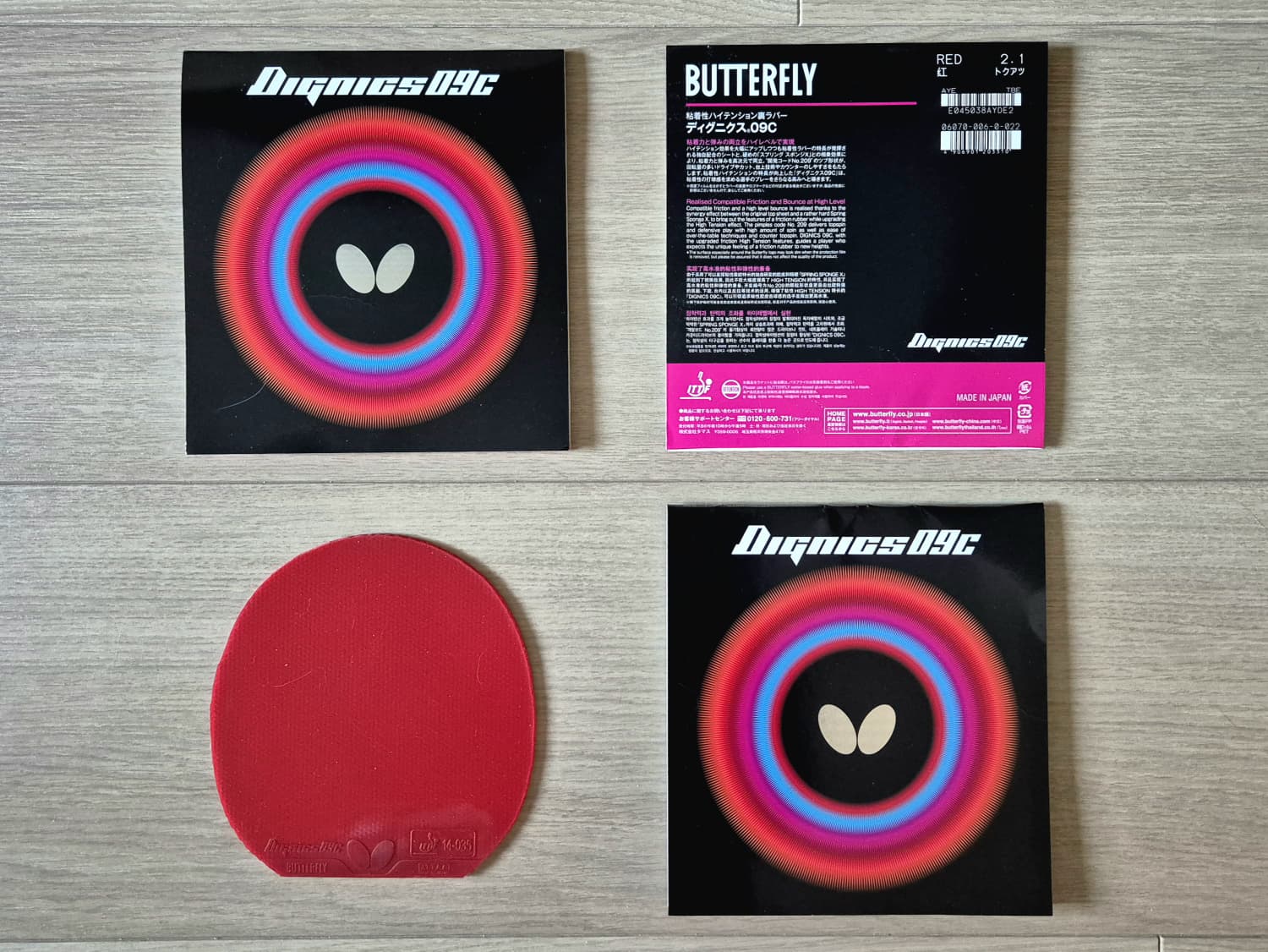
The Butterfly Dignics 09C has incredible spin and power, but most amateur players will struggle to use it to its full potential. Instead of helping you improve, it can actually slow down your development.
Expectations VS Reality for Amateurs
Side note: What is an amateur for this article? A recreational or club player that trains 1-3 times a week for no more than 10h total and is still developing solid technique fundamentals on both wings. Likely under 1800 USATT.
Every week I hear from amateur players who decided to put Dignics 09C on their forehand or backhand and more often than not, the story does not end up well. After just a few matches or training sessions, the rubber is already being peeled off and stored away.
But how is this possible? Many people consider it as one of the best rubbers of all time and Butterfly themselves have non-pro reviews praising the rubber. Plenty of Youtube videos say the same, and even Timo Boll himself says it's excellent for all kinds of players.
Since I was terribly curious about this, I decided to spend some money and test the Dignics 09c myself for a year, so I played a couple sheets (1.9 and 2.1) on different rackets in training and competition matches. I even won the South Holland Championships (Doubles, Category E) with it on my BH! But my conclusion after all this time is not what you would expect so let me break the ice immediately: it is not a rubber for most of us amateurs, and what the marketing is telling you versus what the reality often is for the average player, is not the same.
The reasons in a TL;DR format?
Okay, that was the controversial introduction, now let's break it down and get to the details of it! But first, the needed technicalities and review sections as always.
Butterfly Dignics 09C: A review of how it plays before we discuss why this rubber may not be for you

Butterfly
Dignics 09C
The Butterfly Dignics 09c was designed by and for Timo Boll, and I think that it matches his playstyle and particular technique (but notice that most pros don't play like him anymore on FH) very well.
It costs about 70-80 euros depending on the location you are in but it used to be around 100 before the release of the new Zyre 03 (which is faster and wilder than the D09c). The durability of the rubber is very good, and after 5-6 months of training about 7 hours a week, it was still holding up perfectly fine, with the tackiness level (it is medium tacky overall) being a bit less but still there. I was very happy about this, at least you get value for money!
The sponge is 44 degrees (butterfly scale, similar to a Hurricane 3 Neo 39-40) and it comes in two thicknesses, 1.9mm and 2.1mm. The 1.9 is the more controlled version than the 2.1mm because in my opinion (and also according to online reviews) with max thickness the ball just flies away unless you always do the right things. Also, the sponge is very hard but it does not feel that hard in the hand. Many others say this and it's true, it does not feel as hard as a Hurricane 3 Neo 39-40, more like a DHS 37 degrees-ish, when you contact the ball you can feel it is much softer/bouncier than stated and that is by design.
And now that we have the technicalities covered, let's get into the real review sections!
Speed & Control
Let's talk about speed and control first, as this part if often controversial. Many people say that this is not a fast rubber, and that it has to be used with carbon frames but I do not agree with them for the amateur level. I have used this on a 5-ply all-wood blade (Nittaku Violin), on a 7-ply all-wood blade (DHS PG7) and on an inner carbon blade (DHS Wang Chuqin) and when the sponge is activated with the correct technique (hit-brush, like with any other chinese hard tacky rubbers), it has plenty of kick and power on both. Sure, it has more kick on a carbon blade but it is not a slow rubber. I can understand that many pro players say that, but for us amateurs, if you think it is slow, it is because you have not managed to activate it yet and are mostly brushing with it, possibly because you are closing the racket angle too much to adjust to the high throw angle.
So as you can see, whether it is slow or fast depends on what you are doing: when you actually get through the sponge with a proper hit-brush it has plenty of kick and a long flight, and when you are passive or late it is genuinely slow and has almost no tempo. So the speed is there but it is conditional, and that is very different from a normal tensor where the speed just shows up whether you deserved it or not. And that's why I say that control is very good in the low and medium gears. In the short game it is confidence-inducing and easy to keep low, and in fast rallies it is demanding, so I would not call it a controlled rubber overall even though Revspin has it at 9.0, I would call it a rubber with a lot of gears where you are responsible for picking the right one.
Spin & Grip
Spin potential is about as high as it gets, and I have it as max in the rubber database for a reason. The grip comes from the tackiness rather than from the sponge (but the sponge of course helps a bit), so on slow brushing contacts you get a lot of spin for very little effort, which is exactly why the short game and the serves are so good with it. And during hard rallies, the sponge and topsheet work together to give you a lot of catapult combined with a relative good amount of dwell time, which is one of the characteristics of the rubber.
Even in fairly humid conditions in the summer I have also managed to play without too many issues, and the grip stays there for a very long time, so this is perhaps one of the best things of the rubber: grip is amazing, spin is as high as it gets, but in order to get it, you have to work a bit for it.
So conclusion of this section: if you see people online saying that this is one of the spinniest rubbers out there, they are right, it has a massive amount of spin, and most of my training partners (or when I play against it, it's the same) cannot return more than 3 or 24loops on the table, that spinny (and powerful) it is.
Throw Angle
This is one of the things I will mention later on, because it is also one of the things that defines this rubber, and one of the things that most people have a hard time adjusting to.
The throw angle of the Dignics 09c is very high, the highest of all the rubbers I have tried so far (and I have tried a lot haha). That means a lot of clearance over the net, which is fantastic when you are counterlooping from a bit further back, but when you combine this with a pretty long flight in power exchanges, it can definitely be an issue and something to get used to.
It is also a problem when you are just starting to use the rubber, it plays so differently than most things we amateurs have played before, so do take 1-2 months to adjust. Your game will improve if you go through the first weeks of pain, but most people don't enjoy that, so the throw angle is one of the key reasons why most amateurs drop it after a couple sessions.
Drives & Loops
When you get it right this is the best part of the rubber, the ball has a big arc and lands heavy and the opponent feels it, and I would occasionally rip a backhand that felt like a Fan Zhendong highlight (and then not be in time for the next ball because I was still admiring it, which tells you something about my level LOL).
But when you do not get through the sponge you get two things: either a very spinny, slow and arched loop, which is tricky for players of the regional lower classes but gets ripped by higher category players OR a below-average slow drive/loop that gets you nowhere and often loses you the point. This is also why I say that the rubber is demanding, it will not play on autopilot like other hybrids do, so take that into account please.
Serves
Getting into the serving game, the Dignics 09c is very good at it, both short and long serves are loaded with spin and very dangerous for the opponent once you have adjusted to the rubber, it just takes a couple sessions.
But anyways, Butterfly says that serves are one of the main advantages of the rubber and I agree to that. The hybrid tackiness lets you get a lot of spin on a slow contact and the hard sponge keeps the ball from jumping, so short serves stay short and low without much effort, and that is also what I mentioned above, on the low gear, this rubber is a fairly easy to control and steer with precision.
Flicks
Another area where the Dignics 09c does very well when used correctly!
The very high throw and the grip of the rubber are very helpful here because you can close the racket angle and still get the ball up and over with a lot of spin, which is why this rubber suits players like Timo Boll (or any other pros for that matter) so well on the backhand.
My own backhand flick got better (really great shots that you admire again) with it but my forehand flick did not really (I couldn't easily adjust to the high throw, sent a lot of balls long), but my forehand flick is not the best anyway so take that with a pinch of salt.
Pushes
Pushes and flicks are often connected (slow/medium gear where control and finesse matter more than raw power), so if one of them is good, the other is usually good as well, and this is the case with this rubber.
You can push the ball short and low with the Butterfly Dignics 09C, the tackiness plus the hard sponge means the ball just dies on the other side if you do it properly, and that was a proper plus point for me.
The only thing to mention here is that even though pushes are great overall, it is not forgiving on 'lazy' pushing (by lazy I mean reaching with the arm and the shoulder instead of stepping in and using the wrist and the tip of the racket), because then the ball tends to pop up and then you have basically handed the point away, so take that in mind.
Blocks
Blocks are tricky with the Dignics 09c, and you will notice this as you get better and play against stronger opponents. I will dig deeper into this section later on, but let's just say that defense is one of the weakest parts of the rubber for amateurs.
This is because a passive block (which is often what we all amateurs do against a power shot) needs a much more closed racket angle than you are used to because of the high throw, so in the beginning the ball flies long, and people then to overcorrect and then it goes into the net. Especially against a tough matchup and in a moment of tension (9-9, 2-2) you are going to feel this.
All of the above is because the Dignics 09c is a rubber built for counterlooping rather than for blocking, because that is what most pros do when they get a power loop from the opponent.
This is also the reason why many players say it is a great rubber, they do not often play against an aggressive attacker or against strong opponents that can really add spin and speed to their shots, so they have probably not experienced this very often.
Flat hits and counterhits
I do not like the flat hits with the Dignics 09c, the hard sponge and tackiness make flat hits pretty difficult, as it is the case with any of the DHS Hurricanes. This is not a real disadvantage of the rubber, it is just the consequence of making tradeoffs when producing rubbers, you can't have it all, you can't have a lot of gears (which requires linearity and usually harder less reactive sponges) and explosive punches (which requires easy activation of the catapult effect and softer sponges).
But if you are a flat hitter or a hitter-blocker, I would not recommend this rubber for you, because it always needs a bit of brushing into it. If you can adjust to that, then it's fine, if not, pick a better tensor or hybrid tensor, specially on the backhand for aggressive punches.
Boosting
Do not boost this rubber even though others may do it, it already has a lot of built-in tension for us amateurs and if you find it too hard or too dead, this is not the right rubber for you, you can then look for any of the other hybrids on my blog (check the rubber database as well to find you right rubber!).
You will also decrease the durability of the rubber and make it too 'agitated' in my opinion, making it become a different rubber, so if you want the true D09c experience, don't boost, just improve your technique and footwork ;)
Why the Dignics 09C is so popular
Now that you read all of the above, you may think, why am I saying that it is not a rubber for most amateurs, it all sounds amazing! And yeah, there is some truth to that and that is also the reason why it is so popular nowadays.
Personally, I really enjoyed playing with the Dignics 09c on my BH (and FH around 20% of the time), but I also know this is not a rubber for me because I'm not good enough for it. Every training session (or in games) I would rip a couple of magical Fan Zhendong backhands and still lose the point because I would not be in time for the next ball.
So before I tell you why I think you should not buy it, let me also tell you the good things overall and why it got so popular nowadays, so you have the complete story with all the pros and cons:
So it's not just that the pros use it so it's a cool piece of gear. There are more reasons for it, namely that you get the best of both worlds in one rubber. You can just use the topsheet at low speeds and pure brushes and have a lot of spin and control, but you can also engage the sponge and get a great catapult effect like with normal tensor rubbers. And two bonus points, it does not need to be boosted for our level and lasts a long time. What's not to like?
But if it is so awesome, how come I say that most amateurs should not use it? Let's talk about the main Dignics 09c issues for amateurs.
The easiest metaphor I can give you here is that even though a Ferrari is a fantastic car that has it all, most drivers should not buy one. Yes, it can reach 300 km/h, and yes, it looks fantastic, and yes, I'm sure it's a pleasure to drive it BUT: do you really need a Ferrari for going to work or doing groceries?
This is by the way not only applicable to the Dignics 09c of course, it is also applicable to most premium pro gear out there. But for some reason that I can't understand, many people out there still think that the D09c is a reliable controlled Toyota instead of the Ferrari. Maybe it's just that the marketing department did the job very well.
OK, enough with the metaphor, let me break down the issues and explain in depth why if you are an amateur like me, there is a big chance that you will not benefit from it (and it may even hurt you). Most of those I explained above with the review, but I want to dig into those in depth now:
1. The sponge is not easy to activate so you often generate less speed and spin
The Dignics 09c has a very hard sponge, and even though it is not as hard as an average H3N, it still is much more difficult to activate than your normal tensor rubbers (think R7, C1/G1, Rasanter, etc). Even most of the hybrids out there are easier to activate.
By the way, what do I mean by activating the sponge? Sinking the ball into the sponge, so you can get the full spin and speed/rebound potential of the rubber. But since the sponge is so hard (if you remember from other blogposts: smaller pores, thicker walls, pips arranged more densely together), it takes considerable force to achieve this. And we all know that force is created with correct technique and body mechanics.
If you don't do this in every stroke (probably you can't, I cannot keep up in fast rallies either), you will get less speed and spin that with the more forgiving rubbers, so then I think: what's the point of using Dignics 09C if you can use Glayzer 09C, pay less, and actually produce more spin and speed in real matches?
By the way, there are many other good alternatives to Glayzer 09c, so keep reading for that.
2. The throw angle may create bad technical habits and lose you points in competitions
This is the second point of attention for amateurs and the one where most people get surprised in the beginning. The high throw is both a good and a bad thing. If you are a pro, you need strong grip with a closed racket angle for flicks, low loops and counterloops. That's why the rubber is amazing for Timo and Co.
But if you are an amateur, you must not develop the wrong habit of closing the racket angle too much, because you will end up brushing too thinly, losing consistency (ball contact is too short and unstable) and not understand that power comes from hit-brushing. Please see this article to understand this. The high throw also means that in the beginning many of your shots will go long over the table as this rubber is very different to others, so takes a long time to adjust, I'd say some weeks at least, but some people take longer, and unforced errors keep happening.
3. Passive/defensive shots are either too hard to control or too slow to be dangerous
The rubber has a lot of gears which is amazing for good players. It can be very slow and controlled in the short game due to the tackiness and hard sponge, so you can drop the ball really short in push rallies. But because it has the spring sponge tech, when you hit hard, it is a rocket full of spin and kick.
This is all fantastic if you know how to use it but let's be honest here: When an opponent attacks your long push with a good loop, can most club players follow up with a strong counterloop or is it more likely that they just passively block because the feet and body are not in time to attack that ball?
The latter is what normally happens and the ball flies away because you need to close the racket much more than with normal rubbers to compensate for the high throw. This is a rubber made for counterlooping, not so much for passive blocking like most amateurs do. It is also not very good for 'lazy' pushing (by lazy I mean reaching with the arm and shoulder instead of using the wrist and racket top part) as the ball tends to pop up unless your racket angle is correct.
But there is more, without the right technique or in a passive rally, the rubber is very slow and has no tempo, so you will also suffer from this. You can clearly feel this on a low tempo ball block, where your ball either goes into the net or does not carry any danger for the opponent so it gets ripped by the other player. This is not something that will happen to the pros, but it will happen often to the average amateur player.
4. It is very expensive compared to most other rubbers
This is simple math, if you need to replace the rubber every 6 months, you will spend 150 euros a year on one side, 300 on both sides. For that money I can get many blades and many rubbers that will create more speed and spin (plus win you points) for most amateurs. Keep on reading to see what those are.
I understand what you say, but then, who should/could use Dignics 09C?
It's always difficult to speak in ranking or ELO points, so let's talk about technique. You can fully benefit from the Dignics 09c if:
If not all of the above are true for you but you still feel like trying stuff out for fun or just want to look cool at the club, then by all means do buy it, but don't tell me later I did not warn you in advance! ;)
And hey, I'm sure you will have a blast when you hit that FH/BH as Fan Zhendong, maybe just because of that it is worth it!
All right, I'm not buying it, what are the better alternatives for most amateurs?
There are plenty but it depends on your level:
If you want my tl;dr on the above:
What other articles can I read about Dignics 09c to inform myself further?
I think it is important to give credits back to the other Table Tennis creators, not only because they also took the time and effort to make their guides, but also because we all benefit when there is more information out there. I enjoyed reading the following guides and articles so I'd like to give back some recognition to those:
Final words
The Butterfly Dignics 09C is a fantastic (and fun) hybrid rubber for advanced+ players, but it requires very solid technique and table tennis fundamentals. For most amateurs out there including myself, we are not there yet, and a more forgiving rubber will give you more spin and speed, and less money spent, bad habits and unforced mistakes. Or in other words, you will win more games and develop faster, which is what most of us want :)
I hope you enjoyed reading this and that it was helpful! And if you need any personalised gear advice, you know where to find me, check the section below.
Have fun and see you at the table!
Need personalized equipment advice?
I can help you find the perfect blade and rubber setup for your playing style.