Nittaku Hurricane 8-80 Power Review: Not the Backhand Rubber I Expected
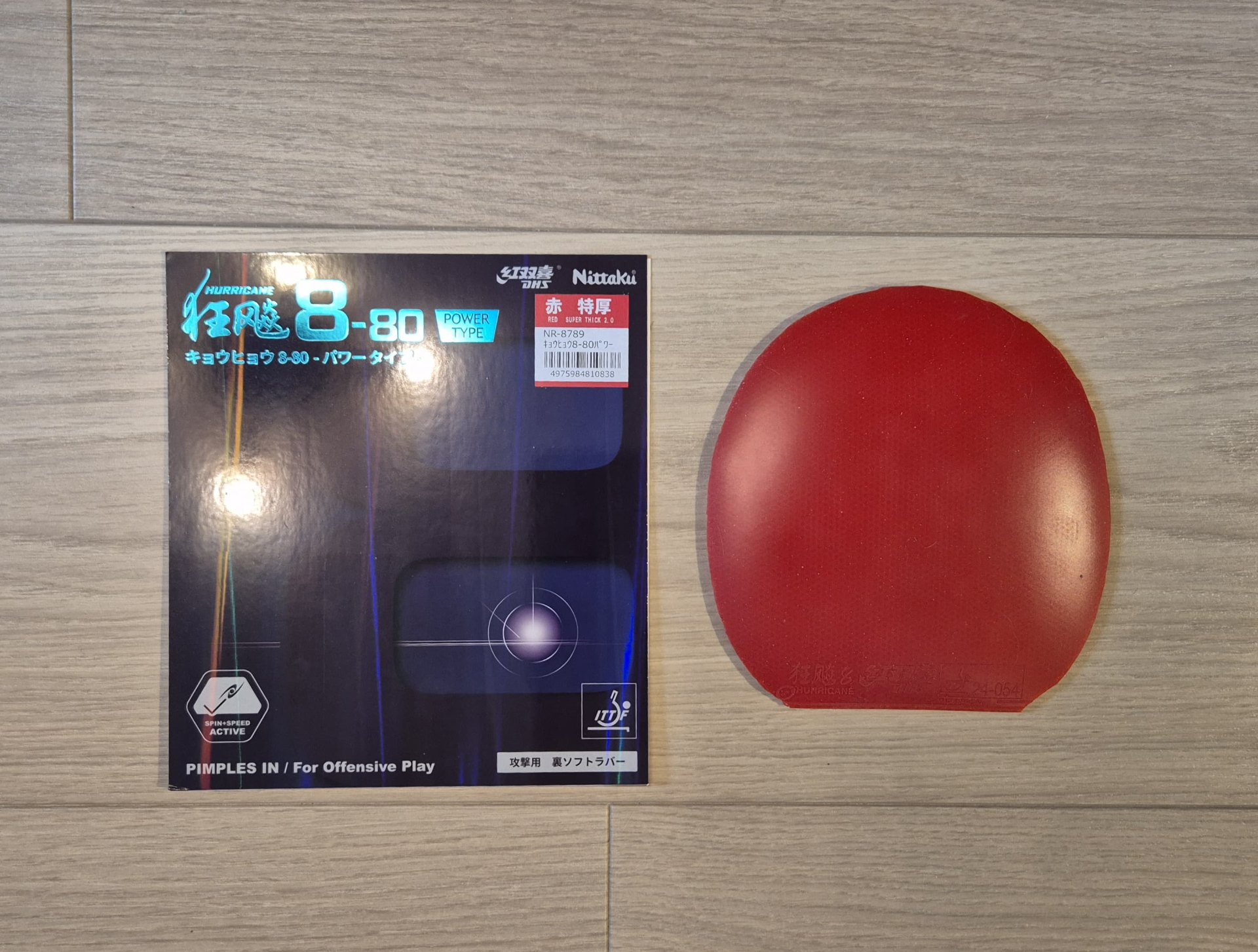
A faster, lower-throwing alternative to DHS 8-80, but is it actually better?
I recently reviewed the DHS Hurricane 8-80, one of my favorite hybrid backhand rubbers of all time and the one I currently use. After that, a lot of you asked me about the Nittaku version, the Hurricane 8-80 Power, and since I had not tried it yet and was too curious to let it go, I decided to get myself a sheet (that came all the way from Tokyo) and try it out.
So, I tested the Nittaku Hurricane 8-80 Power on my backhand for about a month, using it on both my DHS Wang Chuqin blade and a Loki K6. I wanted to see how it would do on a faster premium inner carbon blade and a slower, more controlled and linear 7-ply budget wood.
I have to tell you all, I was super excited and pumped about it. I had high expectations that it would be a higher quality Hurricane 8-80, something with more power and that is easier to activate, but the results were not what I expected: I actually did not enjoy playing with it on my backhand, and during some training sessions it frustrated me quite a bit.
It may be that some of you love this rubber and that it's just not the right tool for my playstyle, but in any case, let me tell you all about it so you are well informed before getting it. I must say that it did have some positive things though, not all was negative, so let's break it down and see what happened!
Nittaku
Hurricane 8-80 Power
The TL;DR
| Category | Nittaku Hurricane 8-80 Power |
|---|---|
| Weight | Heavy, around 53 grams when cut |
| Sponge feeling | Hard-ish Hybrid Chinese sponge, feels a bit harder than DHS 8-80 |
| Spin potential | Very high due to the level of tackiness, slightly less than DHS Hurricane 8-80 |
| Speed & Gears | Noticeably faster than the DHS 8-80 |
| Throw angle | Noticeably lower than the DHS 8-80 |
| Loops | More difficult than with the DHS 8-80, still good at looping |
| Serves | Less spin than the DHS 8-80, still plenty of spin |
| Flicks | Worse for flicks than the DHS 8-80 due to lower throw angle |
| Pushes | Good control and spin, similar to the DHS 8-80, slightly worse |
| Blocks | Decent control, similar to the DHS 8-80, slightly worse |
| Flat hits | Not great, similar to the DHS 8-80 |
| Boosting | I would not boost it |
| Price | Medium-high price, around 40-50€ |
The technicalities
The rubber comes in a premium dark blue shiny package, weighs about 75 grams uncut and 53 cut (heavy, like Rakza Z), and has a nice red sponge that feels different from the DHS 8-80, (Nittaku says it's also different) with a very tacky H8 topsheet. The first time you bounce a ball on the just-glued rubber, it dies very quickly, just like with the normal Hurricane 8s. I got the rubber in red, and I could only choose a thickness of 2.0mm.
The Nittaku Hurricane 8-80 Power in depth
Sponge Feeling
The first thing you will notice when you try the rubber is that the ball has quite a lot more catapult than the DHS 8-80. Besides, I'm getting mixed feelings and confusing information on the sponge hardness. Some people say it's about 50 ESN, some others 47.5 ESN, and my own feeling is that the sponge feels a bit harder than the one of the DHS 8-80. I also must say that this feeling stayed during the whole testing period, it didn't feel much different after breaking in, so this was one of the things I did not enjoy as much. The feeling was more similar to a normal Hurricane 8, which I enjoy on my forehand, but not on my backhand. Funnily enough, this sometimes feels like a forehand rubber more than a backhand rubber.
Speed & Control
Speed is where the rubber delivers on its promise, it's called power for a reason, and you can feel that from the get-go. It is noticeably faster than the DHS 8-80 and the catapult effect is much clearer here. So if you want a faster Hurricane 8-80, then this is that for sure.
However, the cost for more speed is less control, and this is no exception. I had a considerable decrease in control with most of my shots, and I found myself overshooting or netting the ball often as I had to adjust to the low throw angle and stronger sponge tension. On the backhand this was not a fun experience, but when I swapped it to the forehand, it got better, just like a tuned Hurricane 8 really.
So if you are going to try it, remember it is going to feel like an 'agitated' Hurricane 8-80, and you can get a similar feeling if you boost a DHS 8-80. But since I didn't enjoy my experiences boosting it, this was pretty similar to that.
Spin & Grip
This is similar to the DHS 8-80. I did not experience any kind of ball slippage except when I was the one who caused it with poor technique. The tacky topsheet does the job and you get a lot of spin and grip. I do think that the DHS 8-80 has more spin than the Nittaku version, likely because the ball stays shorter on the rubber before shooting out. I will mention this again when I talk about serving. For me it was a small disadvantage as I serve with my backhand quite often.
Throw Angle
This is one of the other big differences compared to the DHS 8-80, the throw angle is very low on the Nittaku version of the rubber. I'm not sure if that's because they tried to have a more Hurricane 8 experience, but for the backhand it was a tough one. On the forehand it is okay, I enjoy low throwing rubbers, even though I prefer the more balanced throw of the Hurricane 3 Neo.
If you are like me, and prefer a high throwing rubber for the backhand, I would not go for this one to be honest. You are better off with Rakza Z, Dignics 09c or the DHS 8-80 if you are looking for a tacky hard hybrid there. Just a reminder here that those rubbers are not easy to use, and you will need your body to hit the ball, not just the arm. If you prefer a more forgiving rubber, stay tuned for upcoming reviews as I will be talking about European hybrids (i.e. Nuzn, Bluegrip, etc) soon.
Loops
Looping with the Nittaku Hurricane 8-80 was more difficult than with the DHS version, simply because you have less dwell and a lower throw to work with. The ball flies off as it touches the rubber and it has a pretty flat trajectory, so it is not easy to land safe loops. Those that you land though, are pretty loaded and powerful, so as always, that's where the tradeoff is. You can also just brush with the topsheet and you get some good results due to the tackiness, but it is more difficult to do this on the Nittaku version. This is not a rubber made for control, it's a rubber made for killing the ball in one loop.
I must say that I prefer the safer loops on my DHS 8-80, and if I wanted more power and kick, I'd go for a Dignics 09c instead because of the higher throw and higher quality overall. For the forehand, I still get more spin and power with the Hurricane 3 Neo, so I'm not sure I'd use this rubber on the forehand either, especially since at its price there are better and cheaper options.
Serves
Serves are not bad with the Nittaku Hurricane 8-80, there is a bit less spin than with the DHS 8-80 but it is not a world of difference. The tacky topsheet still gives you quite nasty serves, and you just have to be a bit more careful with the bouncier sponge, that's all. If you read the other DHS Hurricane 8-80 review, you can pretty much apply what I said there to this review as well, it's a very good rubber for serving in any case.
Flicks
I struggled with my backhand flicks with the Nittaku version of the 8-80, the lower throw and lower dwell made it much harder to flick with safety, and it just felt like it was not a balanced combination in that regard. That was definitely a downgrade compared to the DHS 8-80, where backhand flicks are pretty easy to do, and quite dangerous due to the huge spin (not speed though) on them. On the forehand, I tried a couple times but I was not very successful or comfortable at doing so, so I mostly pushed back aggressively, where the rubber does a much better job.
Pushes
Pushes were almost as good as with the DHS Hurricane 8-80, they had a lot of spin and were very low, lower due to the throw angle of the Nittaku version. I enjoyed those, but I did have to be more careful because of the lower dwell time and throw. If I landed them, they were nasty, but I missed a bit more than before. I guess for the rest, you can pretty much apply the same things I said on the DHS review, it has a bit less control on short pushes but still a lot of spin on aggressive long pushes.
Blocks
Blocking was a bit more difficult on the Nittaku Hurricane 8-80 due to the higher catapult and lower dwell and throw. The ball leaves the blade faster and with a lower trajectory so I needed to adjust to that. It's not bad by any means, you can still do a lot of 'dead' blocks when you absorb the incoming shot's energy, but if the opponent gave me a heavy loop, I had to be a bit more careful. I'd say that I enjoy the DHS 8-80 more, but it's a matter of preference because many other highly tensioned rubbers are still more difficult to block than this one.
Flat hits
I don't think the Nittaku Hurricane 8-80 is made for flat hitting, it's a rubber made for looping, and you can clearly notice that. So all I can say is that if you play a lot of flat hits/counters, then this will likely not be your rubber of choice, just the same as with the DHS version.
Boosting
I would definitely not boost this rubber, it already has a low enough dwell time, so if you tension it more, it may become impossible to play. Yes, you may gain more speed, but you don't really need it and I doubt you will get the desired result because the balance will be very hard to manage. If you want more speed, I'd recommend getting a different rubber.
Price
This is definitely a more expensive rubber than the DHS 8-80. You do get more quality and better consistency than with the DHS one, I'm sure, but for the price it has in Europe (50€), I don't think it is worth it given how it plays and what it does. If I want a cheaper and more controlled hybrid rubber, I'd always choose the DHS Hurricane 8-80, and if I want a more premium and faster one, I'd rather choose Nuzn or Bluegrip instead. For the forehand, if I wanted an easier to activate Hurricane, I'd just boost my normal Hurricane 3 Neo or take any of the hybrids I just mentioned.
So who is this rubber for?
To be really honest with you guys, I really don't know who this rubber is for. I don't understand what Nittaku has tried to achieve here, and even though I can appreciate the quality of the sponge and the extra power in it, the way it plays for the price it has makes me a bit confused. I guess that I can only see one target audience for this, and that would be the people who really love the DHS Hurricane 8 (likely on the forehand) and want a softer but still powerful, lower-throwing rubber.
And who may not enjoy the rubber?
If you like the DHS Hurricane 8-80 for the characteristics that it has (and that I mentioned above), you will not like the Nittaku version (neither did I). You will not like it either if you prefer tensor or slightly hybrid rubbers. Lastly, you will also likely prefer the Hurricane 3 Neo on your forehand if you enjoy traditional Chinese rubbers there.
Final thoughts
When I first saw the Nittaku Hurricane 8-80 Power package, I was excited and very much looking forward to it, I even thought, maybe this is going to be my new backhand rubber!
However, after testing it, I was pretty disappointed and a bit frustrated after losing a lot more than before. I don't think this is a good backhand rubber, and I struggle to understand why I would choose this rubber over the Hurricane 3 Neo on the forehand.
So as I said above, I'm not sure what the point of this rubber is, but hey, maybe you have a completely different experience than I have, and that is fine, table tennis is a sport full of nuances and subjective preferences!
That was my review of the Nittaku Hurricane 8-80 Power, until my next review, and see you at the table!
Need personalized equipment advice?
I can help you find the perfect blade and rubber setup for your playing style.