Donic BlueGrip S2 Review: A Control-First Learning Hybrid Rubber
How does the Donic BlueGrip S2 actually play? Can developing players benefit from its strong 2-gear behaviour? And does it sacrifice too much speed for control and consistency?
After the in-depth reviews of the Andro NUZN 45 and 48, I'm excited to come back to the world of hybrid rubbers and I'm starting a new review cycle on the Donic BlueGrip S and BlueGrip C Series, where I will be talking about the BlueGrip S2, S1 and C2. I do plan to review the new BlueGrip J series at some point, so stay tuned for that!
The reason why I continue talking about hybrid rubbers is actually twofold: I really enjoy tacky rubbers as a personal preference and at the same time, I think they are the future of modern table tennis due to their flexibility and high amount of gears. I recently commented on r/tabletennis about this.
Besides that, I also find it really interesting that within the world of hybrid rubbers, there are so many different flavours: tensor hybrids (like Andro NUZN or Tibhar MK), Chinese hybrids (like DHS Hurricane 8-80), pure hybrids (like Yasaka Rakza Z or Butterfly Dignics 09c). This just once again shows how complex the world of table tennis equipment is and how important it is to take into account the player's background to recommend one or the other rubber.
But anyways, that's a long enough intro for today, so let's get started with the BlueGrip S2 and talk about its characteristics in depth!

Donic
BlueGrip S2
The TL;DR
| Category | Donic BlueGrip S2 |
|---|---|
| Weight | Medium-ish, it's ~67g uncut and 47g cut to my Appelgren blade |
| Sponge & Topsheet | Soft sponge with a slightly tacky topsheet |
| Spin potential | Medium-highish when engaged properly |
| Speed & Gears | 2 gears, very slow on passive play, medium-fast when engaged |
| Throw angle | Medium-highish throw angle, noticeably short flight |
| Drives & Loops | Good for learning technique correctly, not remarkable |
| Serves | Decent spin, less than with NUZN 45 |
| Flicks | Not the easiest, harder than with other learning rubbers |
| Pushes | Good control, topsheet dampens bounce on the low gear |
| Blocks | Prefers active blocking than passive dead blocks |
| Flat hits | Good, it rewards thicker contact |
| Boosting | No need to boost it, sponge is soft and it's a learning rubber |
| Price & Durability | Average for ESN rubbers, usually between 40-50€ |
The technicalities
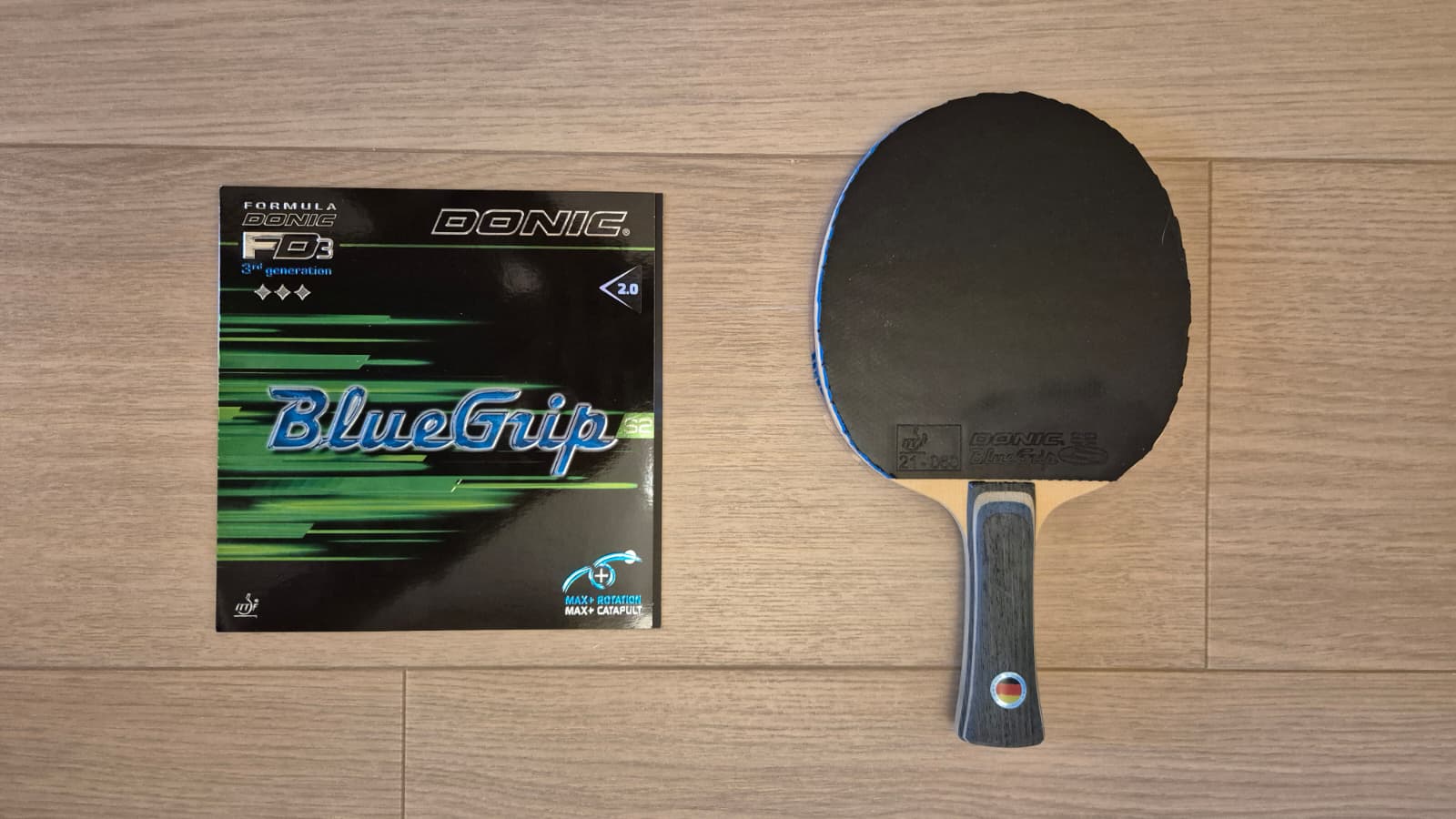
The Donic BlueGrip S2 comes in a nice black and green package, weighs about 67 grams uncut and around 47g cut to my Donic Appelgren World Champion 89. The sponge is light blue and it's the same as the ACUDA S2 sponge while the topsheet is harder and slightly tacky. The initial tack will fade away after the first few play sessions but it will still keep some minimal tack after a month of playing with it if well protected (I always clean all my rubbers with a TT sponge and water, plus a rubber protector once dried). To give you an idea of its tackiness, think a tiny bit tackier than the Andro NUZN/Tibhar MK rubbers, but just by a little bit.
Donic positions this rubber as a controlled and safe rubber to develop your technique, and I can agree to that. I think this is a learning rubber and I would not recommend it to the more advanced players, so I would probably place it between low-intermediate and intermediate, but in certain scenarios, a beginner could benefit from it as well. Definitely not high intermediates or further.
How I tested the Donic BlueGrip S2
I wanted to do something a little different this time, just because I have a wonderful blade at home that I don't use anymore (the handle is not for me), the Donic Appelgren World Champion 89. It's a soft inner 'carbon' (zylon + some carbon actually) blade, and it's got a really great feeling to it plus a lot of control, so I thought, why not try Donic rubbers on my Donic blade?!
And do not fear, I still tested the BlueGrip S2 on my DHS Fang Bo B2X later on, but I can tell you that it was not a success. The hard, direct and stiff nature of the B2X accentuated the strong 2-gear nature of the rubber plus it had this fast car/slow tyres feeling to it that I didn't like (and lost me a good bunch of rallies where I lacked power and ended up forcing my technique to overcompensate). So for this review, I will focus on the feeling of the BlueGrip S2 with the Appelgren WR 89 blade, where it was actually pretty all right and a nice rubber to test for about a month during training and matches.
Lastly, I exclusively tested the BlueGrip S2 on my backhand, as it is way too soft for my forehand (it bottoms out easily on the forehand with the DHS B2X). I'm sure that there will be players that like playing it on the forehand if they are used to very soft rubbers overall, but I would not recommend it as a forehand rubber based on my preferences and equipment philosophy (I like hard and tacky forehands).
The Donic BlueGrip S2 in depth
Sponge & Topsheet Feeling
Since the sponge is the same as the Donic Acuda S2, it is pretty soft and it also feels very soft, you can easily compress it with your hand and fingers, so nothing new in that regard, just a normal soft ESN bouncy cake sponge. The topsheet however, feels clearly harder in comparison to the sponge (plus it has this slight tack to it), and this will also feel this way when playing.
The combination of these two factors creates an interesting gears situation that I will describe in depth in the next section, but for now, let's just say that the rubber feels pretty soft and has a decent amount of catapult/bounce when activated and it's a bit dead and hard when playing passively and slowly.
Speed & Control
The Donic BlueGrip S2 has a particular and interesting behaviour that I would describe as a '2-geared' approach. The best way that I can explain this is by saying that you sometimes feel like the rubber is 'choking' (Donic and other people call it 'dampening') the ball on impact. I had seen this description in the Table Tennis Daily forums somewhere in the past and it kind of stuck with me as it was a nice way of describing the feeling. After testing it I can tell you that this is indeed true, and this is also how I felt about the BlueGrip S2.
And yes, dampening or choking the ball is also what other hybrids and tacky rubbers do, nothing new there, but with the Donic BlueGrip S2, this feeling is particularly intense. When you do nothing and play it very passively, the ball falls into the net more often than not, and you are left wondering what happened. This is especially apparent during passive blocks and very thinly brushed loops. By the way, some people may also call this slippage / grip issues, which is similar to what happens in practice, but I never experienced any sort of slippage issues when I engaged the sponge correctly.
And I say the above because when you truly hit into the sponge with the correct technique, the catapult effect kicks in, and you get a very safe and short flight that almost always lands the ball on the table. It is not the fastest of the shots, and not the spinniest of the balls, but it's still pretty good quality for a learning rubber and gives you a good hand feeling.
I think the summary of this section is pretty obvious. The Donic BlueGrip S2 is a rubber made for control and to teach players how to activate the sponge correctly with a very similar hit-brush technique that is also required to activate traditional hard and tacky Chinese sponges. If you do this, it will be very easy to control and land decent shots on the table, but if you fail to do so, it will punish you a bit more than you would expect for a learning rubber, so that's the tradeoff right there.
Spin & Grip
Spin is always very important for me, as I value spin more than I value speed and raw power. I think that when you are under pressure in a 9-9 game, you realise how important having good spin is.
Anyways, with the BlueGrip S2 I expected a rubber that was mostly spin oriented, and I can say that this is correct. You do not get as much spin as with the Andro NUZNs or with the Rakza Z or with the normal Hurricanes, but the spin generation is not bad at all for a learning rubber.
As I said above, you do need to engage the sponge and hit into the rubber a bit more than you may be used to, but if you do so, results will be good. So don't expect easy brushing and perfect easy shots, this is not the rubber for it. Easy brushing will also not grip the ball as well as a Glayzer/Dignics 09c or Hurricane H3N/8-80 may, so you do need to commit to your shots to get the spin and grip. This is something that some people will value as it teaches the correct technique, but others will not, and they will think it's not a good rubber. Both can be right in essence, BlueGrip S2 teaches good technique, but does not get you points for free or in an easy manner. This is why I call it a control-first learning rubber.
But that aside, spin generation was good in loops and also in counterloops, and you can land a lot of those on the table. Opening loops against backspin are also pretty easy and safe, although they will not win you the point directly. Last thing to mention here is that BlueGrip S1 is a bit easier to loop and counterloop than S2, I will mention more of that in my next blog post.
Throw Angle
The throw angle of the BlueGrip S2 is medium-highish, it's similar to the NUZN 45 I'd say, maybe with some small differences, but not that far from each other. Throw angle depends on your shot, gear and technique, so do remember that, my DHS Fang Bo B2X is not particularly high throwing so you may experience a bigger throw than I do.
For sure with the Donic Appelgren WC 89 the throw was a bit higher, so that shows that different gear will change the throw significantly. Overall and in any case, I'd say that the BlueGrip S2 is not a low throwing rubber, but also not a really high throwing rubber like Dignics 09c, so it's a bit in the middle with a touch of high throw, just fine for the backhand.
One very characteristic thing of the BlueGrip S2 and definitely worth noting here, is that it has a very short flight, or in other words, the loops land just after the net, and not very far at the opponent's table. This of course means that the rubber is very safe and controlled, but it also means that those shots have less danger and power than you may like. This makes sense for this rubber but do take it into account. I wanted to mention it because it's one of the rubbers where I have felt this the most!
Drives & Loops
Drives and loops are nice and easy with the BlueGrip S2 as long as you are active and committed to the shots. If you doubt a bit and not finish your stroke or if you very lightly brush the ball without conviction, it may not go over the net, you need to give it the extra forward push and momentum so the catapult activates and then it's all good. This is the same topic I discussed above and it can be seen as both a positive and negative thing, depending on how you look at it. I want to believe it is a good rubber for learning technique so I will see it from a positive perspective.
In any case, opening loops against backspin are very easy and safe, you get a lot of spin on those for such a controlled rubber so the opponent will have to watch out if they are not very experienced or developed yet. Normal topspin shots and attacking loops close to the table are also nice and controlled, almost always landing on the table but not being particularly dangerous. Further from the table though, you will start experiencing issues getting the ball over the net, as the lack of catapult and the softness of the rubber will make this challenging.
Dwell time is plenty but less than things like Glayzer 09c for example, but higher than the NUZN 45 for sure, which is nice when you are learning how to feel the ball and the shot.
And to finish this section, counterloops are not easy but also not hard. The rubber has a certain amount of catapult built in (due to the Acuda sponge) so if you add some of your own power, it's possible to do safe and short counterloops. I much prefer BlueGrip S1 for this but they are not bad for a learning oriented rubber.
Serves
Serves are just what I would expect from a control-first rubber with a fair amount of dampening. Short serves sometimes go into the net because you need to put a bit more from your side, but once you get used to that, it's all good. Spin generation is not bad at all on those, and sometimes the opponent would put my heavy backspin on the net, so I was surprised about that since I expected less spin from a safety rubber. The ball also didn't pop out, so that was a nice extra. I do think that NUZN has a bit more spin here though, but those serves are a little bit harder to keep low and short.
Long serves are also quite nice and the catapult is not too present, sometimes I did over hit a bit when I was trying to get the ball over the net but once I adjusted it was fine. Spin was again pretty good, it is better on BlueGrip S1 but not bad for a slow and controlled rubber.
Flicks
Backhand flicks took me a bit more effort than I would have liked, and they were not as easy to execute as with other rubbers that have a better grip on thin balls, so I could execute flicks less safely than with the DHS Hurricane 8-80, Rakza Z, NUZN or Glayzer/Dignics 09c.
The way that the rubber works encourages a thicker contact, but this is not always a good idea for backhand flicks, where I prefer a thinner and safer contact on backspin returns under pressure, so this was a minus point in my opinion. For dead and topspin serves, this was less of an issue and I could hit those through with much more ease.
Pushes
Short pushes were pretty nice with the BlueGrip S2 due to the good dampening on the incoming ball, and I could drop those quite short on the other side of the net without too much effort. I actually really enjoyed those drop shots, as it's one of my main shots when the occasion arises, so that was a plus point!
Long pushes were also nice and low, but I sometimes needed to adjust the angle a bit. The catapult doesn't activate too early and even when it does, it is not too much, so it was not really a problem as it happens with other more tensor-like hybrids. Spin was good and I could do some aggressive long pushes. They were not direct points as the spin is not that intense but they did force the opponent into a less comfortable opening loop.
Blocks
I'm not a master blocker, but blocks were nice and easy once I adjusted to the 2-gear behaviour of the rubber. Having tested the NUZN 45 and playing other faster rubbers myself, the BlueGrip S2 took me some minutes to adjust to, as my normal 'dead' blocks that I often do to change the pace of the rally would fall into the net, and they left me wondering what happened there.
BlueGrip S2 is not a rubber that has much catapult or tempo built in, so you need to be active in your blocks, and lead the ball where you want it to be. I think this is a good thing to learn and in that regard I enjoyed doing it more often, and using the defense a bit more often than the attack. Once I got the hang of the rubber (took me 10 minutes or so) then it was all good, blocks were very safe and I was also in position to do a mini counterloop on the blocks, which was also satisfactory.
So I'd say that it is a good blocking rubber, but you need to be active when blocking and understand how it works and what it needs, then it's no problem!
Flat hits and counterhits
Because the BlueGrip series rewards a thicker contact rather than a thinner one, I found myself hitting a bit more on my backhand, which was very fun and satisfactory. The rubber catapult would activate and I could do really nice counterhits on incoming topspin loops, which sometimes left my opponent surprised and wondering where that came from, so that was certainly a good thing.
I will discuss this section more in depth with the BlueGrip S1 in my next blog post but the BlueGrip S2 can also do nice counterhits, they are just a bit less loaded, land shorter on the table and require a bit more commitment to them, but they can also be very tricky to return for the opponent, especially on a faster blade.
Boosting
I will keep this section short for today, and just say that I see absolutely no reason to boost the BlueGrip S2. It's a rubber made for learning and the main key characteristic of it is control. That linked to an already pretty soft rubber, makes it so that boosting would likely ruin what the rubber is made for, so don't boost it.
Price & Durability
Without any discounts, the price of the BlueGrip S2 is around 40€ to 50€ although I have seen some offers in different shops (including our club sponsor Table Tennis Store eu) so you may be able to get it for less. This means it is not an expensive rubber and it falls into the normal ESN category. It is not as cheap as most of the Chinese rubbers but it also doesn't cost you as much as the more higher end rubbers.
When it comes to the matter of durability (as it is an issue for many ESN hybrid tensors), I do think that the Andro NUZNs feel a tiny bit fresher after the 1 month period. It is not a world of difference but some players have reported that you may want to change rubbers after 4-5 months. In my case, I always clean the rubbers after each play session with water and a TT sponge plus I put a rubber cover on it, so I hope I can keep them fresh for a bit longer.
In any case, the durability is not bad in my opinion, there are way worse rubbers, but it probably is not as durable as a Hurricane or as the NUZN, where you can have around 6 months of good performance. More to come on this as I keep playing with them for a couple other weeks to see how it goes, but for the price you pay, it's not a bad deal.
So who is this rubber for?
I'd say that the Donic BlueGrip S2 is a entry-level hybrid rubber for those who are developing their technique and learning how to use hybrid rubbers, so I'd say that you will like it if:
1. You are a developing player (low-intermediate to intermediate) and want to use a slower and more controlled hybrid rubber to learn the correct backhand technique.
2. You are a developing player and want to step up your game from your initial slow and controlled rubbers to something a little bit more dynamic but with a clear focus on control and safety.
3. You are a high intermediate player with wrong backhand habits and want to significantly step down in speed to force you to go back to basics (and you don't mind the temporary frustration). Be careful though, you may like BlueGrip S1 (or other rubbers) more depending on your blade and level, more on this with the next review.
And who may not enjoy the rubber?
This category is pretty clear for me: If you are a high intermediate (or above) and you have a decent technique on both wings but particularly on the backhand, do not choose this rubber as it will make you lose games.
If you are particularly interested in the BlueGrip series due to their key characteristics (shot dampening, slight tack, good catapult when activated, many gears, Donic feel, etc) then stay tuned for the upcoming BlueGrip S1 and C2 reviews, as I think you will find those much more suitable for your needs!
Final thoughts
I'd say that the Donic BlueGrip S2 is an interesting rubber as it sits in a particular spot in the hybrid category: it tries to get closer to a Chinese hybrid while keeping the Donic ESN vibes. And it does this while staying very controlled and significantly slower than other ESN hybrids, so I suspect that this will be a rubber to try out if you gave it a go to slow Chinese hybrids (the Loki Rxton 5 comes to mind first somehow) but couldn't find yourself in it because maybe it was too hard, or too difficult to play, or too dead, or just not your taste.
Regardless of that, I think Donic has created a controlled and very safe/slow hybrid that will force you to learn the right technique in order to use it and develop your technique. Whether this is a good or bad thing, I'd leave that to you all to decide, I think it can be both depending on your perspective ;)
That was my review of the Donic BlueGrip S2, until my next review, and see you at the table!
Need personalized equipment advice?
I can help you find the perfect blade and rubber setup for your playing style.