GEWO Iconixx 55 & 50 Review: Durability Issues Undermine a Promising Rakza Z EH Alternative and Softer Rakza Z Option
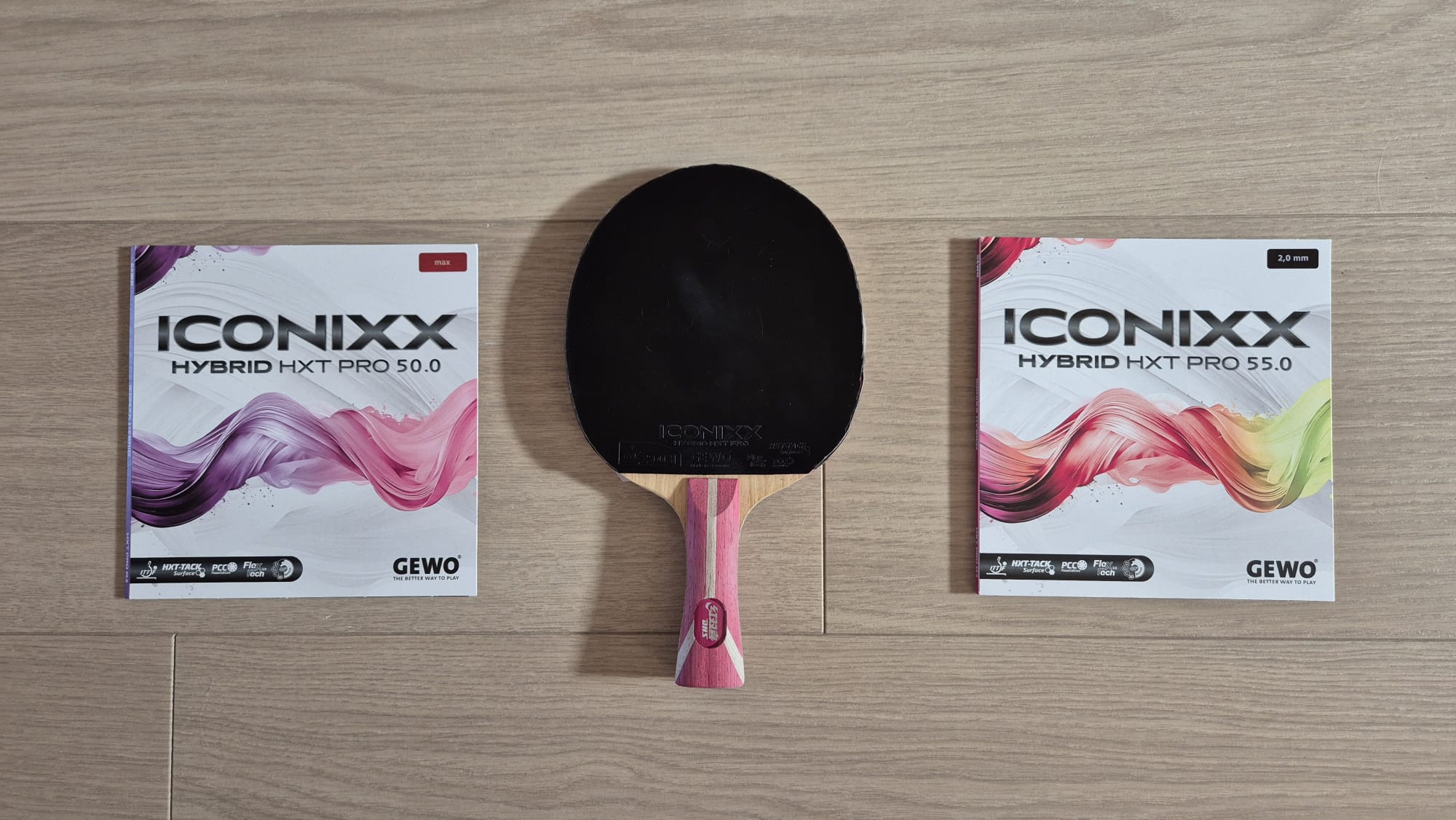
How do GEWO's new Iconixx hybrid rubbers compare to the very close competitor Rakza Z? After testing the Iconixx 55 and 50 for five weeks, I tell you all about them, and how unfortunately, durability has become a major concern for these rubbers, so read this review before you buy.
Autumn is coming, the competition season is starting again, and new rubbers keep entering the fast-growing hybrid market. It's crazy how rapidly hybrids are spreading, and now that almost every brand has their own hybrid flavour, I couldn't resist and test the new Gewo Iconixx 55 and 50.
Gewo is a somewhat unfamiliar brand for me, I have tested the Nexxus EL Pro Super Select a couple times as some of our best players use it for a while (and one of the national Dutch champions as well, great guy by the way), and I've also tested some of their beginner frames, but that's about that. Since I'm a curious guy, and I don't ever want to restrict myself to a specific brand, this was a perfect chance to test their new stuff.
So I asked my great friends from Sport Europe - TableTennisStore.eu to send me one 2.0 sheet of the Iconixx 55 and a MAX sheet of the Iconixx 50 to give them a spin (pun intended) and tell you all how they are. And a big thanks of course to them for that, they are a great partner and you all still get the 25% off from them :)
The super short summary of this review is that things started really promising: the Iconixx 55 behaves pretty similarly to a Rakza Z Extra Hard but with more high end power (a bit abrupt though, more on that later) and that the Iconixx 50 is a softer Rakza Z which I was very excited for. However, after 5 weeks of hard testing (almost played with them exclusively) the Iconixx 55 gave up in the middle of my forehand, and that has led to significant slippage. The 50 is starting to experience the same issues, so that was very disappointing and meant it's not a one-off production defect. I was genuinely enjoying the first weeks of the testing period, and I also really liked the softer Rakza Z approach, but durability is for me non-negotiable, most of us are not rich, so buying 2 rubbers per season is not an option.
So with that summary in hand, let me tell you all the good and the bad in detail below! Because if money is not an issue for you, and you are focused on short term performance, perhaps one or both of these rubbers will fit you.
Side Note: There are also softer versions of this rubber, 48 and 45, but I have not tested those. It's to be expected (logically and looking at the Gewo ratings) that those are more balanced and controlled versions of the rubber, aimed at making the rubbers easier to use.

Gewo
Iconixx Hybrid HXT Pro 55.0
Gewo
Iconixx Hybrid HXT Pro 50.0
The TL;DR: Gewo Iconixx 55 and 50
| Category | Iconixx 55 | Iconixx 50 |
|---|---|---|
| Weight | Heavy, 53g cut to the B2X, similar to the Rakza Z Extra Hard | Heavy, 51.5 grams cut to the B2X, just a tiny bit lighter than Rakza Z |
| Sponge & Topsheet | Hard 55 sponge (feels softer and livelier) with a medium-low tacky topsheet | Medium-hard 50 sponge (feels softer and livelier) with a medium-low tacky topsheet |
| Spin potential | Lots of spin on all shots, plenty enough for amateurs, grip issues appeared after 5 weeks of testing | A lot of spin on all shots but slightly less than the 55, great grip initially too but same issues expected |
| Speed & Gears | High gears but not unlimited, starts controlled, explodes a bit abruptly | Bit less gears but high enough for amateurs, more focused on control |
| Throw angle | High-ish throw angle, long flight and good post-bounce kick | Higher throw angle than the 55, shorter flight and safer trajectory |
| Drives & Loops | A lot of power but demanding to handle, requires correct technique with thicker contact and body usage | A bit less power and more control, tolerates wrong technique better and it's easier to handle |
| Serves | Great spin, similar or possibly higher than Rakza Z EH | Very good spin, a bit more than Rakza Z I think |
| Flicks | Less good flicks than Joola Charged or Rakza Z | Easy and safe backhand flicks, but less power than Joola Dynamic |
| Pushes | Pretty good control, rubber is fairly linear at low gears | Even more control, so easier to push short and long with aggression |
| Blocks | Very good blocking and relatively easy to control the catapult effect | Also very easy passive and active blocking, even safer, I liked it |
| Flat hits | Not good, catapult at high impact activates very quickly, easy to miss | Not bad at all for a 50 rubber, I enjoyed great flat-ish counters |
| Boosting | I would not boost it, some of you may boost it to soften the 55 sponge, but control will suffer | I would not boost it either, it's already lively, go for the 48 if you want softer |
| Price & Durability | Premium rubber segment without discounts, price-wise not worth it due to durability issues | Premium rubber segment without discounts, price-wise not worth it due to durability issues |
The technicalities
I got the Iconixx 55 in 2.0 and the Iconixx 50 in MAX, and they came in a nice modern white package with paint colours merging into each other, very beautiful box design, one of the best I've seen recently. The 55 weighed 74g grams uncut and 53 grams cut to my DHS Fang Bo B2X, and the 50 weighed 71g grams uncut and 51.5 grams cut to the same blade. So both are heavy rubbers, the 55 being similar to what a Rakza Z Extra Hard would be and the 50 being just a tiny bit lighter than a normal Rakza Z, nothing crazy though if you are already playing with pure hybrids, but still worth noting because tensors are always considerably lighter.
And talking about the Rakza Z, I need to mention it here in particular, because the first thing I noticed when I took the Iconixx 50 out of the package was how much of a Rakza Z it is. Same hard and sticky plastic protector, same inwards built-in tension when you take that off, a really similar sponge, and even the same sponge colour. The tackiness is a bit less than a Rakza Z in the beginning (later it becomes stickier) but not much less, and it is still quite tacky for a hybrid, so the short version of it is that the Iconixx 50 is a soft Rakza Z, and it also plays very similarly!
The Iconixx 55 goes the other way and reminds me of the Rakza Z Extra Hard, which by the way I have never played with for months, only for a couple weeks and it was a while ago. Anyways, the sponge is clearly harder, it is pink (cool!), and it is still a bit cakey-ish but with way less inwards built-in tension than the 50, but it comes with the same thick sticky protector on top of it. So yeah, same in many ways, different in their philosophy, the 55 being a clear forehand rubber, the 50 being more versatile, it can really be both, it depends on the player.
Lastly for this section, Gewo positions the Iconixx 55 as a rubber for pro players and the Iconixx 50 for advanced players, and I agree with them. The 55 is definitely from advanced onwards, no doubt there, same as the Joola Charged really. For the 50 though, I would say that a high intermediate with a decent technique can be fine with it, because it is less demanding than its bigger brother. Both of them also feel and play softer than what the package says, and I think this is why the box itself also has a range, not a definitive number. I liked that cool detail there from Gewo, hadn't seen it in others before.
How I tested the Gewo Iconixx 55 and 50
I kept the test simple this time, same blade as always, the DHS Fang Bo B2X (89g this one), with the Iconixx 55 in 2.0 on the forehand and the Iconixx 50 in MAX on the backhand. That made sense to me and I guess is also what Gewo intended when they made these rubbers, plus it is also how I suspect most people will use them (same as Joola Charged and Dynamic).
The testing period was five weeks in total: the first three weeks I played with them while occasionally mixing with the Joolas, and the other 2 weeks exclusively, except the last testing day when I compared the Joolas, Rakza Z and the Gewos all in one session. All of that during normal training and matches, as always.
The Gewo Iconixx 55 and 50 in depth
Sponge & Topsheet Feeling
The first thing I realised is that the Iconixx 55 feels like a Rakza Z Extra Hard but a bit more explosive, and that the Iconixx 50 feels like a soft Rakza Z, with also a bit more kick than a possible Rakza Z soft (it doesn't exist, but I can visualize it :D). If you have played with any of them, you can pretty much have a good idea of what you are getting.
So as I said before, both rubbers feel a bit softer than the 55 and the 50 degrees on the package, and this is specially the case with the 50, which plays clearly softer than a 50 degree sponge normally does, maybe like a 48 would. The 55 feels properly hard in the hand, no doubt about that, but it is not a 55 dead brick like an unboosted Chinese tacky rubber, it has a liveliness to it that you notice from the first shots.
About the topsheet, they are both quite tacky for a hybrid, less than a Rakza Z but not too far from that, and the grip you initially get is very good. However, and as with many other hybrids (unfortunately for us all), I have the feeling that this extra tackiness must come at a price, and only two weeks after I could already see the forehand topsheet degrading in the middle. At that moment I had not lost any grip yet, so I noted it down and kept playing. I thought maybe it is just a cosmetic thing (other rubbers have this and it's fine), but I will come back to this in the durability section because it did not end up well, sadly.
Speed & Control
Let's start with the Iconixx 55, it is a pretty fast rubber but not in the way that the Donic BlueGrip C2 was for example, where the catapult was there intensely from the mid gear onwards. With the 55, the low/medium gear is slowish and controlled (still a notch faster than a Rakza Z though), but the high gear deserves its own section here, because it's something a bit different of what you would expect from a 'Rakza-like' rubber (read: I expected linearity but that was not the case).
The thing is, that Rakza Z is quite linear in its behaviour, it has a lot of gears, but you need to put the effort into it to get to its highest power. It's of course not so good if your condition is not the best, and I guess that this is something that Gewo took note of, and tried to fix with the Iconixx. But for me, it's a bit too abrupt. When you apply a decent amount of force to it, it explodes quickly and without too much dwell time, it goes like calm, calm-ish, boom. This is also the reason why in the rubber database I say that it has fewer gears than you would expect. The Charged for example has more dwell and more gears, and the Rakza Z also has more of both. So in practice, the Iconixx 55 behaves like a hybrid on the low and medium gears and like a fast tensor on the high gear, whereas the Charged and the Rakza Z kept more linearity all the way through. I will tell you later what this did to my forehand in the loops section, but it is worth mentioning it here already.
On the other hand, the Iconixx 50 is slower and safer overall, and it has a similar amount of gears, but please do not underestimate it, if you hit it properly on the backhand, it still is a cannon, and I have made many down-the-line points like this, with the opponents being pretty surprised by those. The good thing is that the power on the Iconixx 50 only really happens on the high gear, while the slow and medium gears stay quite controlled, which is exactly why I think a high intermediate can handle the 50, and what made me excited about the rubber, I thought, maybe it's my new backhand rubber!
And for those of you who like the Dignics 09c, the Iconixx 55 is in a way similar to it, mostly because the Rakza Z is also similar to the Dignics 09c, so think of a Dignics 09c with a lower throw, less top end speed, and easier to activate overall, but with less catapult at the very top.
Spin & Grip
There is a lot of spin in both rubbers, so no complaints from my side here, but I would place them a bit below the Joola Trinitys and the Dignics 09c. Compared to the Rakza Z, I would say they are similar but probably just a bit more spin on both the Iconixxs, so we are talking about very spinny rubbers in any case, and definitely plenty of spin for the normal amateurs like us.
Because they are pretty tacky (at least while it lasts), the short and touch game was not a problem, and to a certain extent I could just use the rubbers as if they were Chinese rubbers, they really worked great on the low gears.
But yeah, then you come to the grip, and the truth is that I had no slippage at all during the first weeks of the testing period, even in humid conditions, so that made me really excited. However, we went downhill in the last weeks of the testing, so please do read the durability section before you get too excited about the initial grip feeling. I'm saying this because one of our club players got very excited by testing my blade and bought the Iconixx too. He's been using them now for 3 weeks and says it's all good (has been winning more than before), so that's of course a great thing, but I had to disappoint him a little bit today. I do hope he will be able to use them both a bit longer, fingers crossed :)
Throw Angle
Now talking about the throw angle of both rubbers, the one of the Iconixx 55 is high-ish, I'd say higher than the Joola Trinity Charged, pretty similar to the Rakza Z Extra Hard (maybe a bit higher? Hard to say), but for sure lower than a normal Rakza Z. That makes it a good option for the forehand, and it felt comfortable on my B2X from the beginning.
The tricky part is not the throw itself but what happens when you combine it with the speed at high impact. Just like with the Joola Charged, a good amount of my shots ended up going long, and against heavy backspin quite a few went into the net (or long too), because the flight is long and this is a rubber built for power and not for safety. That is also why I fully agree with Gewo that this is an advanced rubber. So yeah, it's a tricky rubber for us amateurs to get all shots on the table, the kind in the category of high risk and high reward.
The Iconixx 50 on the other hand throws higher, I would say a Rakza Z give or take, and the flight is shorter, more of a medium-long, so it's clearly a safer rubber. It is also safer than the Joola Trinity Dynamic and it somehow has a bit more catapult than a Rakza Z, which is a nice combination to have on the backhand.
For the forehand, and to be completely honest with you, I still feel much safer with the throw angle of the Rakza Z than with the Iconixx 55, so I hope this gives you an idea more or less of how the throw is for normal amateurs. I also felt a bit safer with the Joola Charged, but that's because it felt a bit more Chinese to me, a bit less explosion and more Hurricane-like feel.
Drives & Loops
Continuing with the drives, there is not much to tell you that is different from the Joolas or from the other hybrids in this category. At medium speed both rubbers are very solid and stable, and almost all balls land on the table if your technique is right. Nothing exciting, and I mean that in a good way: the throw, the grip and the catapult do the work for you and you can warm up for fifteen minutes without thinking too much about your equipment.
Loops however, that's where the two rubbers differ. With the Iconixx 55, normal topspin loops are harder to put on the table, and I found myself having to aim at the table somehow (this felt weird to me, didn't have it with other rubbers before), but with the Iconixx 50 I could control the ball much easier at higher speeds. That said, finishing a point with a power loop is no problem at all with either of them, so no worries there.
Against heavy backspin the Iconixx 55 got difficult for me. It is tough in the same way that the Joola Charged was tough, but somehow I felt more confident with the grip and safety of the Charged (and for sure the Rakza Z), which is a bit weird because in theory it should be the other way around, but this is my honest feeling after five weeks with them, it is what it is. I clearly missed more openings with the Iconixx 55, and I also made many more unforced forehand errors when trying to finish the point, and remember that this was with the 2.0 version, which should already be the safer choice. I couldn't really figure out why, and now I think that it should be what I mentioned in the speed section: the lower dwell and that abrupt catapult do not give you a lot of safety margin, so it's even more all or nothing than others.
The Iconixx 50 is a different story against heavy backspin, it is much easier to open the rally with it, very much like the Joola Dynamic in that regard, and it is very confidence-inducing. You still need to commit to the shot for sure, but sometimes half a shot is fine and the ball still lands, whereas with the Iconixx 55 you almost never get away with half a shot.
And to close this section, counterloops are easy-ish with both of them. With the Iconixx 50 they are pretty easy, you just hit on top of the ball and towards the table and there it goes most of the time. With the Iconixx 55 they are also relatively easy for an advanced rubber but significantly more spin and speed sensitive, so you have to be more precise or the ball flies away fast.
Serves
Serves are very good with both rubbers and I have gotten a lot of free points with them, which is always the nicest kind of point in my opinion ;)
For the short serves, the best way I can describe it is to think of the Rakza Z on the low gear but with even more spin on it, because that is pretty much what you get. It has less spin than a Dignics 09c but not that far off, both are better than the Joola Trinity Charged for sure, and with the Iconixx 50 I would even say it is perhaps a bit better than the Joola Dynamic.
Long serves are also very good and there is plenty of spin on those as well, and even though they have less tempo than the Joolas, they were still very dangerous for my opponents.
So overall, keeping the ball short (and dead when needed) and low is easy, long and low is easy, and long and dead is easy too, so there is really not much to complain about in this section, I was happy with the serves on both the Iconixx 55 and the Iconixx 50.
Flicks
Forehand flicks with the Iconixx 55 were not very easy, and for sure less easy than with the Joola Charged, while I have to say I expected the opposite. More of them went long, and I had less of a control feeling on the contact, so it gave me a bit less confidence when I had to flick under pressure, defaulting more to a wide forehand short push or a long down the line aggressive push. My forehand flick is not the best, so maybe other players don't have an issue here, but I did not feel that it was the strongest area of the Iconixx 55.
On the backhand, the Iconixx 50 flicked very much like a Rakza Z would, so more spin based, and less of the hit oriented backhand flicks that you get with something like a Dignics 09c or the Joola Dynamic. That makes the Iconixx 50 safer but also less dangerous, which for most of us amateurs is a good tradeoff. So I would say that the 50 is very good for controlled backhand flicks and the 55 is 'demanding'.
Pushes
I only needed to adjust my racket angle a little bit in the beginning, but that is the normal thing with every new rubber, each of them has a slightly different push angle that you need to find. Once I found it, there was a good amount of spin available on both of them.
The Iconixx 55 was nicer for the short game, dropping the ball dead behind the net and pushing wide to the forehand, while the longer pushes took me more effort to get right. And with the Iconixx 50 I could do really nice backhand pushes, long and aggressive, and those gave my training partners a fair amount of trouble. I guess I expected this one, the Iconixx 55 being pretty dead on a slow short push, but having more trouble at a higher speed on the long pushes, and the Iconixx 50 being the opposite.
But in any case, both are very nice rubbers for pushing, the slow gear and the tack do the job here nicely, so really no complaints, I'd qualify them both as good pushing rubbers.
Blocks
Blocking is one of the areas where I really enjoyed both rubbers, and I did not immediately expect that from the Iconixx 55, given how much tempo it has on the higher gear (so I thought that incoming power loops would take a good amount of effort to get right).
But that was not the case, which was a nice surprise! The Iconixx 55 was actually really nice for blocking and the catapult is relatively easy to control, so you are not fighting the rubber on every incoming loop, which is not always the case with fast advanced rubbers (i.e. Dignics 09c.)
With the Iconixx 50 it is even easier and safer, both on passive and on active blocks, and I really enjoyed it. Just as a comparison here from the last day I tested the Iconixx last week: the Joola Trinity Dynamic has much more catapult than the Iconixx 50 on blocks, and you can properly see it, when switching to the Joola Dynamic after having played with the Iconixx 50 for a while, the balls fly away when blocking power loops and you have to adjust a lot. But with the Iconixx 50, you can drop the ball dead on a passive block without much effort at all, and that gave a lot of trouble to the opponents that more often than not, landed their ball on the net, not expecting how much tempo the Iconixx 50 had absorbed on a dead passive block (similar to how a non-boosted Hurricane would behave, for those of you who know the feeling :D)
Flat hits and counterhits
As expected, and as it is the case with many pure hybrids, the Iconixx 55 is not a rubber aimed at flat hitting, and in my opinion, this is directly connected to what I explained before: the catapult activates very quickly at high impact, so it is very easy to miss those shots as they tend to either go long or into the net. If you are a hitter-blocker, this is definitely not your rubber.
The Iconixx 50 on the other hand is not bad at all at flat hitting for a 50 degree rubber, and I quite enjoyed some flat-ish counters (a tiny bit of spin helped) with it on the backhand. Not the reason why you would buy it, but a nice thing to have when the situation asks for it, for example as a surprise down-the-line backhand shot after a couple diagonal rally exchanges.
Boosting
For the Iconixx 55, I can imagine that some of you will want to boost it in the same way you would boost a Joola Charged, and yes, you would gain a bit more throw with it and a bit more ease of activation. But you would also lose control and safety, and in my opinion, control is not something this rubber has to spare, so I would not do it.
And for the Iconixx 50 I would definitely not boost it either. It is already soft enough for what it's meant to be, and lively enough straight out of the package. If it still feels too hard for you, then the answer is not at the bottom of the Haifu or Falco bottle (or any other bottle for that matter haha), the answer is choose the 48 or the 45 version.
Price & Durability
We've now arrived at the bittersweet section of both rubbers, price, durability and value for money. Because if you made it until here, you may as well think, 'oh, it would seem like the Iconixx 50 could work great for my forehand or my backhand, perhaps even the Iconixx 55'. As you have seen, they actually have a lot of plus and good points, they are not bad rubbers at all.
However dear table tennis friends, I do not buy rubbers that are dead in the middle after 1 or 2 months, this is a principle thing for me, I'm not rich, and I do not want to change my rubber in between the competition, I at least want to play with a rubber that can keep its peak performance for 4 months, and I think that's a fair ask when nowadays most hybrid rubbers are starting to be all 50€ plus.
Unfortunately for me, and I'm sure for many of you too, these are not durable rubbers, and they suffer from the same issues that have been haunting hybrids for a while now. And because of that, I would have expected more from a new rubber generation, this is a well known hybrid issue, so I would have hoped that the lessons of the past were taken into account.
But since that was not the case, and even if I could get these rubbers for let's say 40€, I would still not recommend them to you, just because after 2 months, you will need to buy new ones if you use them around 6-7h a week.
Because what happened is that after only two weeks, I started seeing those matte stains in the middle of my Iconixx 55 topsheet, right on the spot where the ball hits. Not on the edges, not from handling them badly, but exactly in the contact zone (and I always take good care of my rubbers after playing). At that point they were only cosmetic as far as I could tell, the grip was still all there and I had no slippage at all, so I made a note of it and carried on playing.
Five weeks in, the Iconixx 55 has given up in the middle of my forehand, and by that I mean that the topsheet in that contact zone has lost its grip and I now get significant slippage on forehand shots, forcing me to adjust my technique, which I do not want to do by any means. And the Iconixx 50 is starting to show exactly the same thing, which for me is the important part of the story, because it means this is not a one-off bad sheet, it is happening on both of them. The reason why I think it is slower in the Iconixx 50 is because I hit less hard on my backhand, so the process takes a bit longer, but I do not think it will last more than 2 months. So if you put it on your forehand, and give it some hard shots, it may also last 1 month at peak performance.
Just a small caveat to finish this story though: five weeks of almost exclusive play is more than what many club players do in two or three months, and I am not going to tell you that the rubbers died after two sessions, because that is not what happened. But this is a premium priced rubber, and for me durability is non-negotiable. Especially when a Rakza Z or a Rakza Z Extra Hard will do a very similar job and last you considerably longer.
So the honest summary of this section is: really good first weeks, and then a problem I cannot ignore, big pity though.
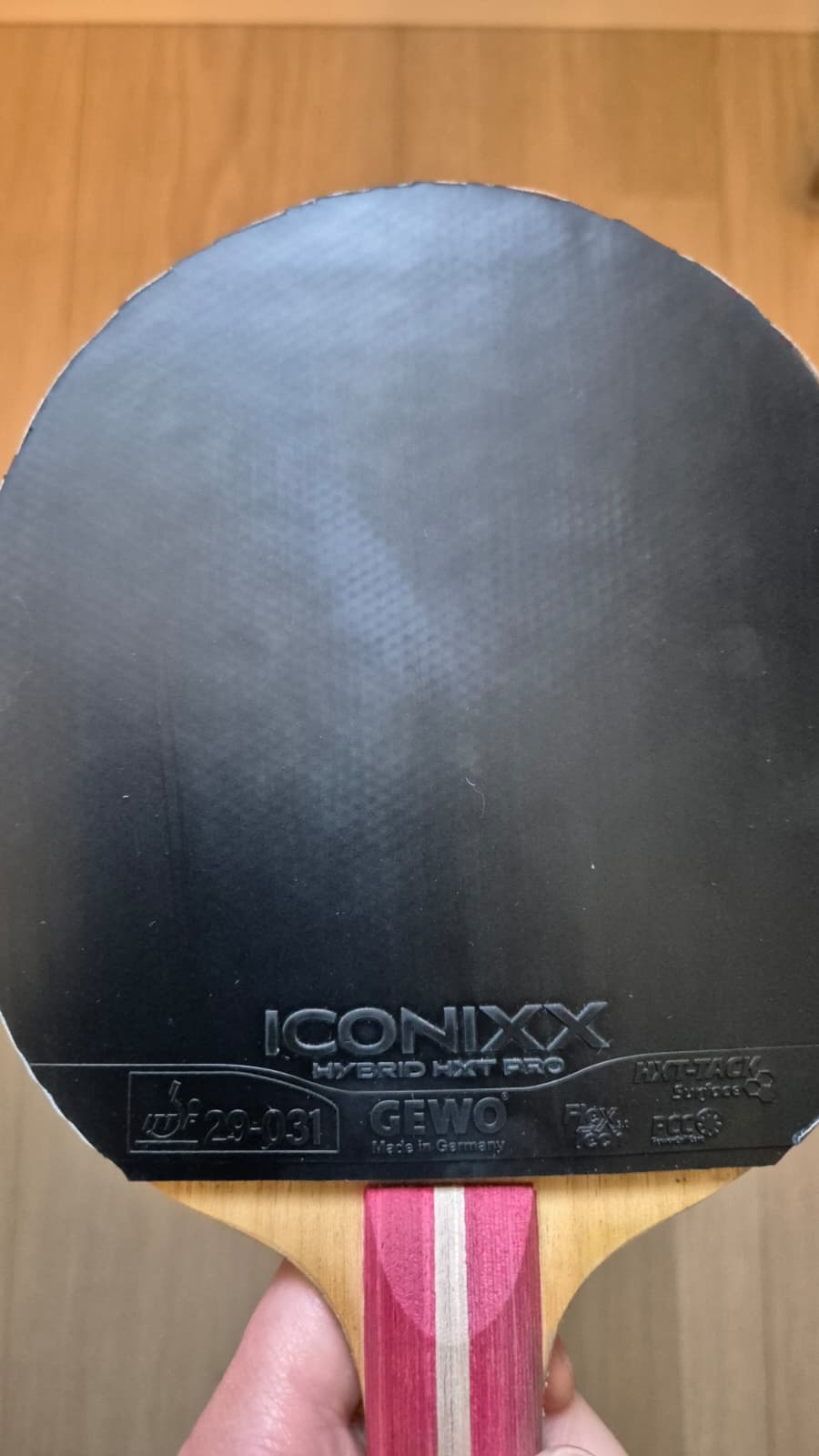
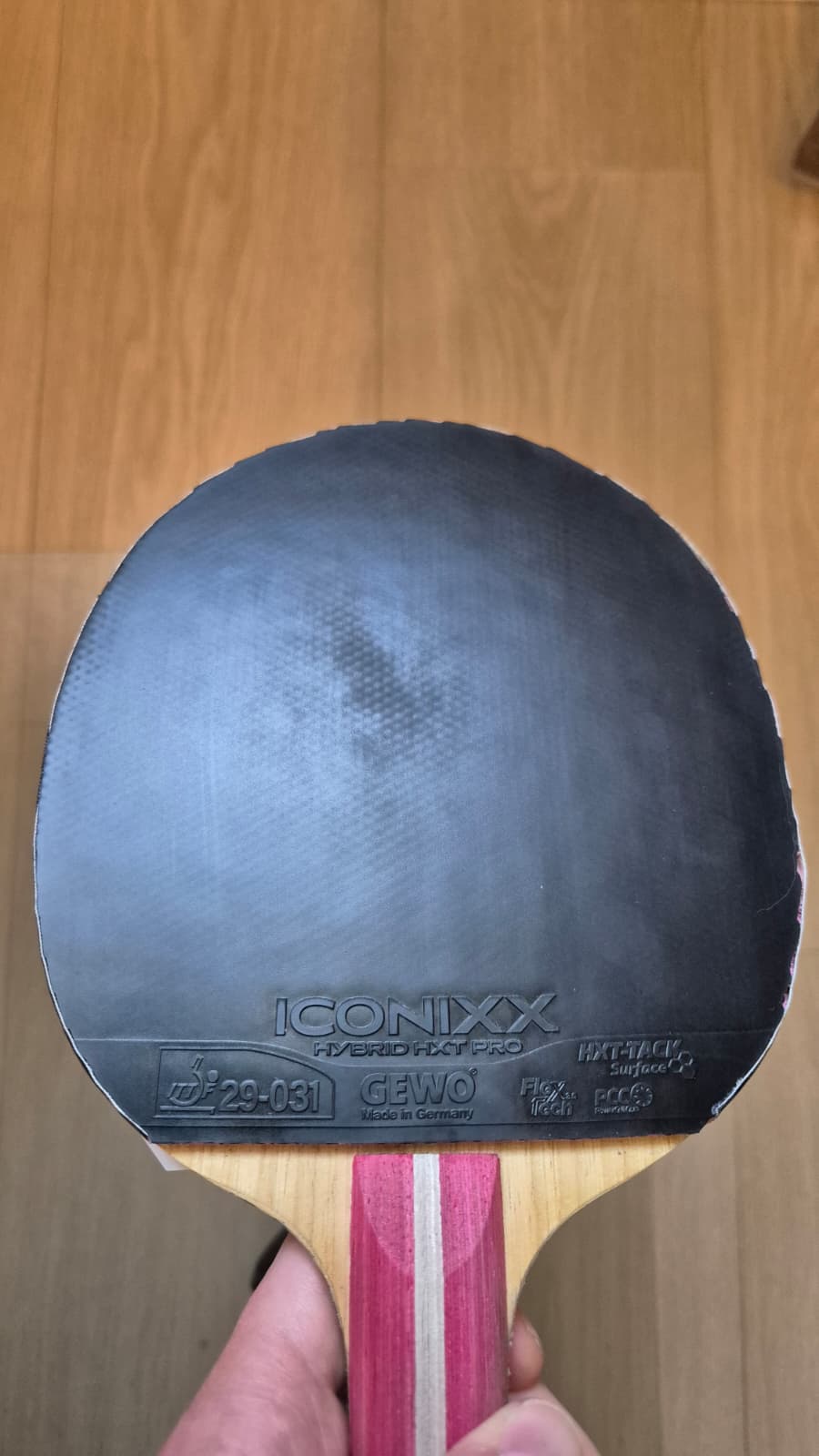
Topsheet photos attached, it's really hard to see this perfectly fine in a photo, but if you press your thumb against the rubber and try to move it, it slips in the middle, and it stays put in all the other topsheet areas
So who are these rubbers for?
If the durability issue gets sorted out (or if it turns out that both sheets were just unlucky, let's see what happens to my friend using them now too), this is where I would place them:
And who may not enjoy the rubbers?
Final thoughts
It's been a bittersweet story with the Iconixx 55 and the Iconixx 50. What started as a promising new generation of hybrid rubbers turned out to be a disappointing durability story.
Because if the durability turns out to be fine and what I experienced was just an early batch, and let's say that in that case the damage on the topsheet (and grip) stays mostly cosmetic, then the Iconixx 50 can be a really nice rubber, either standalone on the backhand or combined with a Rakza Z on the other side. I did genuinely enjoy it, and a softer Rakza Z with a bit more power is a good market idea in my opinion!
The Iconixx 55 is a harder sell even in the best case, because it lands in a category where the Rakza Z Extra Hard and many other harder hybrids already exist. So even with perfect durability, the 55 is going to have a lot of competition there.
That said, I really hope Gewo will have a look into this, because there is a good rubber in there, and it would be a pity if the topsheet is the thing that stops it.
That was my review of the Gewo Iconixx 55 and 50, until my next review, and see you at the table!
Need personalized equipment advice?
I can help you find the perfect blade and rubber setup for your playing style.