Tibhar Hybrid MK vs Andro NUZN 48 Comparison: Linearity & Control vs Power & Durability
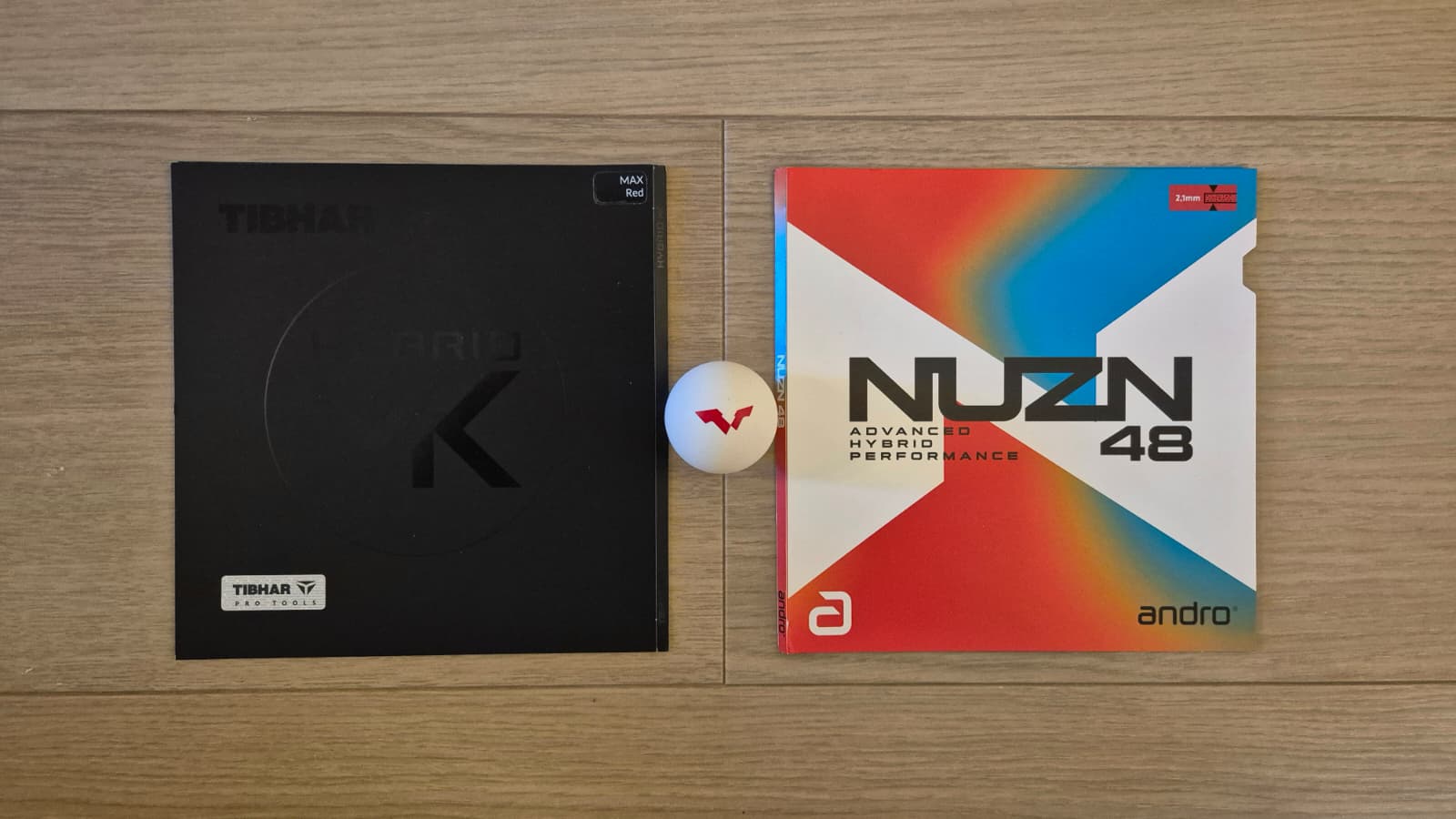
Both tensor hybrids and around 48 ESN hardness degrees, the Tibhar Hybrid MK focuses on linearity and control but it starts losing its catapult after a month, while the Andro NUZN 48 gives you the bigger speed cap, a better short game and the durability that the Hybrid MK does not have, provided you have the technique for it, and you trade safety for more power
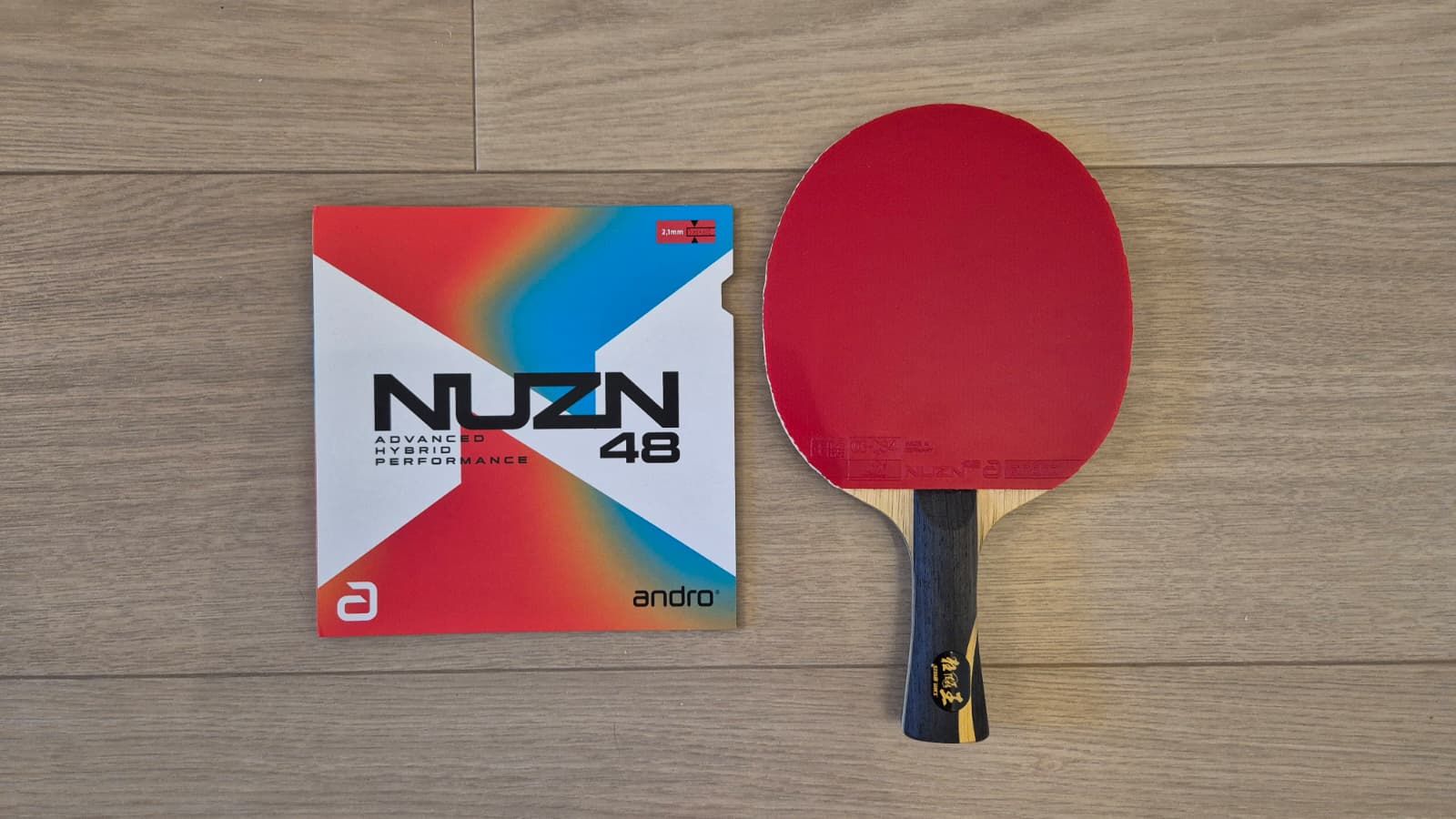
Since I recently tested both the Tibhar Hybrid MK and the Andro NUZN 48, I have been getting a lot of questions about how the compare to each other. Because even though they may share the same hardness (around 48 degrees) and rubber type (tensor hybrid), you do get different playing experiences on the table, so it is worth discussing their pros and cons, and their differences and similarities.
I enjoyed playing with both of them, they are both good grippy, spin-first rubbers, so whatever you choose, it's going to be a good choice if you accept the tradeoffs. And remember that if you want all the details and information you can always read the full Tibhar Hybrid MK review and the full Andro NUZN 48 review reviews.
OK, that was the intro and now let's get started!
Hybrid MK vs Nuzn 48
9 of 12 ratings differ.
| Rating | Hybrid MK Tibhar · Tensor Hybrid | Nuzn 48 Andro · Tensor Hybrid |
|---|---|---|
| Weight | 46g (Max) | 47.5g (Max) |
| Hardness | Hard | Medium |
| Tackiness | Low | Low |
| Ease of use | Easy | Moderate |
| Spin potential | High | High |
| Speed potential | Medium | High |
| Overall gears | Medium | High |
| Throw angle | High | Medium |
| Flight distance | Medium | Medium |
| Attack value | Medium | High |
| Defense value | High | Medium |
| Peak durability | 3-4 months | 4-6 months |
All rubbers tested for 35-40 hours on the same DHS Fang Bo B2X. Ratings are my own and therefore subjective.
Tibhar Hybrid MK
Get it if you want the most linear and safest tensor hybrid I have tested, and you can live with a lower durability
Andro NUZN 48
Get it if you want more spin and power with no clear speed cap, a better short game and a better durability.

Sponge & Topsheet
Tibhar Hybrid MK: 48 ESN degrees on paper but it plays softer than that, the ball sinks into the sponge easily and there is no 'choking' behaviour like with other hybrids, everything feels pretty predictable from the first ball. The topsheet is not tacky, maybe a 1 out of 10, but it is very grippy and humidity was never really a problem.
Andro NUZN 48: 48 ESN degrees sponge, it feels medium hard rather than medium soft, the ball does not sink in as much unless you hit harder, and it is a bit less bouncy and more firm on the lower gears than something like a Xiom Vega X or a Butterfly Tenergy 05. It also has a slight tack out of the package that disappears after a couple of hours and then just stays as a very grippy topsheet, with pretty much no ball slippage.
Speed & Gears
Tibhar Hybrid MK: it activates early and there is no real very low gear, so the ball always comes off fairly bouncy, but it stays controlled because the flight distance is relatively shorter and there is a noticeable speed cap in the medium-high gears. It is the most linear tensor hybrid I have tested so far, very confidence-inducing, and it reminded me a bit of the Donic BlueGrip S2 for the short flight and the Yasaka Rakza 7 for the safe bounciness (and I mean that as a compliment).
Andro NUZN 48: it is relatively moderated on the lower gears (compared to other fast tensors) where you want it 'calm and quiet' and then releases more as you hit harder, with a much bigger speed cap and no clear ceiling that I could find in matches. This is not a linear rubber though, so if pure linearity is what you are after, this is not the rubber to go for, catapult feeling is still strong.
Spin potential
Tibhar Hybrid MK: fairly spinny even though it is not tacky at all, the topsheet bites the ball a lot and I never had grip issues, and the hit-brush is where it really shined for me rather than the soft thin brushing. Spin is a little bit less than the Andro NUZN, that yes, but still plenty, it is clearly a spin-first rubber.
Andro NUZN 48: a bit more spin than the Hybrid MK and more than the NUZN 45 too, with a really grippy topsheet that creates a ton of spin whenever you use your body and fingers correctly. It does not have more spin than my DHS Hurricane 3 Neo or the Butterfly Dignics 09c, but it is not such a gigantic difference either, and on backspin openings I could often finish the point directly.
Throw angle
Tibhar Hybrid MK: high throw angle, getting towards a Yasaka Rakza Z but just not as high, with a medium flight distance that is really safe and inspires confidence since you start using it. Almost all your shots land on the table, and on the B2X, which is a fast and lower-throwing blade by nature, that was still the case.
Andro NUZN 48: medium throw, clearly lower than the Hybrid MK for loops and attacking shots, a bit higher than the DHS Hurricane 8-80 but not by a huge margin, and definitely higher than the Nittaku Hurricane 8-80 Power. The flight is longer too, so you need to play more towards the table, and when blocking you have to keep the angle closed so the ball does not shoot off.
Drives & Loops
Tibhar Hybrid MK: very safe on everything, the drives start faster with a higher throw and a shorter flight, openings against backspin are easy to the point where you feel you can open anything (cool!), and the initial catapult gives the loops a great feeling. Counterlooping is where it gets interesting, I mostly played half counters and counter drives and it was great at those, the shorter flight and the speed cap together mean much more safety for us amateurs.
Andro NUZN 48: each loop and drive goes a bit longer and lower with more power behind it, and you can simply notice the safety versus power tradeoff, but there is still plenty of net clearance. Counterlooping was a pleasure and very easy, you did not need to do much more than going forward with a more or less closed angle and the ball got back on the table, which is the opposite of what I found on the Hybrid MK Pro for example.
Serves
Tibhar Hybrid MK: good spin on serves, not excellent or out of the ordinary, just good, and good enough to make some direct points (not always but sometimes, let's be realistic haha). The main weakness is that it is harder to keep the ball short and low, as the early catapult makes the serve bounce a bit more on those shots.
Andro NUZN 48: a bit better here, the sponge does not activate as much on the lowest gear so short and low serves stay short and low, and players coming from fast tensors will appreciate that. Long serves are where you have to be a bit more careful with the catapult, I overshot the table a couple of times when I started playing with it.
Flicks
Tibhar Hybrid MK: good backhand flicks but very safe rather than dangerous, mostly all of them go on the table and placement becomes the important thing. It is not the kind of power flick you get with the Butterfly Dignics 09c or the Stiga Helix Hybrid XH, it is the safe, slower, arcing and spinny flick that opens the rally, which for most amateurs and certainly in tricky match situations is a good thing.
Andro NUZN 48: a bit more difficult but also a bit more dangerous, with more spin and kick, and I guess the lower throw angle combined with less dwell is what causes both of those. Still nothing spectacular though, just good and dangerous when executed correctly, you will likely not win the point straight with those.
Pushes
Tibhar Hybrid MK: relatively safe because it is linear and controlled, but the early catapult means some pushes tend to go higher and you have to get a bit used to that. I did not have the same ease I have with tackier and harder hybrids for dead and wide pushes or for aggressive long pushes.
Andro NUZN 48: clearly the better pushing rubber of the two, the firmer sponge takes longer to activate so with the right contact and finger power I could push long aggressively and those pushes were surprisingly low for a tensor. In the short game I could drop the ball dead quite easily too, enough that one of my left-handed training partners complained that his pendulum serve was less effective.
Blocks
Tibhar Hybrid MK: this is its best shot, blocking is very good and works on autopilot, it absorbs a good amount of incoming power and brings the ball back on the table with safety. Very rarely I blocked a power loop out of the table, and it reminded me quite a lot of the Yasaka Rakza 7 here, so do use placement and active blocks (mini counters) as your way to disrupt, because the passive blocks are not very tricky.
Andro NUZN 48: harder work, the main issue is overshooting the table on passive blocks rather than failing to clear the net, so you need to close the racket angle more and think more actively. When you do block actively with the proper angle it is very stable and handles most incoming shots without too much effort, so it is not a problem, it just asks more of you.
Flat hits
Tibhar Hybrid MK: very good at flat hits, punches and counter drives, and I did a lot of these down-the-line, it is a rubber where you can safely punch through and it will add the arc and spin for you while keeping the ball on the table. One of the best hybrids I have tested for this kind of shot, which is exactly what you would expect given its real nature as a linear tensor.
Andro NUZN 48: also quite enjoyable here, I got a fair amount of backhand punches and forehand counters close to the table that the opponent could never return, and that was much better than with my usual tacky rubbers. That said, I would still not buy it if you are a hitter-blocker, it is nice that it can do it when the need arises rather than being built for it.
Boosting
Tibhar Hybrid MK: please do not boost it, the only case would be to revive a bit of the catapult when it is coming to an end, and even then be careful because the sponge looks and feels very fragile, removing the glue is already a challenge on its own.
Andro NUZN 48: no need at all, it is plenty fast for most club players and it is designed for controlled power rather than all-out raw speed. I also suspect the sponge would break too much, I could not safely remove the glue on my NUZNs without damaging the sponge and that was with Revolution 3, which is known for easy removal.
Price & Durability
Tibhar Hybrid MK: without discounts it goes towards the 60 euros but the real price with the usual discounts is more around 50, which is normal for this kind of semi premium ESN tensor. The durability though, that is where it gets a bit bittersweet, it started losing some of its speed and catapult after 1 month already and you can feel it, it is subtle but if you pay attention it is there, and I would expect it to be more or less finished after 3-4 months, let's say around 100 hours of play, give or take.
Andro NUZN 48: around 55 euros without discounts, so the same medium-premium ESN segment, and after a month of testing it played exactly the same as on day one, no speed, spin or grip issues at all. From what others have said online the reports are the same, so this is the one of the two that I would expect to last significantly longer.
Who should get which
Get the Tibhar Hybrid MK if:
- You are an intermediate player who likes tensors but wants more linearity, a higher throw and a bit more grip than with the Yasaka Rakza 7, and you are fine with less durability as the tradeoff.
- Your backhand is where you want safety above all, because blocking, counter drives and flat hits on this rubber work on autopilot and the ball just keeps landing.
- You come from pure or Chinese hybrids and you find them too hard, and you want a step towards the tensor world without losing linearity.
- You are not chasing a speed cap, because there is one and you will find it in the medium-high gears.
Get the Andro NUZN 48 if:
- You already have the technique to handle power and you do not want to run into a ceiling when you hit harder, you want more speed and spin. This is the first main difference.
- Your short game matters to you, because dead short pushes, low short serves and aggressive long pushes are all better on this one.
- You want to buy a rubber once and still be playing the same rubber in four months, which for me is the second biggest difference between these two.
- You counterloop with spin aggressively and you just go forward with a closed angle.
And who should skip both: if you want raw tensor speed and do not care about linearity, both of these will feel too tame and then you are better off with things like the Tibhar Evolution MX-P or Tenergy and Dignics. And if you want a real tacky hybrid with proper dwell, neither of these is it, they are grippy tensors at heart, so go for a Butterfly Dignics 09c, Rakza Z or any of the others in the pure hybrids category.
Final thoughts
The way I see these two in the market is that the Tibhar Hybrid MK sits somewhere in between the Andro NUZN and the Yasaka Rakza 7, it is more controlled and linear than the NUZN but a bit faster and grippier than the Rakza 7, and the Andro NUZN 48 is the one with the extra power and durability.
So if you want linearity, a high throw and a rubber that makes your backhand defense feel easy, the Hybrid MK is the better pick and it is the most linear tensor hybrid I have tested so far. If you want power on demand, a better short game and durability you can count on, the NUZN 48 is the better pick, and honestly, if durability is anywhere near the top of your list, I would just get the Andro NUZN, maybe with a slower blade, because it is more or less the same idea but it will last longer.
Overall, both are good rubbers and the best tensor hybrids I have tested so far, so it really comes down to your preferences and needs.
That was my comparison of the Tibhar Hybrid MK and the Andro NUZN 48, until my next review, and see you at the table!
Need personalized equipment advice?
I can help you find the perfect blade and rubber setup for your playing style.