Joola Hugo Calderano Trinity Charged & Trinity Dynamic Review: Great Hybrid Rubbers for Advanced Amateur Players
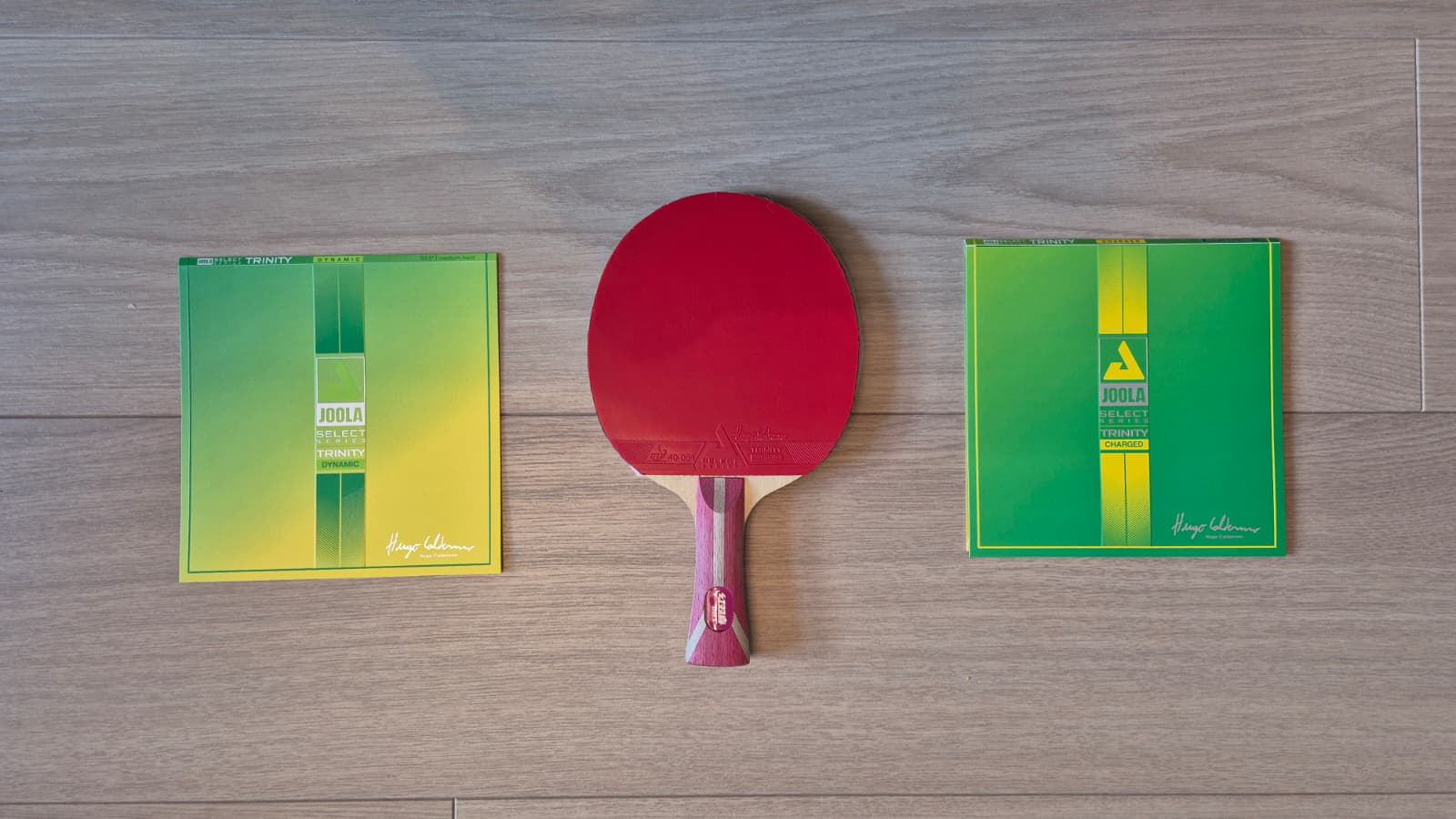
How do Joola's new flagship hybrid rubbers compare to other great options like Dignics 09C, NUZN, BlueGrip, and Hurricane? After several weeks of testing both the Charged and Dynamic, here's how they play and which players they'll suit best.
Hey everybody, I'm back! After a nice summer holiday and some warm (and sweaty) training sessions, I wanted to start strong again and bring you guys a review of two very interesting new rubbers: the Joola Trinity Hugo Calderano Charged and Dynamic.
I'm actually really looking forward to telling you all about Calderano's rubbers because I initially thought they would not be for me at all. I was pretty skeptical in the beginning, but after testing them exclusively and intensively for a bit more than a month (I have not played any other rubber during this summer period), I'm super happy with them and I may even keep them in my normal match setup!
Also, I'm trying something new this time: I'm reviewing both rubbers in one blog, so it's easier to compare them and saves you some time going back and forth. It will be a bit more compact, but hopefully more insightful.
Lastly, a big thanks to our club sponsor SE - TableTennisStore.eu, they gave me the rubbers for free because they wanted to know how they perform for a couple weeks, so I was their test subject (successfully, I want to believe haha). And as always, they will give you 25% off when you order through this link.
So let's get started with the Calderano rubbers and see how they are!
Ps. If you haven't done so yet, there are two very good reviews of the rubbers on Youtube (Iba Diaw + Matt/MH) , so feel free to check those out as well.

Joola
Trinity Hugo Calderano Charged
Joola
Trinity Hugo Calderano Dynamic
The TL;DR: Joola Trinity Hugo Calderano Charged and Dynamic
| Category | Trinity Charged | Trinity Dynamic |
|---|---|---|
| Weight | Very heavy, 56.5 cut to the B2X, similar to a boosted Hurricane | Heavy, 51 grams cut to the B2X, similar to Rakza Z for example |
| Sponge & Topsheet | Hard 57.5 sponge (feels softer and livelier) with a slightly tacky topsheet | Hard 52.5 sponge (feels softer and livelier) with a slightly tacky topsheet |
| Spin potential | Lots of spin on all shots, maximum spin potential without clear cap | Bit less spin, but not a major decrease, still very high spin |
| Speed & Gears | Many gears especially on the high end, linear-ish and no clear cap | Many gears but just a little bit less on the high end than the Charged |
| Throw angle | Medium-high throw angle, long flight and direct post-bounce trajectory | High throw angle, much safer flight and trajectory |
| Drives & Loops | Really high power but requires correct technique to activate it | Less power and more control, tolerates wrong technique better |
| Serves | Great spin but less than a Hurricane | Great spin but less than a Hurricane |
| Flicks | Easy to do FH flicks with the right technique, requires commitment | Very easy backhand flicks, induces confidence to do them more often |
| Pushes | Great control for such a fast rubber, both short and long is easy | Great control, even easier to push short and long with aggression |
| Blocks | Very good blocking for such a fast and powerful rubber | Easy and controlled blocks, better than Dignics 09c for example |
| Flat hits | Not very good, this is a rubber made for hit-brushing, like the Chinese | Not very good either, just a bit better than Charged |
| Boosting | I can imagine that people will boost it, but for me the main point was not to boost it, it plays great as is | I would not boost it, it's just perfect out of the box, it's not as hard as you may think |
| Price & Durability | Premium rubber segment, durability seems the same after 1 month | Premium rubber segment, durability seems the same after 1 month |
The technicalities
Both rubbers come in a cool green and yellow (or yellow and green) packaging, and my MAX Charged weighed 80 grams uncut (with the protector on) and 56.5 grams cut to my DHS Fang Bo B2X. A pretty heavy rubber but not so different from a boosted Hurricane. The MAX Dynamic weighed 76.5 grams uncut (with the protector on) and 51 grams cut to the same blade.
The sponges are purple and feel pretty hard, while the topsheet is not too sticky but you can feel a slight amount of tack (that is still there after a month of playing and protecting them well). I feel like the tackiness of the Dynamic is a bit higher than the Charged, but I cannot confirm this by any official channels.
Joola positions these rubbers as their most advanced and high performance rubbers, and since I have not thoroughly tested the other Joola rubbers, I will believe that, but they feel in any case definitely better than any other Joola rubbers I briefly tested before (i.e. CMD or Rhyzen). Besides that, these are not beginner or intermediate rubbers, these are advanced rubbers and unless you have the correct technique and are used to hit-brushing with Chinese hard rubbers, I would not recommend the Charged to you. The Dynamic is easier to handle so it can work for high intermediates as well.
So as always, do not waste the money on them if you are tight on budget and your level does not match the above. And if you do want to try them, try the dynamic first before going to the Charged, the Charged is not an easy rubber to handle ;)
How I tested the Joola Trinity Charged and Dynamic
This time I did not overcomplicate the test too much, I just used my normal test blade, the Fang Bo B2X (91g) and glued the MAX Charged on the forehand and the MAX Dynamic on the backhand, just like Calderano does. To me it made sense to do it in this way, and as I will explain to you later, I believe this is the intended usage of both rubbers, at least for amateur players.
I also have a Charged 2.0 waiting to be tested (I bought it myself just to see the difference) but I haven't glued it yet, so more news on that when I get to it. I often prefer 2.0 on the forehand and MAX on the backhand but I got both in MAX to test the rubbers like Hugo would!
I tested them both on the same blade for a bit more than a month since I came back from my holidays and I have exclusively played with them for all that time, that's right, nothing else in between, as I wanted to dive deep into both rubbers, and since I enjoyed the experience from the get-go, I thought why not?!
The Joola Trinity Hugo Calderano Charged and Dynamic in depth
Sponge & Topsheet Feeling
For the Trinity Charged, the sponge is a 57.5 ESN hard but it definitely feels softer and livelier. I think the best way I can describe it would be a well boosted (2-3 layers) Hurricane 40-41 blue sponge, something like that give or take. It is hard and you can get that great metallic 'click' sound that you get with a hit-brush on the Hurricanes, but you get a bit more feedback, plus it's bouncier (less dwell) and less tacky.
For the Trinity Dynamic, the sponge is 52.5 ESN degrees hard but it also plays softer and livelier, similar to how the Donic BlueGrip C2 was in that way. I'd say that it feels similar to the Dignics 09c and it also behaves a little bit like that, with a bit lower throw angle and less immediate catapult. The topsheet felt a bit tackier than the Charged but only by a little bit, definitely less tacky than a Rakza Z or Dignics 09c, similar to BlueGrip I'd say, a bit more than NUZN, but again, give or take.
Overall, and even though some of you may disagree (that's always fine), my feeling was that the Charged felt and behaved pretty similarly to a well boosted blue sponge Chinese rubber (Hurricane or Battle 2 mostly) but with a tensor flavour to it. The Dynamic on the other side was closer to a Dignics 09c with a Chinese flavour to it, so overall you can now see why I'm really positive about the rubbers, my normal combination is indeed a blue sponge Hurricane on the forehand and a Dignics 09c hybrid-like on the backhand.
One last thing, and a detail I liked with the rubbers: the part where the index finger touches (rests on) the rubber has a sort of anti-slip surface, so it makes it easier to go back to the normal forehand finger position after a serve (builds some sort of muscle memory) and helps when using index finger power, particularly noticed (and enjoyed) this on forehand loops and flicks!
Speed & Control
As I mentioned before, these are not the easiest to control rubbers, even though the Dynamic is a bit better in this regard than the Charged. Overall, these are pretty fast and relatively hard to handle rubbers (for sure if you compare them to Rakza Z or BlueGrip S1 for example), and you can quickly notice that they have a lot of built-in tempo and are made for aggressive play, not for passive or controlling styles.
That said, I expected them to be much faster and bouncier as they were made for a top player like Hugo Calderano, but this was definitely not the case, and even though they are fast, they are perfectly controllable (and quite linear in a way) with the right technique, but this is a must, specially with the Charged.
So going into the details of the gears, I'd say that the Dynamic is a bit similar to the Dignics 09c, it has some tempo built in but it does not come to life unless you start activating the sponge (aka going harder). The initial gear is very moderated for a fast rubber like this one, and this means that you have relatively good control on short pushes and the touch game, but also that you need to do most of the work for it to shine, do not expect it to play on autopilot like a Tenergy/Zyre would. Whenever you start accelerating and looping, the speed builds up quickly and you can get plenty of tempo for most of us amateurs. The rubber is not overly bouncy but it does have a lot of speed and power, definitely on the backhand.
For the Charged, it is clearly faster on the initial gear, and you will notice that the rubber is built for speed and aggression, it wants it and it also demands it, it you go half-in or doubt a bit, the ball will either land in the net, go long or just be an easy shot for the opponent to counter. On the lowest gear it is a bit more difficult to control than the Dynamic but once you adjust to it, it has relatively good control on pushes and the touch game, it just needs some sessions to feel how it plays in that regard. On the medium and high gears, you will notice that the rubber is a rocket, especially on outer blades and with a proper hit-brush motion (but not immediately as fast as your classical tensor rockets like MX-P). Remember I told you that the rubber reminds me a lot of a boosted blue sponge Chinese one, so this means that with the right technique it produces amazing and super dangerous shots, but with the wrong technique you will suffer, it's not a forgiving rubber, it has tons of power, speed and kick, but you need to enable that with solid technique and footwork. This is also the reason why I wouldn't want this rubber on my backhand, I'm not powerful or good enough there to be able to handle it.
Spin & Grip
When a rubber is only mildly tacky, I always get a bit anxious on the grip side of things as I'm used to the ultra grip of the DHS Hurricanes, but just as I was positively surprised by the Andro NUZNs, I'm even more positively surprised by the Joola Trinitys, they have a really great grip and I have not experienced any sort of slippage, even during these really warm and humid summer months in the Netherlands. Even in the most humid conditions that I have had in a while in the country, and with my hands being pretty slippery, the rubbers had no issues at all, which very much positively surprised me. And outside of the humid conditions, I have not had any issues with handling any type of shots, both rubbers grip the ball wonderfully well and you can always count on the grip to be there for you.
When it comes to the spin, I'd say that both rubbers have more spin than the Donic BlueGrips and than Rakza Z, also a bit more than the NUZNs and similar to the Dignics 09c and my Hurricanes, perhaps just a bit less than the hurricanes, which is compensated by the amount of speed and power they have.
The only downside I could find on the spin side of things is that due to the built in tempo that they have, it's not as easy to create high spin on the short serve game. This is a common thing in very fast modern rubbers and also one of the reasons why the high toss serve is common in pro players, they just need the extra gravity force to add spin to the serve.
Throw Angle
The throw angle is a tricky one for the Charged, and much safer and predictable with the Dynamic.
Starting with the Charged, the throw angle is medium high, think of a well boosted Hurricane blue sponge and that's more or less how it throws. The tricky part is (just like with a blue sponge Hurricane) the harder sponge and the rebound speed. So what you will initially notice is that most of your balls will go long, and that you will need an adjustment period and to start hit-brushing into the ball so you can truly activate the hard sponge and add enough spin for the ball to drop in time. Essentially what's happening is that the sponge is pretty hard so if you don't hit-brush it (to get that lovely metallic click that you also get with the Hurricanes, see the video of Iba Diaw to understand this and hear the sound as he practices with his coach on backspin opening loops) you won't have enough spin for the ball to drop back on the table. This is a really key element of the Charged, and also the main reason why it's not a safe and forgiving rubber. You need to go all-in for all shots and hit into the sponge for the ball to land on the table (and be really hard to return), but if you don't, the ball will go long or into the net with heavy backspin.
So remember, you need to treat the Charged as a boosted and pretty hard Chinese rubber, you need the body to lead (and finish first), the arm to act as a whip (coming in a half moon motion) and finally the index finger to produce a hit-brushing motion. If you do all this correctly, and hear that nice metallic click sound, most balls will be amazing shots on the table, otherwise, well, you will likely miss the shot :)
For the Dynamic, things are going to be much easier, and the high throwing nature of the rubber combined with a very safe flight will land most of your shots on the table. I remember the first training sessions with it, when I was opening heavy backspin serves, and I would miss most of them with the Charged, while with the Dynamic, it was just on autopilot, and I would put 9 out of 10 on the table from the get-go, very similar to what you would get on a Rakza Z or a Dignics 09c. So that's all you need to know about the throw angle of the Dynamic, fast and powerful, but very confidence inducing even if you do things half right.
Drives & Loops
For the Charged, warm-up drives are very easy and consistent, the rubber is fast, but if you adjust your stroke a little bit, the rubber does most of the work for you when you are just driving back to back, it requires very little effort to land on the other side with good tempo. The Dynamic is pretty much the same, they both instantly feel good when doing normal warm-up drives, but with the dynamic you can feel the arc being higher and the ball landing a bit shorter, that's the main difference.
When you start looping, and just like with the BlueGrip C2 (or any other high geared rubbers), the Charged comes to life and balls start going long until you adjust your angle, contact and body mechanics. The rubber is made for chinese-like big loops, just see how Calderano or Wang Chuqin loop and you can expect that this is what the rubber needs. But provided you like that kind of loop and with some adjustment, the loops have very high quality, tons of speed and spin, and the ball kicks very low after the first bounce, it was not easy at all for my training partners to block more than 4-5 loops after each other. With the Dynamic, things get a bit more relaxed, and most loops go on the table without too much adjustment if you are used to hybrid hard rubbers (i.e. Dignics 09c, K3, Hurricane 8-80, BlueGrip, NUZN etc). It's also a rubber that rewards a thicker contact but much easier to get comfortable with than the Charged. And those loops also have a ton of spin and just a little less speed, but not much less.
Opening against heavy backspin is perhaps the most challenging part of the Charged, it requires precision, correct technique (incredibly important on this shot in particular) and going for the shot. The moment that you doubt, brake during the shot, or not execute the technicals correctly, the ball will go long or into the net. This happened to me a couple sessions where I missed 'easy' openings until I got the hang of it. The moment I realised it works like a 40-ish blue sponge boosted Hurricane, then it clicked. I was expecting more tensor-like vibes and less Chinese ones but hey, it was a nice surprise as I love Chinese rubbers! With the Dynamic, as before, it is much easier to open against heavy backspin. You can almost just drive through the ball and let the legs do the lifting for you, so it gives you a lot of confidence to go for the big shot with the backhand, great stuff really.
Finally, counterloops are pretty easy but as always with a counterloop, this is not an easy shot to execute. The key for these rubbers (like many others of the same kind) is to brush on top of the ball, instead of giving it a big hit, because if you do that, the ball will not have the needed downwards push to land on the table. But if you do brush on top of the ball (you can hit a little bit as well, that's fine, but not too much), most balls go back to the table, which is also really nice. And this is by the way the same for both rubbers, I did not notice that one of them was better than the other in this area.
Serves
Serves reminded me a lot of the BlueGrip C2 in that the long serves are really loaded, and very often you can make a direct point with them, especially the infamous 'long heavy dead' serve, which with these 2 rubbers is a very powerful weapon.
With the short serves, I noticed that the Dynamic produces more spin than the Charged, especially when it comes to a backspin backhand serve vs a short backspin/sidespin pendulum. It's not impossible to give heavy spin with the Charged but it is more difficult (due to dwell time and stickiness) and requires a higher toss. In the end, no rubber is perfect and the ability to be amazing at all kinds of serves while keeping a lot of the tempo, spin, speed and grip is usually a rare combination without boosting.
By the way, even though short serves were not fantastic when it comes to the amount of spin, keeping them low was not a problem like with other bouncier rubbers, so I was happy about that.
Flicks
Since I'm playing with the Charged, I've started flicking a bit more with my forehand, and specially launching myself more into the ball with the right foot. This is likely not so much a rubber development but a technical one supported by a good rubber that lets me feel the ball and the shot better. So I'd say that the rubber is pretty good at flicking topspin/sidespin or dead balls, and not a bad one at flicking backspin, although for short backspin serves, I'd usually go for a wide forehand push or a long backhand aggressive push, which the rubber is also great at.
On the backhand, the Dynamic makes it very easy to flick as well, and you can put a surprising amount of power on it, and it will still land on the table. This is similar to what I felt with the flicks on the Dignics 09c and a couple other hybrid rubbers, so I was quite happy about it. Grip is great, lift is very nice and you can get the tempo to make it hard for the opponent, not bad at all.
Pushes
You will often see fast hybrid rubber struggling with short pushes but this was not the case with the Trinity Charged and Dynamic, they are both very good at dropping the ball short and nicely dead for the opponent if you want it, but you can also put a lot of spin for a nasty push, and the ball will not go too high or too long. One of my favorite shots is the short wide forehand push when I get a short backspin serve on my forehand, and this has now become a weapon with the Charged. On the dynamic, since I flick a bit more than with my forehand, I do not push as much, but those pushes are also very good, especially against the long aggressive ones.
The only difference between the two rubbers is that the Charged tends to shoot the ball a bit longer and faster so you need to be precise on your long aggressive pushes, while the Dynamic just works for pushes and the ball almost always lands on the table without much further adjustment.
Blocks
Blocking was one of my main concerns regarding both rubbers before testing them. I have gotten the MAX version for both and having experienced the Dignics 09c 2.1mm with blocking (pretty hard to block powerful loops due to catapult), I was not looking forward to it. However, I was again positively surprised with both rubbers in this area.
Yes, the Charged is a bit harder to control on power shots, but not much harder than a well boosted blue sponge Hurricane, and definitely much easier than a Dignics 09c or similar hybrid tensor rubber where the catapult kicks in almost automatically. With the Charged however, you get a bit more of a Chinese rubber when blocking, so you can block very passively and dead, and the ball will still land on the table and give some trouble to the opponent. You can of course also block actively, but you have now more options than just an active block that is not always easy to time.
With the Dynamic it is even easier to block, and here it reminded me more of a Hurricane 8-80 (or similar) than of a Dignics 09c, blocks are super easy and accurate, and you get a very nice and controlled feeling on your hand. And this is with a fast blade like a Fang Bo B2X, so I can imagine it will be even better on slightly less offensive blades.
Overall great blocking on both the Charged and the Dynamic!
Flat hits and counterhits
I'll keep this section short and sweet: both rubbers are not good at flat hitting, so if you are the kind of blocker-hitter, do not buy these rubbers as you will waste your money.
These are rubbers made for looping, flicking and counterlooping with spin, not for flat hitting and driving through them during a game rally, and in that regard they reminded me a lot of a normal hard and tacky Chinese rubber, and way less of a normal tensor hybrid (or normal tensor).
Boosting
Now a tricky one, boosting.
I can imagine that some people will want to boost the super hard Charged, just like you would boost a blue sponge Hurricane or similar, but in my opinion, and just like with Battle 2 provincial blue, the point of these rubbers is not to boost them. I think that the Charged has a lot of power and spin out of the box, more than enough for us amateurs, and yes, it is a hard rubber, but if you need to boost it to make it easier, then it's probably not the rubber for you. I also think that boosting it will remove a lot of the control and short/touch game of the rubber so I wouldn't do it, especially given its already long trajectory and already medium-high throw.
Same for the Dynamic, I would not boost it, for me it is perfect as is out of the box, but up to you if you want to experiment with it! Probably don't use Haifu though, the sponge is definitely very different than a normal Hurricane sponge (closer to tensors and ESN hybrids)
Price & Durability
Without any discounts, the price of the rubbers is around 75€ in Europe (as of today) but I'm sure you'll be able to get some discounts here and there, and you can always use my discount code for the time being ;)
They are definitely not cheap rubbers, but they are also not as expensive as a Zyre 03 or a Dignics 09c, so in my opinion, and for what you get, they have a very good price to value ratio, at least for now while the durability is still holding great. I may need to change these words in a couple weeks if the durability drops massively (like with other hybrids) but for now, if they last me 4-5 months at peak performance, I'd say I'm happy with the price.
And speaking of durability, I have not observed or felt any drop in performance since I started playing with them, perhaps a small decrease in speed from the first day and then after the rubber has settled, but not a huge deal. Overall, very happy with the durability so far, so that's a plus point!
So who are these rubber for?
For me, the Charged targets a high-intermediate/advanced player who:
I don't think most amateurs out there will be able to handle the Charged on the backhand, so I would not recommend that, not even Calderano does that so why would you? smiley face
The Dynamic on the other hand, is much more versatile in what kind of players may like it. For me, it was love at first sight on the backhand, it combines the best of a Dignics 09c and a Hurricane 8-80 in the same rubber, so I really liked it. But if you don't like hard hybrids on the backhand, then better avoid it. However, I can imagine that many players will love it on the forehand, it is pretty much a Rakza Z+ or a Dignics 09c- with a Chinese flavour to it, and since it is much easier to handle than the Charged, I think it's going to be a super hit if the durability is good.
Lastly, if you are a beginner or a low intermediate player, please save yourself some money and don't buy these rubbers, there are plenty of other rubbers which work better for you! So just a word of caution there!
Final thoughts
What a wonderful surprise these 2 rubbers have been, that's my feeling of how I would summarise this review!
I came thinking that they would be a sort of rocket fast hybrid tensor, very lively and bouncy with a little bit of tackiness, and I couldn't have been more wrong on this one. What you really get is two high quality rubbers that are also amateur accessible and that together, they essentially mix the best of both worlds: a sort of boosted blue sponge Hurricane on the forehand (Charged) and a more controllable Dignics 09c with a Chinese flavour to it (Dynamic).
Overall, and since I already played with this kind of setup before, I couldn't be happier after testing these two rubbers, so let's see if they become my normal match setup or at least stay as a nice non-boost combination for when I don't feel like boosting (and getting my legs too tired :P)
That was my review of the Joola Trinity Hugo Calderano Charged and Dynamic, until my next review, and see you at the table!
Need personalized equipment advice?
I can help you find the perfect blade and rubber setup for your playing style.