Andro NUZN 48 Review: Faster and More Dynamic Than NUZN 45, But Still Controllable
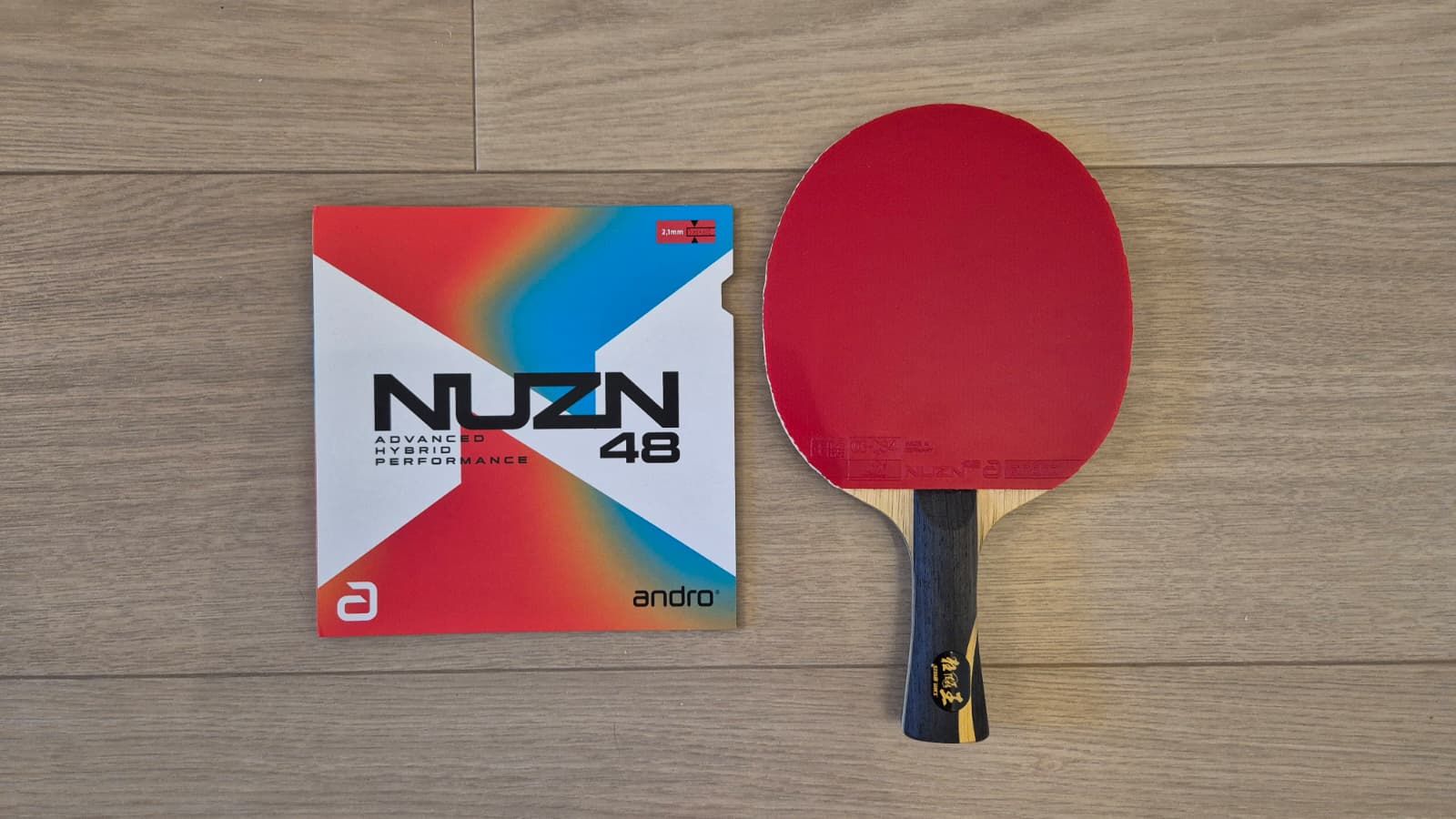
How does the Andro NUZN 48 actually play? Does the extra power come at the cost of control? And who should consider an upgrade from the NUZN 45?
Last week I reviewed the Andro NUZN 45, as this was on top of the r/tabletennis community most wanted reviews, and this week I'm going to continue with its bigger brother, the Andro NUZN 48. After this post, I'm also going to make a quick comparison for those of you who are still doubting, so stay tuned for that!
And before we start, let me just say that I'm still enjoying both NUZNs, they are definitely different from what I usually go for, but they have this good vibe to how they play and feel. I haven't tried the 50 or 55 yet, that will be for another day. But after this testing period, I'm still excited. They've surprised me positively, and the durability seems to be holding up well.
Lastly for this introduction, our club sponsor and good friends from Tabletennisstore.eu gave me the NUZN 48 to test, so a huge thank you to them for that. I never mind spending my own money on table tennis equipment, but hey, from time to time a little gift is very nice. And remember that they are giving everybody 25% off on their shop via this link, so that's double nice ;)
All right, without further ado, let's get started with the review! Let's go!

Andro
NUZN 48
The TL;DR
| Category | Andro NUZN 48 |
|---|---|
| Weight | Medium-ish, it's about 69g uncut and 47.5g cut to my blade |
| Sponge & Topsheet | Medium tensor sponge with a grippy, very slightly tacky topsheet |
| Spin potential | High, a bit more than NUZN 45 |
| Speed & Gears | Higher gears and speed than NUZN 45, no clear speed cap |
| Throw angle | Medium throw, lower than NUZN 45 |
| Drives & Loops | Good quality and fast, and good control still |
| Serves | Spinny, more spin than other tensors I tried before |
| Flicks | Decent, similar to other medium throw and low-ish dwell tensors |
| Pushes | Good control and spin, ball doesn't pop up much on short balls |
| Blocks | Stable but easier with a relatively closed racket angle |
| Flat hits | Not bad, better than other harder tackier hybrids |
| Boosting | No need to boost it at all |
| Price & Durability | On the higher side but still fine, around 50-60€, seems durable |
The technicalities
The rubber comes in a cool white, red and blue-green package, weighs about 69 grams uncut and 47.5 grams cut on my DHS Hurricane King (aka DHS Wang Chuqin), and has a very similar sponge appearance to the Rakza Z (white and half cake-ish). The NUZN 48, just like the NUZN 45, comes with its own sticky plastic protector and it's only a little bit tacky out of the box, but this does fade away quite quickly after the initial play sessions. Andro says it's a rubber designed for the advanced player above all, but can also be used by pro players, and I think that it will be good for the advanced players, but can also be used by intermediates with good technique.
How I tested the NUZN 48
I only had one sheet this time (red 2.1mm), so I glued it directly to the DHS Wang Chuqin to see how it would behave in comparison to the NUZN 45.
But this time, I actually played it first on the forehand as you will see on my blade, just because I wanted to see how it would feel and whether it was too soft for me on that side. It was indeed too soft and bouncy for my forehand taste, but other than that, it was a nice different experience than my normal Hurricane 3 Neo (technique had to be adjusted a bit, more compact and closed angle) and I did notice that counterloops were nice and easy and all other shots had a good amount of speed and spin while being pretty safe.
Then I changed it to the backhand, and it also worked very nicely, no surprise there. Personally I prefer the feeling that it has on the backhand, but this is entirely a matter of taste. If you remember from my Rakza Z blogpost, I had the exact same conclusion. However, I still keep my Rakza Z on a spare blade and use it on my forehand from time to time. It has a feeling I really enjoy when my legs are tired of the Hurricane 3 Neo (I'm getting old you guys) or when the booster is totally gone and I'm feeling lazy to reboost.
Anyways, I suspect that the NUZN 48 will work very nicely for both forehand and backhand depending on the player's level and preferences, so for today's review, I will speak about how it feels on both sides.
And as always when I test completely new gear, the testing period was about a month, where I tested both the NUZN 45 and 48 during normal training and in plenty of matches.
The Andro NUZN 48 in depth
Sponge & Topsheet Feeling
Just like with the NUZN 45, the rubber is pretty clear on how it is going to play and feel from the beginning. It has more bite than its smaller brother, and you can notice it immediately in the amount of power (speed and spin) that it has. I'll talk about control in a second as this is always the tradeoff for more power.
When it comes to the sponge feeling, it has a similar feeling as other similar 47-48 tensor sponges, but it is a bit less bouncy and more firm on low gears than the Xiom Vega X or the Tenergy 05 for example, and the ball doesn't sink in as much as it does on the NUZN 45 unless you hit harder. I will talk about speed and gears in a moment, but what is important to remember here is that the sponge feels medium hard as opposed to medium soft on the 45 version, and that the catapult is certainly more noticeable from the get-go on the NUZN 48. Also worth mentioning here that just like with the NUZN 45, the NUZN 48 does not feel like a pure hybrid, but it is closer to the normal ESN tensors you are used to. Where the difference lies is in the amount of catapult it has and how fast it activates. In this regard, the catapult and bounce release a bit more in stages, so that's where you could call it a hybrid, as I feel that the high-end speed of the NUZN 48 is pretty high but it takes some force to release it.
When it comes to the topsheet and as I already mentioned before, it is not a tacky rubber at all, but more of a very grippy tensor. Out of the package it has this slight tack to it, but after playing for a couple hours, it disappears and just stays as a grippy topsheet. I say very grippy because ball slippage was pretty much non-existent which I was very happy about, because my hands tend to get sweaty. Small note here, I must admit that there was a little bit of ball slippage when my technique was incorrect. I'm used to tacky rubbers where you can brush very thinly on certain needed occasions, but this won't work with the NUZN, just remember that :)
Speed & Control
And now let's talk about speed and control of the NUZN 48, as I'm sure that many of you are wondering about the tradeoffs when compared to the controlled NUZN 45.
My summary would be that the NUZN 48 has a much bigger speed cap than the 45 version, and I have not felt like I was missing power on my backhand, something that I did have with the NUZN 45. On my forehand, I did get to the speed cap from time to time when I was hitting really hard during training but it was never an issue in matches where you rarely play at 100% power. So as you can see, and for most of us amateurs out there, the power that the NUZN 48 has is plenty, and of course the big question is: how much control do you need to sacrifice for that?
And the answer for me is clear: It's a good tradeoff and one that I would be willing to make. I feel like the amount of control that you give in is very much worth the upgrade, provided that you have the technique to handle that power. Basically, if you remember this same section but on the NUZN 45, you can pretty much increase the overall base speed for each gear (except the short and touch game, which remains stable which is great!) and you have a clear picture of how the NUZN 48 is when it comes to the gears.
So as you can see, the NUZN 48 is easy enough to control if you have the technique for it. It is moderated on the lower gears where you need it to be 'calm and quiet', and it releases more power than its smaller brother as you start hitting harder, having a much higher speed cap. Do remember that this is not a linear rubber by any means, so if you want pure linearity, this is not the rubber for it.
Spin & Grip
Spin was one of the things I enjoyed the most on the NUZN 45 and it is the same for the NUZN 48 but it gives you even more. The rubber has a really nice and grippy topsheet that creates a ton of spin in every situation where you can use your body and fingers correctly. And even if you are out of position, it still has a pretty good amount of spin that helps keep the ball on the table.
As with the NUZN 45, I enjoyed a lot of spin on both my backhand and forehand serves and normal shots. It does not have more spin than my Hurricane 3 Neo or the Dignics 09c, but it is not such a gigantic difference, and for the price it has, and given that there is no need to boost it, the level of spin is plenty!
When it comes to the normal backspin openings and counterloops, the amount of spin is much better than on the NUZN 45 and often I could finish the point directly. So as before, if your technique is capable of getting the most out of the rubber, the level of spin will be more than enough for most amateurs out there.
Throw Angle
This is one of the main differences that I noticed when compared to the NUZN 45. On the 45, I always get this medium-high throw angle that makes the rubber feel very stable and controlled, but on the NUZN 48, the throw angle is clearly lower for loops and attacking shots, and only when blocking, I had to keep my angle closed so that the ball would not shoot off and go long. I read that people on the Table Tennis Daily forum had the same experience.
Regardless of this, for my forehand it was better than the NUZN 45 and I enjoyed playing it there for some sessions, and on the backhand it was all fine, I felt like the throw was a bit higher than the DHS 8-80 but not by a huge margin. Definitely higher than the Nittaku 8-80 power, that's for sure!
Drives & Loops
Driving and looping with the NUZN 48 is still as nice as with the NUZN 45, but each loop and drive go a bit longer, and they have more power plus a slightly lower arc. There is still plenty of safety when it comes to net clearance and putting the ball on the table, but you can simply notice the tradeoff of safety vs power here.
Regardless of this, opening backspin long balls is no problem at all and those shots have a lot of kick if you use the right technique and engage the body correctly (I mentioned this on the NUZN 45 blogpost and it's the same with the 48). Normal topspin attacks and loops are also easy to play and you get this nice feeling as the ball gets grabbed by the topsheet, then sinks into the sponge and shoots out pretty aggressively. As an example of this, I could often get a point directly with a good opening loop, and blocking a topspin attack was not easy either for my opponents.
Lastly and connected to the above, the rubber's dwell time is still medium-low as with the NUZN 45, and I felt the dwell was even a bit lower here with the NUZN 48, nothing major, but a noticeable detail. It is still a bit higher than your average loaded tensor rubber, but of course much lower than your classical hard and tacky rubber, so as with the NUZN 45, take that into account if you give it a lot of importance for your game.
And to finish the section here, counterlooping with it on my forehand (also on my backhand but there I counterloop less) was a pleasure and very easy, you didn't need to do much more than going forward and keeping the angle more or less closed, and the ball got back on the table. Definitely a pleasant experience in that regard.
Serves
No surprise here when compared to the NUZN 45. The NUZN 48 is as stable on serves, perhaps a little bit more even as the sponge does not activate as much on the lowest gear. Here is indeed where we can see one of the several hybrid characteristics of the rubber.
So overall, and considering that the rubber is closer to a tensor than to a tacky rubber, I'm still very happy with the amount of spin I can put onto my serves, both on the backhand and the forehand, and I think players coming from other fast tensor rubbers will appreciate how low and spinny they can keep their short serves.
Long serves are also nice but you have to be a bit more careful on the catapult here, as I overshot the table a couple times when I started playing with the rubber, I guess it makes sense but I wanted to mention it as I had to adjust more than with the NUZN 45, where I needed to adjust a bit more on the short game.
Flicks
Backhand flicks were a bit more difficult but also a bit more dangerous (more spin and kick) on the NUZN 48 than on the NUZN 45, and I guess that the relatively lower throw angle combined with a slightly decreased amount of dwell time is what causes this. Of course it is a direct consequence of the rubber having more power, and for those of you with a good flicking technique, it will probably be a good thing rather than a bad thing. I'm just saying this to prevent low intermediate players going directly to the NUZN 48, as I think for those it would be better to start on the 45, not only for flicking by the way!
Overall, and as I mentioned with the NUZN 45, I do not feel like the flicks of the NUZN 48 are something spectacular, just good and dangerous when executed correctly, but you will likely not win the point straight with those.
Pushes
For pushing short and long, the main difference I could feel is that since the sponge is firmer, the catapult effect takes a bit longer to activate, so with the right contact and finger power, I could aggressively push long and those pushes were difficult to handle for the opponent, plus surprisingly low for a tensor rubber. In the short game, I could also drop the ball dead quite easily, and one of my left-handed training partners complained that his pendulum serve was less effective now that I was dropping the ball very short and dead on his wide forehand.
Blocks
As you may know, I'm not an expert in blocking, but I did feel that my blocks were considerably harder on the NUZN 48 than on the NUZN 45. I guess this makes a lot of sense as the rubber has more built-in power and thus when a fast shot comes, it shoots it back faster.
What is interesting is that with the NUZN 45, I sometimes struggled to clear the net on passive shots, but with the NUZN 48, the main issue was overshooting the table on those exact same passive blocks, so you can clearly see the difference between the two rubbers. In any case, and when blocking actively with the proper racket angle, the rubber is very stable and can easily block most of the incoming shots without too much effort, so no problem there!
Flat hits and counterhits
I always add spin to all my shots as I'm used to it (you have to with DHS rubbers), but I still quite enjoyed flat hits and counters with the NUZN 48 as well as I did with the NUZN 45.
From time to time I could actually get a couple of good backhand punches and forehand counters close to the table that the opponent could never return, so this was much better than my usual tacky rubbers. And as I also mentioned before, I would still not buy this rubber if you are a hitter-blocker, but the fact that it can do it when the need arises is very nice.
Boosting
As with the NUZN 45, there is no need at all to boost the NUZN 48. It is plenty fast for most club players out there and if you want more speed and tension, you should really just buy any of the other faster rubbers in the market, there is plenty and this is a rubber that is designed for controlled power, not for all-out raw speed. I also suspect that the sponge will break too much when boosting it, I could not safely remove the glue on my NUZNs without breaking the sponge too much and it is Revolution 3 which is known for easy removal.
Price & Durability
Without any discounts, the price of the NUZN 48 is usually around 50€ to 60€. I guess this puts it in that category where it is not the most expensive rubber (i.e. Dignics or Zyre or Hurricane National) but it is also not the cheapest, so it falls in the medium-premium ESN tensor market where many other hybrids are. I'd say that for what you get, it's pretty good value for the money you pay, just like with the NUZN 45.
As a nice, little reminder here, my friends from Tabletennisstore.eu will give you a 25% discount using this link, so you may be able to get a good deal on that!
Lastly, and when it comes to the matter of durability (as it is an issue for many ESN tensors), I played it yesterday again after a month of testing and it plays exactly the same as before, I did not notice any speed, spin or grip issues, and I could only clearly see the mark of my fingers, but that's the same in every other rubber I've had. From online messages you will see the same reports, so I think the durability is promising and so far, I'm happy with the results!
So who is this rubber for?
I'd say that the NUZN 48 is a direct upgrade from the NUZN 45, they share very similar characteristics but you get more power and less control with the 48, that really is the main summary. So as with the 45, I'd say that you will like it if:
1. You are an advanced player who has used the NUZN 45 before or are used to fast tensor rubbers and want a bit more control and linearity but without giving away too much speed and spin.
2. Or you may like it if you want to stop using tacky hybrids and prefer a more catapulty and soft feeling than other harder and more linear hybrids.
3. It can also work if you want to change from traditional chinese rubbers but it will take much longer to adjust, this is not a true in-between hybrid like Dignics 09c or Tibhar K3 or Bluegrip C2 could be
And who may not enjoy the rubber?
Just like with the NUZN 45, If you dislike 'catapulty' non-tacky rubbers (or in other words, tensors overall) or are a low intermediate player, I would steer away from the NUZN 48 as you will probably not like it.
And if you prefer pure hybrids, I would also not choose this rubber as I mentioned above, you have much tackier and linear options in the market.
Final thoughts: NUZN 45 or 48?
I think the NUZN 48 is a clear upgrade from the NUZN 45, but the question is of course: should you upgrade? And for those of you wondering which one to buy first, then the question is: which one should I get first?
So I hope that my answer helps you with your doubts:
That was my review of the Andro NUZN 48, until my next review, and see you at the table!
Need personalized equipment advice?
I can help you find the perfect blade and rubber setup for your playing style.