Tibhar Hybrid MK & Hybrid MK Pro Review: Safety vs Power, Average vs Better Durability
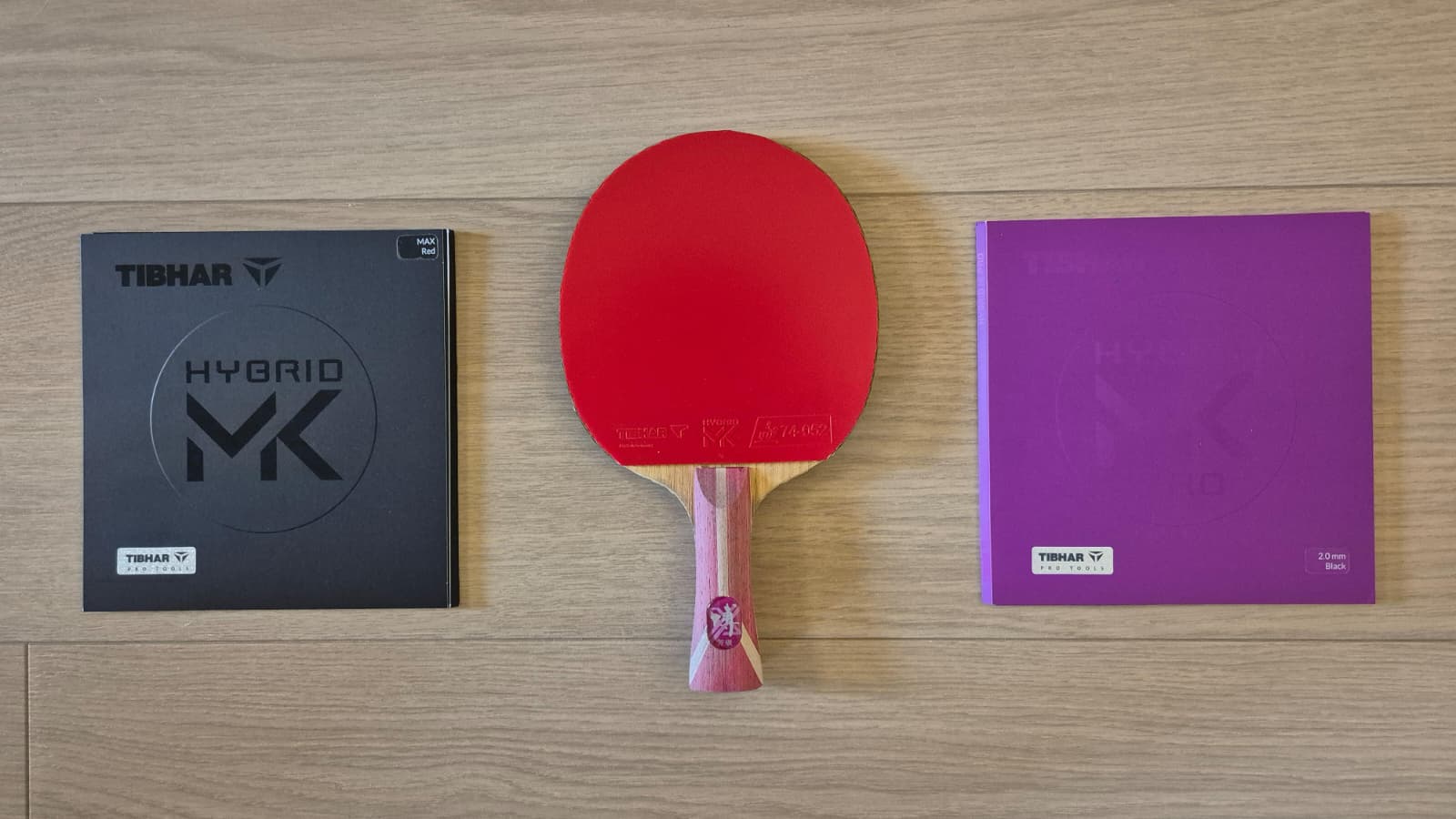
Hybrid in theory but mostly grippy tensors in practice, the Hybrid MK is the most linear and controlled tensor hybrid I've tested so far and a safe step up from tensors like the Yasaka Rakza 7, but it starts losing some of its speed after about a month, while the Hybrid MK Pro is the same story with a lot more power in the higher gears and a longer life, closer to how the Andro NUZN behaves
I keep on analysing new brands and their rubbers every month and this time I'm going to take a closer look into two of the most popular hybrids of Tibhar amongst amateurs, the Hybrid MK and the Hybrid MK Pro, so get ready for another rubber deep dive!
So just like with my previous Stiga review, I was also happy to get to test Tibhar's products in depth as my very first blade (yes, before the Stiga Allround Classic) was actually a Tibhar IV model but back then I didn't know what kind of wood I'd like (I started with balsa, but I'm more a limba guy) and I think the handle was not the right one for me (I prefer flared, not straight). In any case, there was some nostalgia going back to Tibhar's products, especially because plenty of our club's amateur players choose Tibhar for their blades (I like the Samsonov and Stratus) and rubbers (MX-P and Nimbus mostly).
And yes, you all still get the 25% off from my friends at Sport Europe - TableTennisStore.eu (in all blades and rubbers where this applies) by clicking on the button/banner below :) I got the Tibhar rubbers in my last visit to their office in the south of the Netherlands, together with the Donic BlueGrip J1 & J2 that I will review in the coming weeks. So a big thanks to them for that as always!
Finishing the introduction section, you know I like giving you a small sneak peek and summary ahead of the wall of text that is about to follow, so for this review I'd like to mention that the Hybrid MK is the safest tensor hybrid I have tested until today, it's pretty much a grippy tensor, similar to how the Yasaka Rakza 7 is, but with a bit better performance in speed and spin overall, not in durability though. So I'd consider this Hybrid MK as a very good first step towards the world of hybrids for those of you coming from the tensor world. And the Hybrid MK Pro is pretty much the faster version of the Hybrid MK, but it also has a couple other characteristics that make it different enough for you to consider buying it instead of just getting the normal Hybrid MK, especially its added gears, extra power and bigger durability, making it a closer competitor to the Andro NUZN.
Right so that was the intro and now let's get into the review! As I mentioned before, grab a drink and a snack (0.0 radler and some chips is my go-to, I'm a softie haha) and get ready for a deep dive into the world of Tibhar hybrids!
Side note: There is also a softer version of the MK rubbers (Hybrid MK FX), but I have not tested that one. The softer version is likely even more controlled and probably a rubber that tries to get closer to the world of balanced softer tensors, but since I have not tested it myself, I will not comment any further on that.

Tibhar
Hybrid MK
Tibhar
Hybrid MK Pro
The TL;DR: Hybrid MK & Hybrid MK Pro
| Category | Hybrid MK | Hybrid MK Pro |
|---|---|---|
| Weight | Medium, 46 grams cut to my B2X (MAX), pretty light for a hybrid rubber | Medium, 46 grams cut to my B2X (2.0), also very light for a harder hybrid rubber |
| Sponge & Topsheet | Medium 48 ESN degrees sponge but feels softer, it is grippier than tackier, only a very minor tack to it | Harder 51 ESN degrees sponge but feels softer, it is grippier than tackier, only a very minor tack to it |
| Speed & Gears | The most linear tensor hybrid I have tested, also with a speed cap but plenty of power initially | Linear-ish, more explosive from the medium-high gears, less clear speed cap and noticeably faster |
| Spin potential | High spin and very good grip even though it's not tacky | Similar high spin and very good grip even though it's not tacky |
| Throw angle | High throw angle, a bit lower than Rakza Z, safe medium flight that is always predictable | Lower throw angle, similar to a NUZN 48, less safety and consistently longer flight |
| Drives & Loops | Safe and linear power on all shots, very easy openings, topspin loops and counter drives, counterlooping is not as simple as with others | Less safety but more power in all shots, making them harder but more rewarding if they land, especially from the middle gear onwards |
| Serves | Good spin on serves, harder to keep ball short and low as it's expected from a tensor hybrid, still dangerous spin on the serves that wins points | Good spin too, easier on the shorter and lower serves, trickier in the longer serves as catapult activates more on those |
| Flicks | Very safe for flicks that open up the rally, but often not enough power to finish the rally, focus is control | Easy flicks on the forehand, throw and catapult combine well with the high grip, more power on BH flicks |
| Pushes | Good for pushes, quite insensitive to incoming spin, you have to watch out for popping up the return | A bit better for pushes especially in the short game and dead pushes, longer pushes are harder to do |
| Blocks | Very good at blocking, works on autopilot, excellent for controlling the tempo and for precision blocks | Also great blocking but you need to adjust the racket angle on power loops as those tend to go long |
| Flat hits | Very good at counter drives and flat hits and punches, one of the best hybrids for this as expected | Still good at those shots but a bit trickier, the catapult activates more easily and shots go longer |
| Boosting | No need to boost, perhaps only to revive the sponge tension after 3-4 months but sponge feels fragile | No need to boost, sponge is not very hard and has enough speed, durability of tension seems better |
| Price & Durability | Medium rubber segment with recurring discounts, durability seems to be the issue after around 3-4 months, noticeable after 1 month | Medium-high rubber segment but also has recurring discounts, durability seems better, probably the better value-price tradeoff |
The technicalities
I tested a black Hybrid MK Pro in the 2.0 sponge thickness and a red Hybrid MK in the MAX sponge thickness. The Hybrid MK Pro was 51 ESN degrees (38.5-39.5 shore A according to Tibhar) and the Hybrid MK was 48 ESN degrees (36.5-37.5 shore A according to Tibhar).
The 2.0 Hybrid MK Pro came in a purple-pink minimalistic package, had a very thin translucent protector (that I cut and use as a rubber protector as well, works great with hybrids) and weighed 69 grams uncut. Once cut, it weighed around 46 grams on my B2X. The MAX Hybrid MK came in an all-black minimalistic package, had the same very thin translucent protector and weighed 69 grams uncut. Once cut, it weighed 46 grams on my B2X.
Both rubbers had pretty much no inwards/built-in tension and a very low amount of tackiness out of the package, and that tackiness has stayed pretty much the same during the whole 5 weeks of testing. Since the tackiness is so minimal, you could also classify these two rubbers as grippy tensors and you would not be wrong in doing that.
Tibhar's own numbers place the Hybrid MK at 125 speed, 110 control and 125 spin, while the Hybrid MK Pro is placed at 130 speed, 105 control and 125 spin. I can imagine that these rubbers have different audiences, and I'd say that the normal Hybrid MK is very accessible for a wide range of players, while the Hybrid MK Pro will be better suited for high intermediates and advanced players.
How I tested the Tibhar Hybrid MK and Hybrid MK Pro
I tested the Tibhar Hybrid MK Pro on both the forehand and the backhand, on the DHS Fang Bo B2X and also on the DHS Wang Chuqin, and the Tibhar Hybrid MK only on the backhand of the DHS Fang Bo B2X. The Hybrid MK Pro felt to me like it could belong on both sides so I wanted to test that, but the Hybrid MK was a bit too tensorish and soft for my forehand, so I played it exclusively on the backhand, where I have to say that it fits really well.
After the testing weeks, my conclusion is that I prefer both on the backhand, mainly because of the easy catapult activation, the safety and the high throw angle (especially the Hybrid MK), which are things that I can definitely appreciate on that side as an amateur (and also what the modern backhand trend is following). But in any case, the Hybrid MK Pro was actually not bad at all on the forehand, but for me it had a bit too much high end catapult and a bit too little control and tackiness. Do keep in mind that I play boosted Chinese rubbers on my forehand though, so my forehand reference is quite different from the one of a tensor player.
Saying this because two of our high amateurs tested the rubbers and also had interesting impressions:
But anyways, to wrap up this section, the testing period was about 5 weeks, one part I tested them in parallel with the Stiga Helix Hybrid XH and the Stiga DNA Hybrid H, and then around 3 weeks with only the two Tibhar rubbers.
The Tibhar Hybrid MK and Hybrid MK Pro in depth
Sponge & Topsheet Feeling
Let's start the in-depth part of this review with the philosophy behind these two rubbers, because in my opinion, it explains pretty much everything else in this review.
The way I understand it after testing both rubbers is that Tibhar wanted to take the Tibhar Hybrid K3 and make it accessible for amateurs while increasing the durability (more on that in the durability section, worth a read when we get there)
You can see that direction in their own numbers. The Tibhar Hybrid K3 has a 53 degrees sponge with speed 118, control 100 and spin 130, the Hybrid MK goes down to 48 degrees with speed 125, control 110 and spin 125, and the Hybrid MK Pro sits in between at 51 degrees with speed 130, control 105 and spin 125. So softer sponges, more initial speed due to easier lower gears catapult activation but also more control on the higher end and a bit less spin on paper, which is pretty much the job description of a rubber made for most of us amateurs. And remember, the speed number can trick you, K3 has much more power on the higher gears than the Hybrid MKs, but more linearity in the initial gears, so when you put it together, the 'average' speed and power of the K3 is lower yes, but it's more a math illusion than anything else.
And to summarise all of the above, if you look at both of the Hybrid MKs numbers, you see the story very clearly as well, the Hybrid MK is focused on control and the Hybrid MK Pro is focused on speed. That's also how they play and the summary of this whole review in one sentence ;)
But anyways, continuing with how the sponges feel, both rubbers play softer than what they are on paper. The sponge feels fairly soft and very easy to activate, and the ball sinks into it easily, which also counts for the Hybrid MK Pro, where at 51 degrees you would expect a noticeably harder feeling (it is harder, but less than the number suggests).
The Hybrid MK is basically a linear tensor, there is not much 'hybridness' going on there aside from that linearity, and the feeling is very safe. The Hybrid MK Pro has the same kind of sponge but harder and noticeably more powerful as you go up in gears. So initially the sponge gives you less, and then when you hit harder it gives you more, which is just what you would expect from the extra hardness, so it really is the bigger brother in the most literal way.
The topsheet is the same on both in theory, and it is not tacky at all, maybe a 1 out of 10 (after cleaning it with water and a sponge it has a tiiiiny bit of tack, but you really have to look for it), but it is very grippy. Since they are basically tensors, humidity is not really a problem either, and in terms of grip I'd say they are as good as the Andro NUZN, maybe slightly less, but nothing significant, so no complaints there.
Lastly, there is no 'choking' behaviour at all, both rubbers are very linear (the Hybrid MK more than the Hybrid MK Pro), predictable and controlled. So if you come from rubbers that 'choke' the ball on the softer strokes, this will feel quite different, and in my opinion that's a good thing.
Speed & Control
As I said before, both rubbers share the same philosophy and the same approach, and really the only thing that changes is the hardness, but that one difference changes quite a lot in how that translates to the speed meter.
So the Hybrid MK has a medium-high amount of gears and the Hybrid MK Pro a higher amount of gears, so let me explain this in detail.
The Hybrid MK activates early and has a starting low-medium gear, but there is no real lower gear, so the ball always comes off fairly bouncy. It still stays controlled though, because thanks to its shorter flight distance, the ball does not travel that long. In that way it reminded me a bit of the Donic BlueGrip S2, which also had a short flight, or the Yasaka Rakza 7, which is bouncy but very safe and controlled (and I mean that as a compliment). You will mostly play the Hybrid MK in the medium and higher gears, and that is also where the speed cap is, but it is always very linear and super safe, with a very easy to handle catapult. You always feel in control, it is very confidence-inducing, and I really liked it on the backhand for exactly that reason.
The Hybrid MK Pro takes longer to activate, but it has a better low passive gear and a bigger speed cap, so you get more control at the beginning and more explosion at the end. That makes it easy to get started with, but more difficult to control at the top, because the catapult gets non-linear at the end. In that sense it's closer to the catapult of an Andro NUZN or a Donic BlueGrip C2. With the Hybrid MK Pro you also need to play the ball towards the table in the higher gears, otherwise it will often go long, while the Hybrid MK does not have that issue at all, it almost always lands on the table. And by the way, no choking here either, just a smooth transition between the gears and then a big jump at the end that only the Hybrid MK Pro has, so that's the tradeoff right there.
Worth saying though, the Hybrid MK starts losing speed after about a month, and the drop in catapult starts being noticeable from that point onwards (and I'm not the only one, other players in the TableTennisDaily forum said the same), while the Hybrid MK Pro has not given me that feeling just yet. I will come back to this in the Price & Durability section, because I think it is the most important minus point of the Hybrid MK, so keep that in mind.
Spin & Grip
Both rubbers are fairly spinny even though they are not tacky at all, but the rubber bites the ball a lot and you never experience grip issues. Humidity was also not a problem in my experience, and when it did get a bit humid, I just had to clean the topsheet with a sponge and it was good again for the next 20 minutes or so, so no complaints there either.
Both rubbers allow soft spinny balls and harder hit-brushing, but I personally enjoyed the hitting more than the brushing, so the hit-brush is where they shined for me, you get lots of grip and the ball still comes out with plenty of spin.
In terms of spin I think they both have a similar amount, just like Tibhar says (125 on both boxes). Maybe the Hybrid MK Pro has a tiny bit more nowadays, now that the Hybrid MK is losing some of its sponge liveliness, but not a world of difference. Both are very spinny, a little bit less than the Andro NUZN, that yes, but still a lot of spin, they are spin-first rubbers, with the Hybrid MK Pro a bit more speed oriented. Also, no big differences in spin like the Stiga DNA Hybrid H, just good spin on all types of shots, so that was a plus point!
So the grip and the spin are really good and I was happy about that.
Throw Angle
Both rubbers have a high throw angle, with the Hybrid MK being higher than the Hybrid MK Pro. I would say that the Hybrid MK gets more towards a Yasaka Rakza Z but just not as high, and the Hybrid MK Pro goes more towards a medium-high throwing rubber like the Andro NUZN 48, or even Hurricane 8-80-ish. So both have nice throw angles and not too much or too little, they are very balanced in that way.
And when it comes to the flight distances, the Hybrid MK has a medium flight that is really safe, it just inspires confidence since you start using it, almost all your shots land on the table. The Hybrid MK Pro on the other hand, has a bit longer flight distance (you will see this again in Drives & Loops) and needs you to play towards the table in the higher gears, but for the rest, they both land on the table on autopilot, which is where the confidence I talked about comes from (and others feel the same). And as a side note, on the DHS Fang Bo B2X, which is a fast and lower-throwing blade by nature, the throw angle of the Hybrid MK Pro was still comfortable on most shots, so I think that it says a lot.
Drives & Loops
Driving first, I cannot say otherwise than that both are very safe. The Hybrid MK starts faster, with a higher throw and a shorter flight, while the shots of the Hybrid MK Pro go lower and longer, but still with a lot of safety and net clearance. Both are very safe for warm up drives, with or without brushing, and with a great feeling on the backhand, so a nice and easy start of every session :)
With the normal topspin loops, the Hybrid MK is still very safe, with a lot of good spin, and the initial catapult gives it a great feeling. In the warm up, these loops were quite easy for my training partners to block but in the game, it's not that easy anymore because of the spin, and it gives you a lot of confidence to just attack. The Hybrid MK Pro is the same story but faster and with less safety margin. Due to that, I threw some loops long with the forehand so I had to think more about my aim, but on medium shots it's just faster and more dangerous with a good safety-power tradeoff.
Then talking about opening backspin balls, it was very easy with both, they give you that feeling that you can open everything, especially the Hybrid MK (cool!). You do need some brushing, these are not pure hitting rubbers, but hit-brush is all good. On the backhand I needed to go more upwards than with the Stiga Helix Hybrid XH, the Donic BlueGrip C2 or the Joola Dynamic, so on this shot specifically there is less throw angle than with those. But in exchange you get a safer defense and blocking experience, and that's where the tradeoff is. The main difference between the two is that with the Hybrid MK Pro on the backhand I could be more explosive, a bit like the Andro NUZN 48, and I could put balls away easily and also down-the-line, which was my favourite shot with it.
Finally when counterlooping, it was not really easy on the Hybrid MK Pro. Due to the catapult activation on incoming high power loops, it's easier for those to go long, so you need more technique, a shorter stroke and a better racket angle. It's not an impossible shot, but I did not have the confidence that I usually have on my forehand with a tacky rubber, that was a bit of a pity.
With the Hybrid MK I mostly played half counters and counter drives and it was great at doing that, many of them landed on the table. So it's much easier to counterloop with it for us amateurs, because the rubber gives you more control, and the shorter flight, the higher throw and the speed cap together mean much more safety. I think the Hybrid MK is better at the hit kind of counterloops, while the Hybrid MK Pro needs closed-racket brushing and compact strokes, as the dwell is lower on that kind of ball.
Serves
Both rubbers are good for serving, not excellent or out of the ordinary, just good and they are also pretty similar to each other. Overall, I got good spin on both, good enough to make some direct points (not always but sometimes, let's be realistic haha). I did feel though like the Andro NUZN series had more spin on serves, but not by a far distance.
The main difference between both rubbers was that with the Hybrid MK it was harder to keep the ball short and low, as the early catapult made the serve bounce a bit more on those shots, but this effect was not as intense as with the Stiga Helix Hybrid XH for example. The Hybrid MK Pro on the other hand, was easier to handle when it came to short and low (or dead) serves as the catapult is clearly more muted on the lower gears. Longer serves did not make that much of a difference but those were trickier on the Hybrid MK Pro, but overall no real complaints, they played on serves as I more or less expected given that they are really just linear tensors. For those coming from bouncy tensors it will be an improvement, for those coming from harder tackier rubbers, it will be a decrease in serving performance.
Flicks
The Hybrid MK gives good flicks on the backhand, but those are very safe and not that dangerous, mostly all of them go on the table and placement is what becomes important. So it is not the kind of power flick that you get with the Butterfly Dignics 09c, the Stiga Helix Hybrid XH or the Joola Dynamic. It's more the kind of safe, slower, arcing flick that is spinny and opens the rally, which may be good or bad for you depending on what you want from your backhand flick, but I'd say that for most amateurs, and certainly in tricky match situations, this is a good thing.
The Hybrid MK Pro on the other hand, is also very good for flicking but it trades dwell time and safety for more power. I do think in any case that those flicks were still slow-ish flicks to open the rally where the focus still was on control and not so much on making direct points. At the same time, I liked the flicks on the forehand, the throw angle, the catapult and the grip all work together to help you with the shot, and I enjoyed a higher consistency than with other higher throwing rubbers with more catapult or than with lower throwing tacky rubbers (yes, they are far from perfect too haha).
Pushes
The Hybrid MK is relatively safe on pushes because it is pretty linear and controlled, but since the catapult activates earlier than with the Pro version, some pushes tend to go higher, and you have to get a bit used to that. It also means that I did not have the same ease I have with other tackier/harder hybrids to do dead and wide pushes or aggressive long pushes with a lot of safety and grip. If you have ever tried a very tacky rubber, that grip and dwell feeling won't be here when pushing.
The Hybrid MK Pro on the other hand, tends to keep low speed pushes shorter and lower, and this is the same as with the serves, the catapult activates less, and the harder sponge is a bit less reactive on slow thin brushes. However, when you try to add some more spin and power for a long dangerous push, it has the tendency to throw the ball long, so that's the drawback here.
In any case, both are spinny if you brush with the wrist correctly, and the Hybrid MK Pro was also decent on forehand pushes. They are both quite spin insensitive too, which helps a lot with pushing, so overall I'd qualify them both as good pushing rubbers, each with its own small tensor-like weaknesses.
Blocks
Blocking is very good on both rubbers but a bit better on the Hybrid MK, just a natural consequence of all things discussed above.
The Hybrid MK is very stable, absorbs a good amount of incoming power and brings the ball back on the table with safety. Very rarely I blocked a power loop out of the table, and even though those returns were not very tricky for my opponent to continue looping, the rally kept going. If you are going to use this rubber for blocking and defense (which works all fine) do make sure to change placement and rhythm as your main way to disrupt the opponent, or go for active blocks (mini counters) which also work wonders. It reminded me quite a lot of the Rakza 7 here (one of our best regional players still uses it on his backhand and all balls go back on the table, with good placement it truly is a weapon).
The Hybrid MK Pro is, as mentioned before, a bit harder to handle on the defense side of things since it is a bit more difficult to block power loops and smashes, you need to aim better and close the racket angle more, so it requires more active thinking.
By the way, I also did a fair amount of semi-lobs far from the table when I was under pressure, and the Hybrid MK behaved very nicely there too. So yeah, the normal Hybrid MK is a great defensive rubber for amateurs, it's not just an attacking weapon.
Flat hits & counterhits
As expected coming from a grippy tensor type of rubber (also softer than other hybrids), the Hybrid MK was very good at flat hits, punches and counter drives, and I did a lot of these down-the-line. It's a rubber where you can safely punch through, and it will add the arc and spin for you, while keeping the ball on the table due to its flight distance and linearity.
The Hybrid MK Pro is the same story with a bit more power, and a bit harder to do, but both are still fantastic at this kind of shot, just like most tensors would be. And here you see their real nature again, which is the one of a linear tensor. I also really liked the counter drives more than the counterloops, somehow I had more safety when hitting a bit more, maybe that's just a feeling (it can also be my imagination of course haha), but it was good fun :D
Boosting
Please do not boost these rubbers unless you want to revive a bit the catapult of the Hybrid MK when it's coming to an end, and be careful because the sponge looks and feels very fragile, removing the glue is even a challenge already. The Hybrid MK Pro does not have those issues, so there is no need to boost it, and it will likely get too agitated in the higher gears for us amateurs.
So yeah, out of the box they are both pretty soft and have enough catapult, so if you need more speed, the Tibhar Hybrid K3 and many other hybrid or tensor rubbers are there for you, I see no real reason to boost these two.
Price & Durability
Without discounts these rubbers get into the expensive ones, going towards 60-70 euros, but usually you will find them with discounts, and their real price is more around 50 euros, which is a good and normal price for this kind of semi premium ESN tensor in my opinion.
The durability though, that's where it gets a bit bittersweet. Neither of them had topsheet issues, so no matte stains or anything like that (like the Gewo Iconixx), but the Hybrid MK started losing some of its speed and catapult after 1 month already, and you can feel it. It's subtle, but if you pay attention, it's there. From what others have said, and from my own suspicions, this rubber will be more or less finished after 3-4 months, let's say around 100 hours of play, give or take. I find that a little bit too few, and even though the grip is still good, the catapult is an important part of this rubber, so you will get even more control but may start forcing your technique. Due to that, I'd categorise the rubber as more expensive than what you may initially think, but still worth it if budget is not an issue.
On the other hand, the Hybrid MK Pro did not have any of this until now, so I think it will last longer, maybe 4-6 months at peak performance. That is also my personal bar (at least 4 months of peak performance at roughly 6-7 hours of play a week, now that most of these rubbers cost 50 euros plus), so the price-value ratio is better on the Hybrid MK Pro than on the Hybrid MK.
And for those of you who want more durability but also less linearity (which can be good or bad, you decide), you can just get the Andro NUZN, maybe with a slower blade, and it's more or less the same thing but it will last longer.
So who are these rubbers for?
You will enjoy the Hybrid MK if:
And for the Hybrid MK Pro, you will enjoy it if you like the Hybrid MK profile and characteristics, but you are looking for more power in the higher gears and more linearity in the slower gears, or simply a harder feeling.
Obviously, the reasons not to enjoy both of these rubbers are the opposite of what I mentioned above, which in this case is clear: if you want speed and raw power, stay away from the Hybrid MK unless your blade is very fast (maybe the Pro version, but likely you will prefer things like MX-P or Tenergy/Dignics), and if you want control and linearity do not choose the Hybrid MK Pro, just stick to the normal Hybrid MK or go for a more controlled tensor like the Rakza 7 or similar.
Final thoughts
These 2 rubbers by Tibhar are classified as hybrids, but they are not really hybrids, if anything they are on the edge of what I would categorise as tensor hybrids, and only because of their linearity and control in the lower gears, not really because of their tackiness (which is too small to take into account) or because of their other characteristics. And if anything, the Hybrid MK Pro would be the more tensor hybrid of the two as it has more gears.
So if you buy them, don't expect something close to the Dignics 09c or a Chinese hybrid, because you will then be disappointed, but if you buy them as a step towards control and linearity coming from the tensor world, then you may be surprised by how good they are.
So in my mind, the way I understand these rubbers in the market is that the Hybrid MK sits somewhere in between the Andro NUZN and the Yasaka Rakza 7. It is more controlled and linear than the Andro NUZN, but a bit faster and spinnier than the Yasaka Rakza 7 (with better grip also). It's also the most linear of the tensor hybrids I've tried so far, a sort of controlled Andro NUZN 48 or Donic BlueGrip S1 alternative if you want. I see a clear market for it for people who move up one step from the Yasaka Rakza 7 (not in durability though) and want a bit more by trading off some control. It also fits very well in the modern backhand trend, hence why I think it is a popular rubber in the market nowadays.
The Hybrid MK Pro is a similar story, but more towards the Andro NUZN 48 or 50, closer to a faster tensor like the Fastarc G-1, with linearity in the low and medium gears and the explosion in the high gear, so I see more competition there and a different market. It can be the rubber for backhand power attacks for players who like tensor hybrids, since it's a bit more hybrid than the normal Hybrid MK. But it can also work pretty well on the forehand, maybe as an alternative to the Nittaku Fastarc G-1, or as a faster and more tensor-like rubber than the Butterfly Glayzer 09c, while still having a less hard feeling and a lower throw angle than the Yasaka Rakza Z. And I think it can also be a good option for a more controlled setup compared to fast tensors like the Butterfly Tenergy, the Andro Rasanter or the Tibhar Evolution MX-P.
On top of that, both rubbers are quite spin insensitive, so they do relatively well in the short and defense game compared to other tensors. For me, the backhand defense was definitely one of the parts I enjoyed the most of this review.
Overall, together with the Andro NUZN, these are the best tensor hybrids I've tested so far in my opinion. Both feel soft, the Hybrid MK is amateur friendly and very safe, and the Hybrid MK Pro gives you more speed while still being sort of amateur friendly. So it really comes down to safety vs power, plus the durability of the Hybrid MK, which you need to take into account. And if both sound like a bit too much for you, there is also the Tibhar Hybrid MK FX. I haven't tested it, but I'd expect it to be more controlled and a sort of Yasaka Rakza 7 alternative ;)
That was my review of the Tibhar Hybrid MK and Hybrid MK Pro, until my next review, and see you at the table!
Need personalized equipment advice?
I can help you find the perfect blade and rubber setup for your playing style.