Loki Rxton 5 Unboosted & Boosted Review: A Hard Chinese Budget Rubber I Did Not Like Either Way
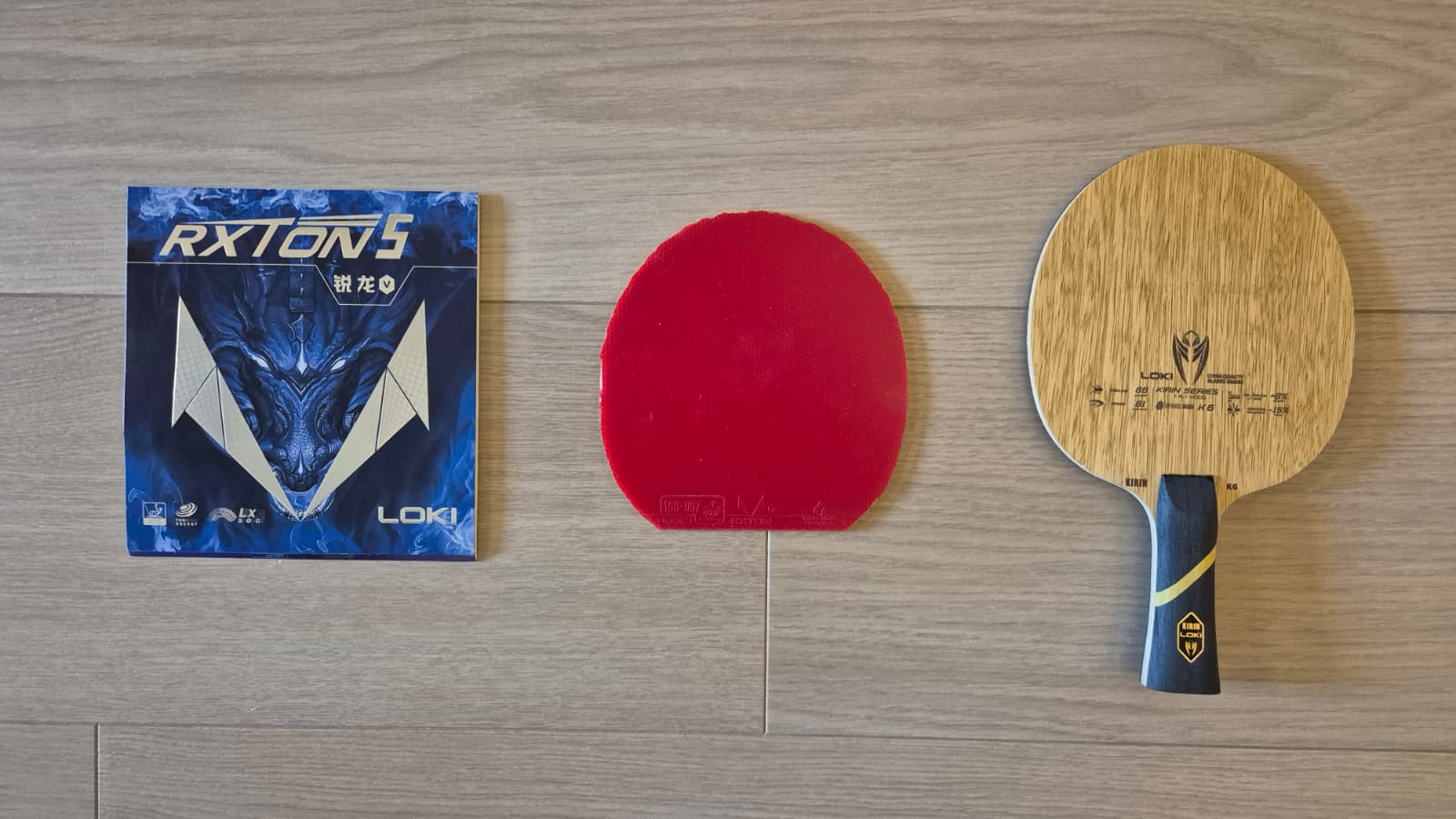
The Rxton 5 is a slow and unresponsive low throwing rubber that made me force my entire forehand technique in order to get some power out of it. Perhaps a quality control issue, but I believe that the Yinhe Mercury 2 or the Friendship 729 Super FX are better budget options for a control-first beginner rubber
I tried the Loki Rxton 5 a couple months ago, and I never got to make a review out of it because I really did not like it, so today I'm going to close that loop and unfortunately give it a negative review to inform others who may be interested in buying it. And before we start, I also want to mention that I only tested it for around 15-20h (not my usual 4-5 weeks), it was long enough and I really had to force myself to play with it in games or training, as I missed too many forehand shots, and those that landed on the table, had no real danger for the opponent.
Fortunately for Loki, I’ve since tested some of their other products (Arthur China, Rxton 9 Orange Sponge, K5, K6, W81 ADC) and I quite enjoyed those (will add reviews soonish), so either it was a bad batch, or just an older version of the Rxton rubber line that belongs to the past, as I actually quite enjoyed the new Rxton 9 with the orange sponge for example, it’s a great rubber when boosted.
Finishing the introduction section, I usually like giving you a small sneak peek of the long text that is about to follow, but for this review I will keep it short: the Rxton 5 felt very slow and dead in my hands, it had a very short and low flight which I found very hard to handle, and boosting it didn’t make too much of a difference. Perhaps it could be an alternative to the Friendship 729 Super FX for beginners, but I started using that rubber when I started my table tennis journey (and most of our beginners still use it too) and I still somehow find it more trustworthy than the Rxton 5.
Right so that was the intro and now let's get into the rest of the analysis, as mentioned before, I’m going to keep it much briefer than usual.
Side note: There is also a Loki Rxton 5 Pro with a blue sponge, but since I have not tested that myself, I will not comment any further on the topic.
Loki
Rxton 5
The TL;DR: Loki Rxton 5
| Rxton 5 unboosted and boosted | |
|---|---|
| Weight | Light, around 45g cut to the B2X and 47g after boosting it |
| Sponge & Topsheet | Hard and dead feeling in the hand, medium tackiness at the start that wears off pretty quickly. Boosting didn’t change the deadness that much, it did soften the sponge. |
| Speed & Gears | Very slow, not many gears, slow and medium slow unboosted, just a notch faster and livelier when boosted. |
| Spin potential | Spinny, maybe one of the best things of the rubber for the price that it has, boosted it was a bit spinnier |
| Throw angle | Very low throw angle and short flight distance, many balls didn’t clear up the net, boosted it improved a tiny bit |
| Drives & Loops | Not pleasant to loop with, drives were okayish but needed fairly more force than usual, after boosting it got a bit better |
| Serves | Easy to keep the serves low and short, long serves were average in spin, not too fast, boosted it was a bit better |
| Flicks | Not easy and/or confidence inducing for forehand flicks |
| Pushes | Easy to push short and low, main problem is to clear the net with those shots, longer pushes were easy and had decent spin |
| Blocks | Very good for blocking, the rubber absorbs most of the incoming tempo, you just have to be careful not to drop it in the net |
| Flat hits | Not made for this, very bad at any sort of flat contact |
| Boosting | If you are going to play it, play it boosted, but a lot of hassle to do this for a cheap rubber and for starting players |
| Price & Durability | Very cheap (similar to 729 Super FX), seems fairly durable, 3-4 months without boosting, 2-3 boosted max |
The technicalities
Starting with the technicalities, the Rxton 5 I tested had the blue dragon and silver V packaging, it came in red, had a thickness of 2.1mm and it was labelled as 41 degrees Hard in Shore A. The package also mentions that the sponge is of the type ‘Loxa’ and the rubber had quite the smell when I opened the package. It was ~45 grams cut to my Fang Bo B2X / Loki K6 when unboosted, and got to ~47 grams when boosted, still pretty light for a classic hard Chinese rubber. Worth mentioning that out of the box, the sponge feels and looks very similar to a Hurricane 3 orange sponge.
Out of the package the topsheet was hard and medium tacky, but that tack started to wear off quickly and nowadays is pretty much non-tacky. The sponge feels very hard and unresponsive with a classic Chinese feeling but a bit more extreme in this case, definitely less responsive than a Hurricane 3 Neo or a Big Dipper 5. Some people have mentioned that it feels a bit like a classic Hurricane 3, and I can understand that (especially from the looks of it), but I’d rather play with an old Hurricane 3 than with this one. At least from my memory, the classic Hurricane 3 performed better in almost all areas, for sure when boosted, like day and night.
How I tested the Loki Rxton 5
I played the Rxton 5 exclusively on my forehand (B2X and K6), as it was even harder to play on the backhand. I can see that some players may enjoy such a rubber on their backhands for controlled blocking and defensive types of backhands, but I like to be aggressive with my backhand and this rubber was not the right type of tool for that.
As I mentioned before, the testing period was about 15-20 hours (felt way too long), which is less than the 35-40 hours I normally do for a full review and the reason why this one is a mini review, so the durability part is more of an expectation than a verdict, and some details would probably still shift with more hours on it.
Regarding the booster, I applied 1 thick layer of the Haifu Seamoon yellow booster (commercial).
The Loki Rxton 5 in depth
Sponge & Topsheet Feeling
The first thing I noticed with the Rxton 5 was that the rubber felt very hard and unresponsive (read: dead) with pretty much any kind of drive or loop. This was also the main reason that got me to boost it later on, because I felt like the 41 degrees sponge was impossible to play with, in the beginning I missed most of my shots. And sure, most of these old school Chinese rubbers need some break-in period, others also mention this online, but with my sheet, the break-in period never really occurred, even after boosting it, it just became a bit livelier, that’s all.
So unboosted the Rxton 5 is a slow hard dead rubber that I would not recommend to any player and boosted it’s where I could maybe see beginners using it instead of the Friendship 729 Super FX, but it’s quite the hassle to boost a beginner rubber, so I’m not recommending that either.
Also worth mentioning that the topsheet starts medium tacky out of the package, but don't get too attached to that feeling, as the tack wears off quickly, and nowadays it’s not tacky at all.
Speed & Control
As I mentioned above, unboosted, the Rxton 5 is very slow, it is maybe faster than the Friendship 729 Super FX (hence the mention above) but in my opinion it has less control. This is because of the super short flight it has, so many balls end up in the net in the beginning. And you can’t really fix that with more gears, because the rubber does not have a high gear, it’s pretty much a slow and medium slow gear, and no matter how hard you hit, that’s just that. So you end up forcing your technique for more power, but not getting that much profit out of that.
Boosted, it gains a little bit of gears and liveliness, and more balls clear the net as the speed is higher and the throw angle a bit higher, so control increases. I’m not sure if Loki always intended the Rxton 5 to be boosted, but that’s how it feels to me.
Overall, I did not feel like I was in control with this rubber, so I would rate the speed as very low and the control as low too, but not because it’s fast or non-linear, but because I did not find it predictable/trustworthy and thus had no confidence with it.
Spin & Grip
Spin is where the Rxton 5 does well for its price, unboosted it's already spinny and boosted the spin is a bit better, but what I did find is that the rubber was at its best when you brushed it, more than when you hit brushed it (sure, you can hit-brush it hard and it works especially when boosted, but control diminished a lot), sort of like the 729 Super FX. This sort of reminded me of the old way of playing table tennis, with very long and spinny forehand brushes.
The grip is fine initially but after the first few sessions it starts degrading a bit as the tackiness starts fading away. You can still play with it though, it just bites a bit less and is a bit less spinny.
Boosting it made the sponge softer so some of the spin came back, grip also improved and tackiness degraded a bit more, or maybe it was already on its way to degrade, I can’t be sure of that.
Throw Angle
The throw is very low unboosted, it is one of the rubbers in my rubber database with such a low throw angle so far, so keep that in mind if your blade is already on the low-throwing side (like my B2X). Combined with a very short flight distance, the rubber really was not easy to use at all, and many normal shots ended in the net as I said above.
Boosted, the throw gets a tiny bit higher and the flight distance increased a bit too, so that's a plus point for boosting it, but again, if I really need to boost a beginner rubber with 3 layers or 4 in order to make it work, then it is not worth doing that (time and money) unless you are getting top performance out of it.
Drives & Loops
When unboosted, drives are very slow and I had to adjust a lot to make sure they would go on the other side of the table, it just takes more force than usual (and needed really) to get the job done, I did not enjoy the dead slow feeling there.
Topspin loops are pretty much the same, thin brushing worked sort of okay, but normal hit-brush loops were a pain to execute and very inconsistent plus they give you a sore body from forcing the technique which is not what you want.
Opening loops were very difficult to execute correctly and safely due to the low throw angle, and counterlooping was pretty much impossible for me, nothing worked like I was used to with my normal Hurricane 3 Neo or similar (even Battle 2 or Target National are much better at this)
Boosted it was a bit better, but since I only applied one layer, I think that I did not get to the point where the rubber would actually start behaving like it should, I had to do a bit less effort, but it was still inconsistent and not safe in any way.
Serves
Serving short was not too hard given how low the catapult of the rubber is, and the spin the rubber initially has, so it was all right, I just had to put more force than usual into it so the ball would go over the net. Serving long was more difficult and those serves had very little speed or danger for the opponent, spin again was fine.
When boosted it got a bit better but nothing remarkable for me to mention here.
Flicks
I tried to flick a couple times on my forehand and it was not a pleasant experience, you have a lot of things working against you: the very low throw angle, the lack of any catapult effect, the rubber’s sensitivity to incoming spin, etc. So I basically did not flick with it, a dead short push was better. Boosted again made no real difference.
But well, since this is a rubber made for beginners and low intermediates in my opinion, a forehand flick is the lowest of the priorities so then it can be just fine.
Pushes
As mentioned before, short and low pushes are one of the easiest things to do with this rubber, because you have all the factors working for you here. The only problem is not to net those shots, and I had to put more force than I usually would on passive dead pushes. On active thin brushing pushes, it was fine and you could also do some decent long pushes, also when boosted, as the boosting effect didn’t hugely affect its lower gear catapult.
I think that for the public that this rubber is intended for, pushing and blocking as I will mention below are some of its best capabilities.
Blocks
Blocking is very good unboosted, which is the logical consequence of how slow and linear the rubber is, all the incoming speed and tempo seems to die down easily and gets absorbed by the rubber, so you mostly just have to be careful not to net those shots down. Active blocking was more difficult as the rubber does not help you there, also not really when boosted.
Blocking is one of the best things of the rubber for sure, and I can imagine that some traditional Chinese penholders and defensive players may even enjoy this rubber on their backhands as a sort of disruption and surprise tool.
Flat hits
The worst section of the Rxton 5 is for sure flat hitting, it just won’t work with that, boosted or unboosted, no difference, one of the worst (if not the worst) rubbers I’ve tested for that.
Boosting
The rubber is clearly made to be boosted unless you want to use it as a brick wall for defensive purposes and as a disruption tool. Sometimes I even felt like I was playing with a rubber that needed the good old speed glue, a sort of Mark V or so, but worse.
I did not want to overboost it initially, but in hindsight, I should have boosted it more to get something out of it, but yeah, if after one thick Haifu layer it still is not responding correctly, then I sort of give up, it takes a fair amount of time to boost with 3-4 layers plus the money you spend on the booster.
But in any case, I just don’t think this makes any sense for starting players, as you can get a Mercury 2 for the same price and be happy with it from the get go. Or a 729 Super FX which does not need to be boosted and plays better out of the box in my opinion.
So yes, it needs to be boosted, but I’m not sure I’d bother as a developing player, bringing us to the natural conclusion that I would not recommend this rubber to anyone.
Price & Durability
The price is great, nothing to be said about that, it’s similar to the 729 Super FX and since the rubber is in the same category for me, that’s why I could see it as an alternative to it.
Durability is also not that bad for the price, but worse than the 729 Super FX, which can stay all good for 6-9 months with good care. I think the Rxton 5 will work for about 3-4 months unboosted (even though tackiness will fade away in the process and end up being non tacky) and about 2-3 months boosted, maybe less. For a rubber of 10 euros this is not bad.
So who is this rubber for?
I cannot think of too many use cases for this rubber, especially unboosted, but here are maybe some:
Everybody else, stay away from the Rxton 5 and buy the Rxton 7 or 9, which are much better options in the market from Loki nowadays.
Final thoughts
I think the conclusion is clear on this rubber, just don’t buy it and get yourself something better regardless of your intended use cases and level.
If you are a beginner, you have much better tools available out there that do not require boosting and where you will more easily learn the modern technique. If you are a low intermediate and like Loki, go for a Loki Rxton 7 (heard better things) or 9, I really enjoyed the Rxton 9 recently (boosted of course) and it can be a great Hurricane 3 Neo alternative. Or just get the normal DHS Hurricane 3 Neo, don’t boost it yet and problem solved :)
And if you are a normal intermediate player or above that, just don’t buy this unless you want to start losing matches and getting a sore body, there are better ways to force yourself to do a workout (go to the gym or for a run haha)
Lastly, I still don’t discard that I got a faulty rubber this time, I have read enough of those cases where QC was very poor, but still, I have never had too many issues with other budget rubbers like the Mercury 2 or the 729 Super FX, so it should not be an excuse.
All right everybody, that was my mini (rant) review of the Loki Rxton 5, until the next review, and see you at the table!
Need personalized equipment advice?
I can help you find the perfect blade and rubber setup for your playing style.