Back to all articles
    Equipment Guide

    What Are Hybrid Table Tennis Rubbers and Why Are They So Popular?
    Victor
    10 min read
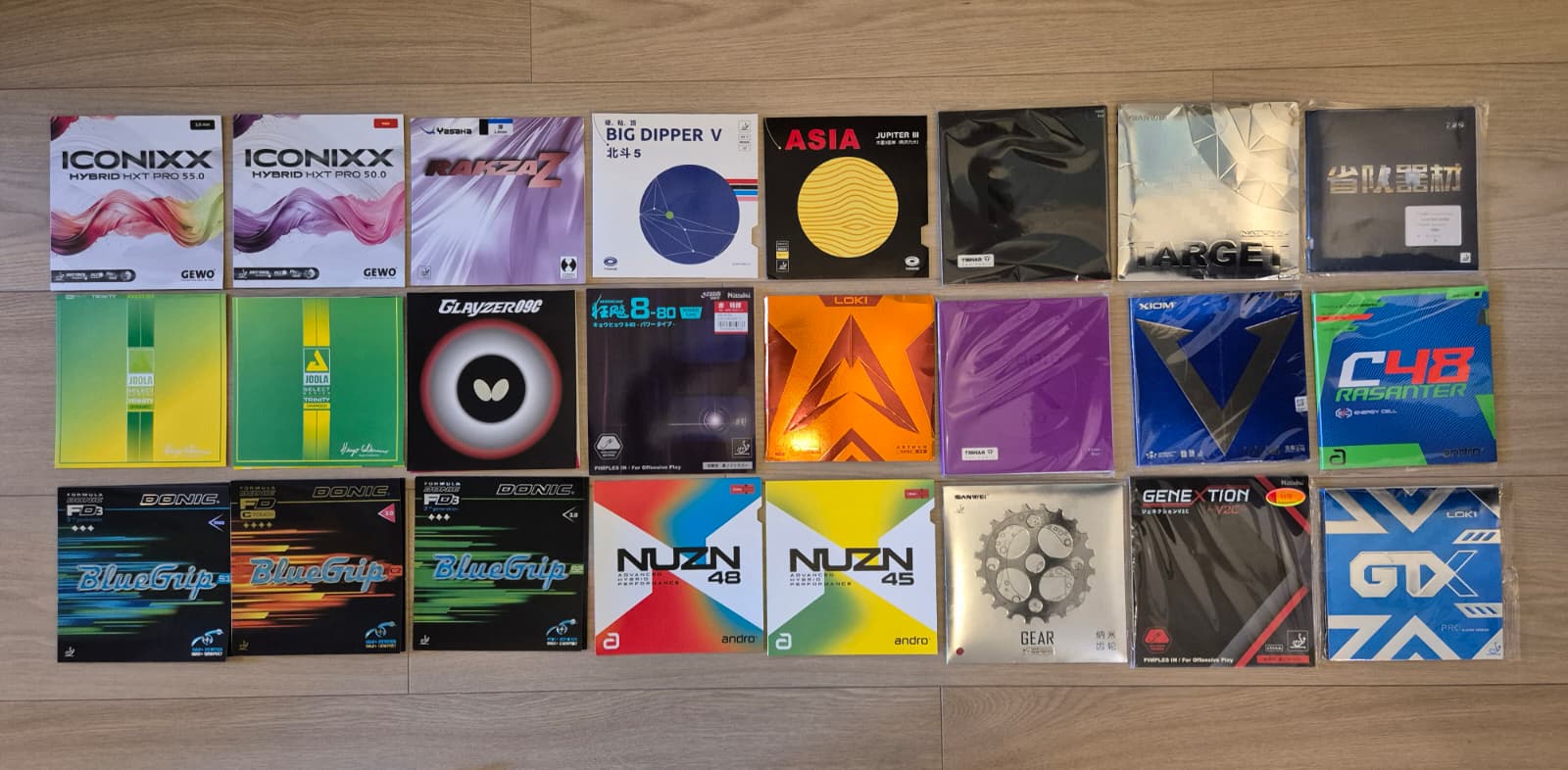
    Collection of hybrid table tennis rubbers tested by Victor including Donic BlueGrip, Andro NUZN, Yasaka Rakza Z and more
    Hybrid table tennis rubbers I've tested this year (and some I still want to test soon)

    It seems like every table tennis brand is launching a new hybrid rubber nowadays, but why? In this article, I tell you what hybrid table tennis rubbers are, the different types available, and what makes them so popular, all in a simple and understandable way.

    I really like hybrid rubbers and since I often write about them, I usually get questions like: 'What is a hybrid table tennis rubber?', 'What's it with the hybrid hype?', 'What is a tensor hybrid and a Chinese hybrid?' or 'Should I start playing with hybrid rubbers?'.

    These are good questions and since the topic can sometimes get a bit complicated, I thought about making a simple and straightforward amateur guide. It's going to be shorter than usual because I want it to be as easy to understand as possible, without going into too many technicalities (I'll need to have some of it, sorry in advance!). So if you are already a pro in hybrids, this article may not be for you. If not, you are more than welcome to keep on reading!

    Let's get into it!

    What Is A Hybrid Table Tennis Rubber?

    A hybrid table tennis rubber is a rubber that combines the best properties of a tensor rubber with the best properties of a tacky rubber. Hence the 'hybrid' name, which refers to the mix of both worlds.

    There are a thousand nuances here, but to simplify the topic, let me briefly explain what a tensor and a tacky rubber is:

  1. Tensor rubbers (aka ESN/European/Japanese/Korean) have traditionally combined a softer sponge (not always though) with a non-tacky topsheet (aka sticky), and they work by easily letting the ball sink into the sponge to catapult it forward. By nature, they have a more pronounced rebound effect that is activated quickly and without too much effort. We call this 'non-linearity', because you get more back than what you put into it.
  2. Tacky rubbers (aka hard/sticky/Chinese) have traditionally combined a hard and firm sponge with a very tacky/sticky (and usually also firm) topsheet, and they work by combining the topsheet friction with as much catapult as the user can produce at contact point (the concept of hit-brushing I've explained in other blogs). By nature, they are much more linear, so they give you what you put into them and have a way less pronounced catapult effect, which is also harder to activate, but when activated, can be equal or more powerful than a tensor rubber.
  3. There is much more to explain here, things like:

  4. Softer rubbers bottom out more easily than harder rubbers
  5. Tacky rubbers with very hard sponges need a different technique and maintenance
  6. Not all tensors are that soft and not all tacky are that hard
  7. A lack of catapult is not always good (i.e. quick explosive backhand rallies)
  8. Very hard rubbers have more high end power but are harder to handle at low/medium contact speed, so tensors are often easier to handle by beginners and intermediates
  9. Tacky rubbers generate more spin (and often have more grip) at low contact speed, which is handy for serving and returning
  10. Lastly, a blade has a lot of influence on the rubber, the same rubber on different blades can be both wonderful and terrible.
  11. The above is already a lot, and because all of it would require its own piece of text, and I already got into too many details here (and this is meant to be a 101 blogpost), let me summarise this for those of you who are like: 'Victor, I still don't get it, explain it simpler', so here's my attempt to explain this whole section in one sentence:

    'Tensor rubbers are naturally bouncy while tacky rubbers are not. A hybrid combines the best of both worlds to give you more possibilities'

    And the word 'possibilities' is the whole point of hybrids, sometimes you need bouncy, and sometimes you don't, sometimes you need tensors, and sometimes you need tackiness, hence why hybrids exist. So let's get into that in detail.

    Why Are Hybrid Rubbers So Popular Today?

    I'm sure that the first time you heard about hybrid rubbers you thought: 'Yeah sure, but what's the point?'

    The point is that by mixing the best qualities of a tensor rubber with the best qualities of a tacky rubber, you get a new type of rubber that gives you more possibilities, more tools, and more gears in a table tennis game. So in the end, you are more likely to play each rally situation in a more optimal way from an equipment perspective.

    So what does that really mean in practice?

    Well as you all know, different table tennis situations require different shots, which are played at different contact speeds/force. In plain terms, sometimes you want to softly brush the ball, and sometimes you prefer to hit it as hard as you can.

    For example: A short serve is done by contacting the ball at a fairly low speed, otherwise it may go long if you apply too much impact. And a winning loop is viceversa, you want to contact the ball as fast and hard as possible to finish the point.

    And once we know that, then it is simple to see where I'm going:

  12. During a serve, a short return, a passive block, or a wide ball you need to save, we don't want too much catapult, we don't want the rubber sponge to activate too much, because in those situations, we need control, stability, linearity if you wish. And if we can add some extra spin and dwell with some tackiness, even better of course.
  13. But for a long and fast serve, a normal drive, an opening loop, or an active block for example, we may need a bit more catapult to help us achieve more spin and speed, and the tackiness will still help us here.
  14. And for sure, if you are going for a winner shot, you definitely want the rubber to help you create some extra explosiveness and spin, certainly on the backhand, where your body is in the way and the timing is harder. (This is also why I often prefer a more linear forehand and a more tensor backhand)
  15. So you see, different game situations require different rubber behaviours, and that was pretty hard to achieve in the past before the arrival of hybrid rubbers. Both tensor and tacky rubbers have their pros, but also their cons, so as an amateur player (pro and advanced players follow different rules) you were almost always playing suboptimally in certain situations depending on your rubber choice. For example, a fast tensor would not allow you to control the short serve as much as you may want, and it would often have less spin than desired. You could fix that by changing to a tacky rubber, but you would then suffer when activating the sponge and getting 'free' power.

    With a hybrid rubber, you can nowadays keep the short serve low and spinny, while later on easily finishing the point with an explosive shot without needing to have the perfect technique, condition and footwork. You can essentially experience what many pros have always experienced, but without their bodies, their timing, their technique and their contact speed. That is the point of hybrids, and that is what it means to give you more possibilities, more options to play optimally in every situation.

    You now understand why hybrid rubbers are so popular nowadays, and why in my opinion, they are the future of table tennis for most of us amateurs.

    Are All Hybrid Rubbers The Same?

    Before I get to the final part, I wanted to take a bit more of your time for one small section to talk about the different types of hybrid rubbers. Many people think that all hybrid rubbers are the same, and that's definitely not the case, there are 3 distinct flavours in the market nowadays, and understanding those helps us choose the better hybrid for our own needs, style, level, etc. The types are:

  16. Tensor hybrids: These are basically tensor rubbers with more linearity in them. So essentially a tensor rubber that does not activate its catapult as fully and easily as a normal tensor. For example, if you think of the Tibhar MX-P and compare it with the Andro NUZN, the NUZN has a more linear behaviour and also more low-end gears, but it is not too tacky and it's still pretty explosive.
  17. Pure hybrids: These are the hybrids as you would expect them, they are more or less linear at low and medium speeds, and explode more at high speeds. They are usually tackier than the tensor hybrids and also have a different composition (more dense and shorter pips, smaller pores), and often a less cakey sponge and a firmer topsheet. In this category you can find the Butterfly Dignics 09c, the Yasaka Rakza Z or the Joola Trinity Dynamic for example.
  18. Chinese hybrids: These are essentially the opposite of the tensor hybrids, they take a chinese baseline, and they add some non-linearity and 'tensor-ness' to it, so you will find rubbers like the DHS 8-80 or the Yinhe Big Dipper V in this category, but there are many more examples. It's the attempt of the Chinese manufacturers (and others) to create a Chinese rubber that is easier to play/handle than a normal hard and tacky Chinese rubber, often not requiring any boosting.
  19. So those are the usual types in the world of hybrids, and now that we have discussed that, let's get to the final part where I'd like to give you a summary of which hybrids are for which players and whether you should change or not.

    Who Are Hybrids For And Should I Change?

    After reading all of this, you may be wondering whether you should change and start using hybrids. That's already one important question and decision, and after that, you have a second one, the kind of hybrid to choose. Since this is not a straightforward decision, let me give you some pros and cons before changing, and then I'll explain what your options could be depending on the type of rubbers you play today:

    The pros of changing to a hybrid rubber:

  20. You get more gears overall, so more options and possibilities in your game, meaning that in the long term your game will improve
  21. You get more control and dwell time, specially in the low gear, so better serves, receives, blocks/defense, etc
  22. You get a rubber that 'often' lasts longer than an average tensor (i.e. Tenergy 05)
  23. You may discover technical gaps that you didn't realise before, and improve on them
  24. The cons of changing to a hybrid rubber:

  25. Unless you go for a tensor hybrid, you may need to adjust your technique, especially with the hard rubbers (you will need to learn to hit-brush and use your body)
  26. Hybrid rubbers are usually heavier than tensor rubbers, but if you play with tacky rubbers, they may be the same or lighter, so perhaps not a direct con, but worth mentioning!
  27. You will lose the initial explosiveness, so it will be more difficult to generate pace initially, and you will make more mistakes in the short term
  28. You need to clean them with water and a table tennis sponge after every training session (or game evening) plus apply a rubber protector, otherwise they will last you a couple weeks only as the tackiness can be gone very quickly without proper maintenance
  29. Lastly, harder linear rubbers are more physically demanding, this could be a bad thing but could potentially be a good thing too ;)
  30. So those were the generic pros and cons, and these are the criteria I'd follow in case you want to change:

  31. Are you playing with tensor rubbers and need a bit more linearity, dwell and control, especially in the short game? You can then check some linear tensors like Rakza 7 or Fastarc, and if that does not convince you, check out the tensor hybrids like Andro NUZN or Tibhar MK (MK review coming soon!)
  32. Are you playing with tensor rubbers and you'd like to greatly increase your dwell time and control, and also learn how to play with harder tackier rubbers in case you ever want to play with Chinese (hybrid) rubbers? Then go for a pure hybrid first, something like Glayzer 09c or Rakza Z or Iconixx 50 (Iconixx review coming soon!) as a step in between. Going from a full tensor to a full Chinese rubber is tough, and you will lose a lot initially plus your body may hurt, so go in small steps first.
  33. Are you playing with tacky rubbers and you need to go a bit easier on your body, your technique and on activating the rubber, for example on your backhand? Then go for a Chinese hybrid or a pure hybrid, both work, something like the DHS 8-80 works wonders on the backhand, but you can also go for Iconixx 50 or Rakza Z or Joola Trinity Dynamic and have a lot of fun. If you want Chinese but just a bit easier, go for a Chinese hybrid, and if you want even more ease of activation, go for a pure hybrid.
  34. Lastly, for beginners, I'd go for a cheap Chinese hybrid like the Yinhe Mercury 2 and learn a lot with it. But you don't need to, you can also go for a classical linear tensor (i.e. Vega Intro) or a classical Chinese tacky rubber (i.e. 729) and be happy with it.
  35. Final Thoughts

    I have played many sports and (video/board) games in my life (and still do!), and I know that having more options in a competitive situation is always better. You never know what the opponent is going to throw at you, so having more alternatives in your toolbox can come in handy in most situations. This is why I think that hybrid rubbers are the future for amateur players, and why I see them becoming more and more popular amongst players like you and me.

    With the release of many next-gen hybrids this year, there are more options than ever, so it can be fun to try some new stuff every now and then and see if it improves your game, you never know until you try ;)

    That was all for today good people, thanks for reading this blogpost and see you at the table!

    #hybrid rubbers#tensor rubbers#tacky rubbers#Chinese rubbers#equipment guide#amateur table tennis

    Need personalized equipment advice?

    I can help you find the perfect blade and rubber setup for your playing style.

    More Articles

    Continue exploring equipment insights and guides.