Joola Trinity Charged vs DHS Hurricane 3 Neo Comparison: Speed & No Boosting vs Spin & Customization
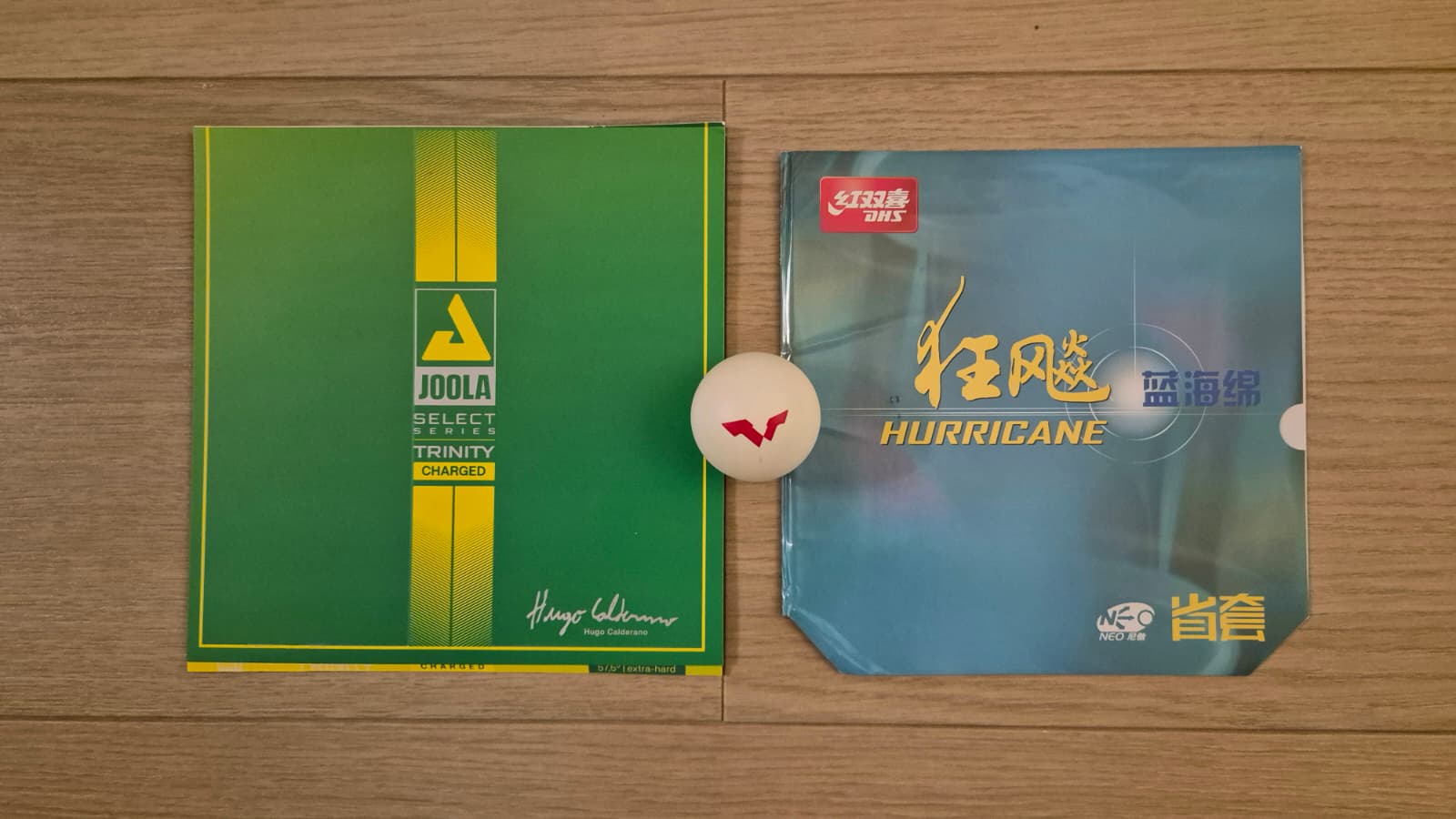
The Joola Trinity Charged gives you boosted blue sponge Hurricane speed straight out of the package with a livelier feel and no boosting hassle, but you trade away the rubber customization possibilities and more dwell time and spin overall
I recently reviewed the Joola Trinity Hugo Calderano Charged and I described it as a well boosted blue sponge Hurricane with a tensor flavour to it. Since then, many of you have been asking me to make a more detailed comparison like I've done with other rubbers, so here it is!
As you will see in the whole comparison, the Joola Trinity Charged offers a lot of the good things that the boosted blue sponge Hurricane 3 Neo has without the need for boosting it (speed, feeling and slightly less spin), but this is immediately its main tradeoff. With the Hurricane 3 Neo you can choose your sponge hardness more accurately and you can then decide how much booster to apply, which one and how often, and how long you let the rubber rest in between. Changing any of those factors gives you a different rubber so you can have a very similar experience to the Trinity Charged, but most players like me will prefer not to tension the sponge that much and focus a bit more on balance and control, gaining more dwell, spin and safety overall. So that is what this comparison is going to be about.
I do think that these two rubbers are after the same kind of player and the same kind of shot, the modern Chinese style forehand loop with a proper hit-brush, so do take that into account before buying it, it is not a rubber made for a short, compact and brushy loop, because then you will not really gain all the advantages of the rubber as you won't compress the sponge enough (so the sponges won't activate and you will mostly play with the topsheet, can work but it's not what the rubbers are made for).
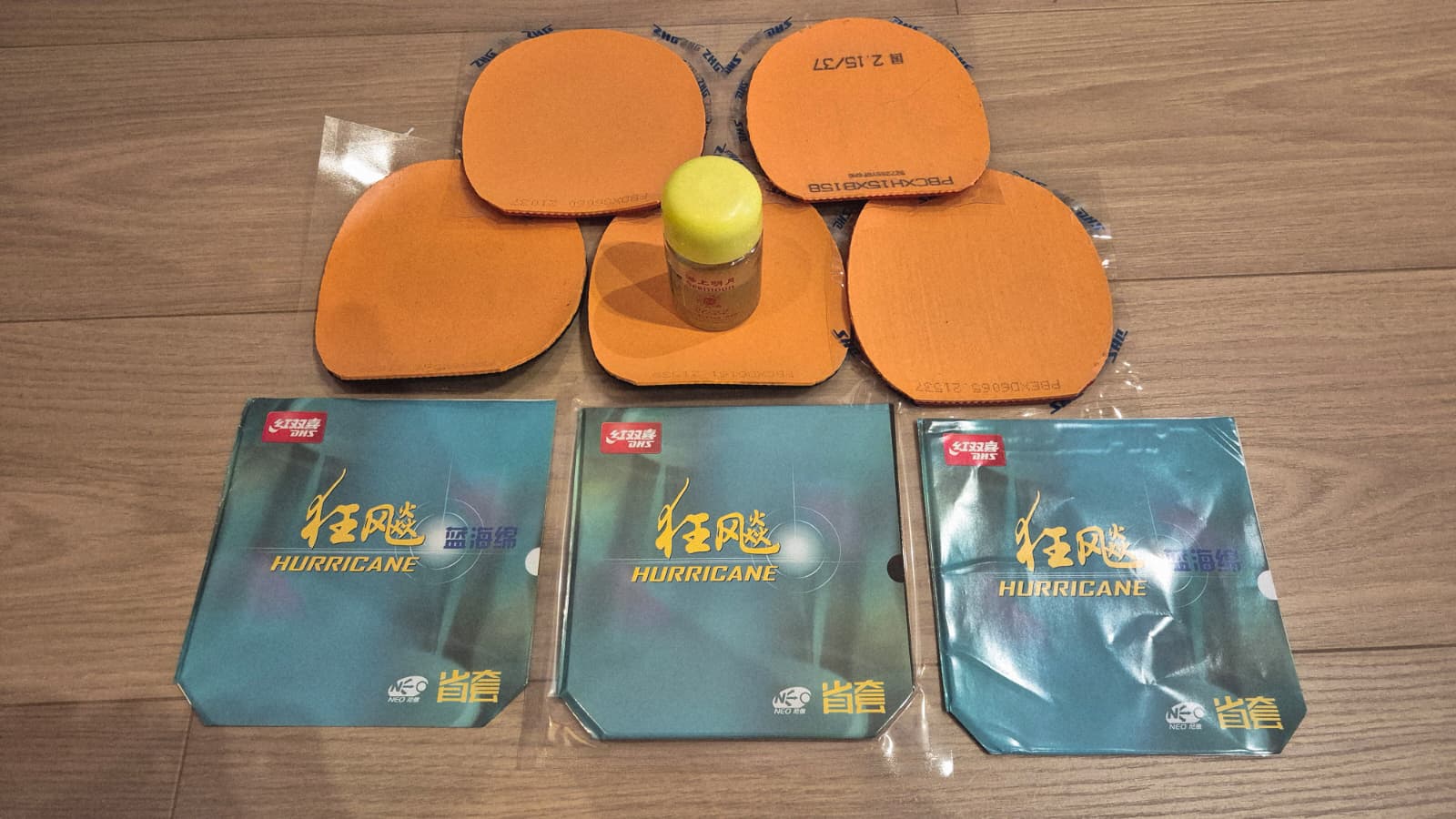
One important note before we start though: the Hurricane 3 Neo is a family of products and not a single rubber, so everything I say here is about the provincial 39 degrees blue sponge, boosted, which is the version I recommend to amateurs and the one I play myself. If you want all the details on both, you can always read the full Joola Trinity Charged and Dynamic review and the full Hurricane 3 Neo guide.
OK, that was the intro and now let's get started!
Trinity Charged vs Hurricane 3 Neo BS Prov. Boosted
5 of 12 ratings differ.
| Rating | Trinity Charged Joola · Pure Hybrid | Hurricane 3 Neo BS Prov. Boosted DHS · Tacky |
|---|---|---|
| Weight | 56.5g (Max) | 52g+ (2.1) |
| Hardness | Very hard | Very hard |
| Tackiness | Low | Very high |
| Ease of use | Demanding | Demanding |
| Spin potential | Very high | Max |
| Speed potential | Max | Max |
| Overall gears | Very high | Very high |
| Throw angle | Medium | Medium |
| Flight distance | Long | Long |
| Attack value | Max | Max |
| Defense value | Medium | High |
| Peak durability | 4-6 months | 6-8 months |
All rubbers tested for 35-40 hours on the same DHS Fang Bo B2X. Ratings are my own and therefore subjective.
Joola Trinity Charged
Get it if you want similar speed and feeling without touching the booster bottle and you are fine trading off spin, dwell time and balance overall.
DHS Hurricane 3 Neo
Get it if you want the best Chinese hard tacky rubber in the market and enjoy fine tuning the experience to your own liking, while accepting the hassle of the boosting process.

Sponge & Topsheet
Joola Trinity Charged: a 57.5 ESN sponge that feels softer and livelier than that number suggests, and one of the closest rubbers I have tested to a well boosted blue sponge Hurricane. You get that same lovely metallic click feeling on a proper hit-brush, but with a bit more feedback, a bit more bounce and noticeably less dwell and safety, and the topsheet is only slightly tacky rather than properly tacky. The rubber is overall quite heavy though, so keep that in mind.
DHS Hurricane 3 Neo: I always play with the 39 degrees (so it's less heavy than the Charged), so in theory that would be softer than the Trinity Charged but it often feels deader unless you boost it a lot. The provincial topsheet is very tacky by today's standards out of the package, and once boosted the sponge gives you that deep sink feeling and the loud metallic crack that tells you the sponge is actually activated, plus the kind of feedback in your hand that tells you whether you did the right thing or not.
Speed & Control
Joola Trinity Charged: clearly faster on the initial gear, the rubber is built for speed and aggression, it wants it and it also demands it, so if you go half in or doubt a bit, the ball will either land in the net, go long, or just be an easy shot for the opponent to counter. On the medium and high gears it is a rocket, especially on outer blades and with a proper hit-brush motion, though not immediately as fast as your classical tensor rockets like the Tibhar Evolution MX-P.
DHS Hurricane 3 Neo: the ultimate linear rubber with virtually infinite gears, so on soft touches and short balls the low catapult and the high tackiness keep everything calm and under control, and when you fully commit with legs, body and finger it becomes as fast as you can hit. Think a lot less catapult than an Andro NUZN or a Tibhar Hybrid MK, and also less than a Butterfly Dignics 09c initially, which is great for control as long as your technique is there, and not so great when it isn't. But if you go for the shot and have good technique (and the rubber is properly boosted), speed is as much as you can handle, more than enough for any of us amateurs.
Spin & Grip
Joola Trinity Charged: lots of spin on all shots with no clear cap, more than the Donic BlueGrips and the Yasaka Rakza Z, a bit more than the NUZNs, and similar to a Dignics 09c and a Stiga Helix Hybrid, which for a rubber that is only mildly tacky definitely surprised me. Grip was never an issue either, not even during the most humid summer months we have had in the Netherlands in a while, so no complaints at all there.
DHS Hurricane 3 Neo: this is where it shines, when you brush the ball properly (this is really important, you must lead the brushing motion with the index finger) the spin is on the level of a Dignics 09c and in my opinion higher, and it is probably as much spin as you can get nowadays with the plastic ball. I would say that it has a bit more than the Charged, which the Joola compensates for with a higher amount of speed and power instead, so that is the tradeoff there.
Throw angle
Joola Trinity Charged: medium high, and once again, think of a well boosted blue sponge Hurricane and that is more or less how it throws, with a long flight and a pretty direct trajectory after the bounce. The tricky part is the same as with a blue sponge Hurricane but even more pronounced here, most of your balls will go long or into the net until you start hit-brushing properly and with a low/forward body, because without enough spin the ball simply does not drop back on the table in time.
DHS Hurricane 3 Neo: right in the middle once boosted, and in my opinion the perfect balance between the 729 Battle 2 blue sponge, which is very low, and the Dignics 09c, which is very high. Unboosted it is a different story and the blue sponge throws pretty low, so heavy backspin and half-long balls become a lot of work to lift, which is one of the main reasons I tell everyone to boost it. Boosted, it is, as I mentioned, my perfect balance, but it still demands a low body, a forward trajectory and the correct hit-brushing technique (again, emphasis on brushing), or balls will go into the net or long as well.
Drives & Loops
Joola Trinity Charged: warm-up drives are very easy and consistent and the rubber does most of the work for you, but the moment you start looping the balls go long until you adjust your angle, contact and body mechanics. Once you do adjust, the loops have very high quality with tons of speed and spin and the ball kicks very low after the first bounce. It was not easy at all for my training partners to block more than a couple shots in a row.
DHS Hurricane 3 Neo: power loops have a really nasty (read: lovely) kick after the bounce, and that loud metallic crack is addictive once you know what it sounds like. The other side of the coin is that you cannot just swing your arm at the ball and expect the ball to land on the other side, a thin brush without the body and the proper finger use gives you a pretty harmless ball in terms of power, and a thick (read: flat hit) contact (like you can do with many tensor rubbers) will mostly go into the net or long due to the inherent flat trajectory. I will say though, the Charged is better at thicker contacts.
Serves
Joola Trinity Charged: great spin on serves but less than a Hurricane. The harder part is the short game, because the built-in tempo and the lower tack make it more difficult to get heavy spin on a short serve, and it often needs a higher toss. Long serves are a different story and are really loaded, and the infamous long heavy dead serve becomes a genuine weapon with this rubber.
DHS Hurricane 3 Neo: a lot of spin while keeping the ball short and low, which is exactly what you want from a serve, the tacky topsheet lets you do very heavy brushes with plenty of deception and variation. No tensor rubber can do this as well as the H3N in my opinion, and this is probably one of the biggest gaps between the two rubbers in this whole comparison.
Flicks
Joola Trinity Charged: pretty good at flicking topspin, sidespin or dead balls and not bad at flicking backspin, and since I played with it I started flicking more with my forehand and launching myself into the ball more. It does require commitment though, this is not a rubber where a half-hearted wrist flick produces anything dangerous.
DHS Hurricane 3 Neo: in my opinion one of the hardest shots with this rubber, because the low catapult means you have to generate all of the speed yourself with a quick wrist, so it is doable with good technique but definitely less free than with a tensor. On the backhand power flicks are also difficult, you get really spinny flicks that can still be dangerous, but mostly they are a safe way of opening the rally. I prefer the Dignics 09c for backhand flicks and I also prefer the Charged for 'easier' forehand flicks.
Pushes
Joola Trinity Charged: much better than I expected from a fast hybrid, it drops the ball short and nicely dead when you want it to, and you can also load a high amount of spin without the ball going too high or too long. The short wide forehand push against a short backspin serve was one of my favourite shots with it.
DHS Hurricane 3 Neo: as amazing as always, the ball stays short and low and dead if you want it to, no tensor or (almost) no hybrid rubber does this as well, so it is a big plus point for those of us who like to pressure the opponent in the short game. The only thing to keep in mind is that the Charged tends to shoot the ball a bit longer and faster on the aggressive long pushes, so the Hurricane 3 Neo gives you a bit more margin there.
Blocks
Joola Trinity Charged: a bit harder to control on power shots, but not much harder than a well boosted blue sponge Hurricane and definitely much easier than a Dignics 09c, where the catapult kicks in almost automatically. What I liked is that you get a bit of the Chinese rubber behaviour here, so you can block very passively and dead and the ball will still land on the table and give the opponent some trouble.
DHS Hurricane 3 Neo: I've always enjoyed blocking with the Hurricane on the forehand, plus passive blocks can sometimes be uncomfortable for the opponent because the ball lands shorter and deader than they would expect, so it is quite deceptive. Active blocks turn into mini counter drives and you have a lot of margin to steer where that block goes, so it is a very good defense rubber even though it is not really known for it, that's also one of the reasons for me to say it's more balanced.
Flat hits & Counterhits
Joola Trinity Charged: not a rubber made for flat hits, so if you are a blocker-hitter, do not buy this rubber because you will not get the return on your investment. It is a rubber made for looping and counterlooping with spin, and in that respect it reminds me a lot of a normal hard and tacky Chinese rubber rather than a tensor hybrid.
DHS Hurricane 3 Neo: definitely not the rubber for this kind of shot, the hard sponge and the direct throw angle mean a pure flat hit with no brush at all easily lands on the net or goes long. So with both of these rubbers I would always go for a hit-brush kind of motion instead, but as I mentioned before, the Charged is a bit easier with the flatter contacts.
Boosting
Joola Trinity Charged: I can imagine people will want to boost it just like they would boost a blue sponge Hurricane, but in my opinion the whole point of this rubber is that you do not have to. It already has more power and spin out of the box than most of us amateurs need, and boosting it would remove a lot of the control and the short game, especially given the already long trajectory and the medium-high throw, so only boost it if you are at that level of play where you need it (advanced and up).
DHS Hurricane 3 Neo: there is no Hurricane 3 Neo (especially blue sponge) without boosting, DHS leaves the sponge unfinished on purpose so you can tune it yourself, this is the reality that you need to always remember, and in my opinion it's a great thing for customization. For the 39 blue sponge I always do two thin layers, let it rest a bit until the massive inner tension has cooled down (if you don't, you will get a similar rubber to the Charged, which can be good or bad) and then glue it. I reboost if I feel it is needed, but it's not always needed, it depends on many factors. I often change the rubber after 3-5 months, but sometimes I keep it a bit longer if I don't play competitions and the rubber still feels fine.
Price & Durability
Joola Trinity Charged: around 75 euros in Europe without discounts, so definitely not cheap, though not as expensive as a Butterfly Zyre 03 or a Dignics 09c either. After 2 months of playing with it on different blades I did not feel any drop in performance beyond the small settling you get in the first days, so the durability did hold up pretty well, and if it lasts four to five months at peak performance I am happy with that price.
DHS Hurricane 3 Neo: usually 40 to 45 euros on AliExpress, so the value for money is excellent as long as you buy the provincial, because the commercial is a gamble on quality (which often goes wrong, plus there is no blue sponge in the commercial version) and the national costs much more for not a world of difference for us amateurs (semi-pros and pros are different, those should buy national). Durability is very good too, at least three to five months (but can easily be four to six) at top amateur performance if you boost it correctly, but unboosted it can easily last a year.
Who should get which
Get the Joola Trinity Charged if:
- You enjoy Chinese hard rubbers on the forehand but don't want the hassle of boosting, you want a lively powerful rubber from the get-go that does not change performance after two or three weeks. This is the first main difference.
- You play an aggressive looping game and you are willing to commit to every shot, because this rubber punishes doubt harder than almost anything else I have tested.
- Your short game and serving game are not where you win your points, because that is the main thing you give up compared to the Hurricane.
Get the DHS Hurricane 3 Neo if:
- You are fine with the boosting process as a routine because you enjoy customizing the experience to your own taste and want the best Chinese rubber experience in the market, provided you can unlock it.
- You want the most spin available with the current plastic ball, and you get a lot of points with your serve and touch game.
- Value for money matters to you, because the provincial costs a fraction of what many other top premium rubbers cost.
And who should skip both: if you are a beginner or a low/medium intermediate, please save yourself the money, both of these will punish you and teach you bad habits instead of good ones, there are plenty of alternative options for your level (if you want to start learning the Hurricane way, then at least get the orange sponge and don't overboost). And if you are a blocker-hitter who likes to drive flat through the ball (or have a compact, short-stroke technique), neither of these is for you, I'd go for a tensor instead.
Final thoughts
You should see the Joola Trinity Charged as Joola's and Calderano's modern take on the Hurricane 3 Neo experience, but without the need for the boosting process for amateurs. I'm pretty sure that Calderano is boosting it, but most of us amateurs don't have the need for that.
Because you don't need to boost it, the rubber has to make some tradeoffs and decisions before it leaves the factory, and in the case of the Charged, the main decision is to focus on speed and power, instead of focusing on spin and balance, because that's actually what the other Joola Trinity rubbers are for. So yeah, with the Charged you skip the boosting entirely, you get a livelier feel with a bit more bounce and a bit less dwell, and in exchange you give up the other things I mentioned during this review (customization, dwell, spin and safety/balance).
So if you have always been curious about Chinese hard rubbers but the boosting routine is what has kept you away, the Charged gets pretty close to that. But if you already boost, or you are willing to learn, the Hurricane 3 Neo is still the better rubber (and potentially the better value) for me personally, and it is still my favourite forehand rubber of all time after many years.
Overall, both are really fantastic rubbers whether you boost or not, but they also demand a certain type of (very solid) technique and good physical condition, so think about that before you buy either of them.
That was my comparison of the Joola Trinity Charged and the DHS Hurricane 3 Neo, until my next review, and see you at the table!
Need personalized equipment advice?
I can help you find the perfect blade and rubber setup for your playing style.