Changing Your Table Tennis Equipment? Read This Guide Before You Buy
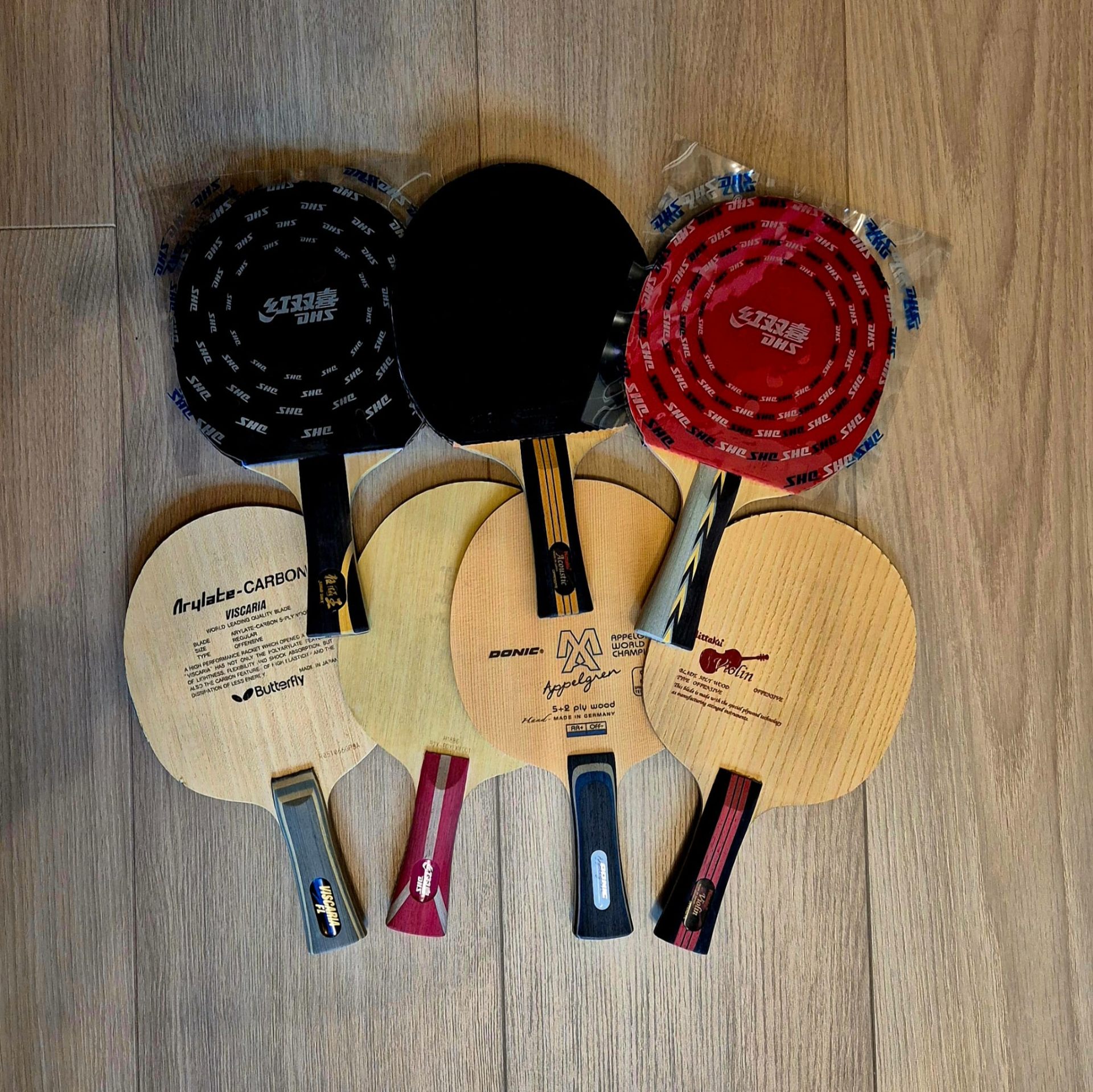
Changing table tennis equipment is always fun. New rubbers, new blades, new possibilities, how can it not be exciting!
But here's the real truth that most people learn the expensive way: changing equipment is one of the easiest ways to slow down your development and get yourself confused.
This is because it is very easy to get lost in the dark forest of equipment and become an EJ (Equipment Junkie), constantly switching gear hoping to find the "magic recipe" that fixes all your problems. Unfortunately, equipment rarely fixes technique, it can help it improve faster but more often than not, it hides or creates problems instead of solving them. I sadly see and hear this almost every other day.
If you want your next setup to genuinely improve your game (and not just drain your wallet), you need to approach equipment changes in a logical way, not just pure emotion (which I understand, I'm the same! haha)
So please, before you buy your next blade or rubber, go through these 5 steps first.
1. First question: Why are you changing equipment?
Most players skip this step, and it's the most important one.
"I want to buy what [pro player name] has" or "I heard this rubber is the next big thing" is rarely a good reason to change equipment. Every setup change resets part of your muscle memory, and that takes time to rebuild.
Instead, think about what the actual problem with your current setup is.
Ask Yourself:
✔ Is your equipment at the end of its lifetime?
If yes, replacement makes sense. If not, keep digging.
✔ Is your setup too fast or too slow?
✔ Is comfort or balance the issue?
👉 Example:
If your only problem is handle comfort, switching rubbers won't solve anything. You likely need the same blade with a different handle or a similar blade with better ergonomics. But if the problem is balls flying long, you may need to change rubbers, blade or both.
2. You need to understand what you are currently playing with
You can't improve your setup if you don't understand your current one. Most players don't go further than brand names or generic terms like rubber hardness, blade speed or brand marketing statements. That's not enough. You need to understand how your equipment actually plays. Here's a quick checklist of things to take into account:
Does your setup lean towards linearity or towards more catapult?
Linear setups are usually better for consistency and learning technique. Catapult setups add speed and spin to your strokes but logically reduce control.
Do you have a lot of dwell time or not?
Beginners usually benefit from longer dwell time because this enhances feeling and gives less speed. Advanced and professional players are the opposite, their main need is not control and feeling but speed and power. Note than even at the pro level, gear can have more or less relative dwell time (i.e soft/flexible blade vs hard/stiff blade).
Do you have a lower or a higher throwing combination?
Please note this is an oversimplification. The topic is very complex as it involves blade angle at the point of contact, but this guide is made for players of all levels. As a rule of thumb, Dignics 09c has a really high throw angle, and your average chinese hard tacky rubber like Battle II, has a much lower throwing angle.
Do you like hard on soft or soft on hard?
Both setups can work and both setups feel different, but if you are used to one, changing to the other may not make you feel at home in the beginning, it will take some time to adjust. I will discuss the pros/cons of each setup at length in another blogpost.
3. Be honest with yourself: What do you need vs what do you want?
This is where most equipment mistakes happen. Most players often choose equipment based on ambition (or ego/status) rather than development needs.
The Speed Trap
Faster equipment does not automatically make you better. For developing players, fast setups often: Reduce margin for error, shorten strokes, and hide footwork/technique problems. I have discussed this topic in detail here.
If you struggle to win more points, the solution is usually better technique, not a faster carbon blade.
Match Equipment to Your Playing Direction
You need to be able to do a self-assessment (or ask me to do it for you) and discover:
The lesson here is: Always buy the equipment that will help with your current technique and to develop your next steps, don't buy the blade that you hope you'd be using in 2 years.
If you don't know what good or bad technique looks like, check the curated videos section here to learn more about that.
4. Is what I have now the same as what I actually like?
Your previous setups tell you far more than you think, because most of us have clear patterns in what we like or dislike. So, ask yourself questions like:
Ignoring your past preferences usually leads to regret purchases because you will buy it and the moment you try it, you will not feel at home. For example, if you always played with chinese hard tacky rubbers, why change that all of a sudden if you enjoyed it before? Or if you always enjoyed a butterfly blade, why not just change the rubbers instead of ditching the blade too?
The moment where you ignore the past and exchange that with an impulse buy, is the exact same moment where all the positive energy and excitement of the change turns into frustration and regret. The whole point of this entire website is to avoid that.
5. What's my budget and what can I buy in my region?
Consider the price
Equipment is performance-related, but it's also practical. A €200 blade is rarely four times better than a €50 blade, this must be said and repeated. Please remember this, so many people make the mistake of buying a Viscaria because it is the best of the best while in practice they could have bought a viscaria-like blade and be much happier for one third of the price.
For most amateur and intermediate players, mid-range equipment delivers nearly identical performance.
Consider product lifecycles
Rubbers wear out, sometimes quickly. For example, the Tibhar K3 or the Stiga Dragongrip are notoriously known for having short peak performance periods and a steep degradation after that. If you buy any of these premium rubbers but can only replace them once per year, you may actually hurt your performance. Playing with fresh mid-range rubbers is often better than worn-out high-end ones.
Think About Availability
Using rare or hard-to-import brands can cause problems when you break your racket before tournaments, or you need a quick replacement, or if shipping times become unpredictable. Specially if you are boosting your rubbers this is a very sensitive issue. Remember that reliable availability matters more than most players realise.
Final thoughts: Equipment is an enabler, not the solution
The right equipment enables the player's correct technical development faster, it will never replace it. I always say equipment is 20-30% of the total package, technique, tactics and condition is the rest. In a sport where every single detail matters, it is still important to have the correct gear to develop the right habits and play with comfort and confidence, but do not fall in the trap of thinking that equipment will solve all your problems.
Last important thought: When changing table tennis equipment, never base your decision on an impulse unless you just want to experiment and have the time and money to have fun. But if that is not the case, equipment changes should be a calculated upgrade based on:
The right equipment won't magically fix your game, but it will make learning easier, progress smoother, and your strengths more effective, which is exactly what good equipment should do. If you have any doubts about your current equipment, get in touch, I can help!
See you at the table!
Need personalized equipment advice?
I can help you find the perfect blade and rubber setup for your playing style.